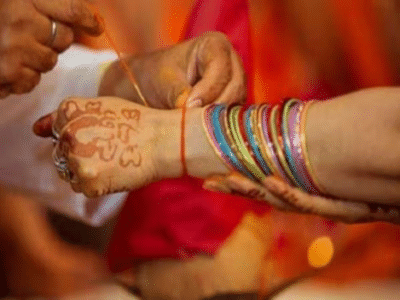
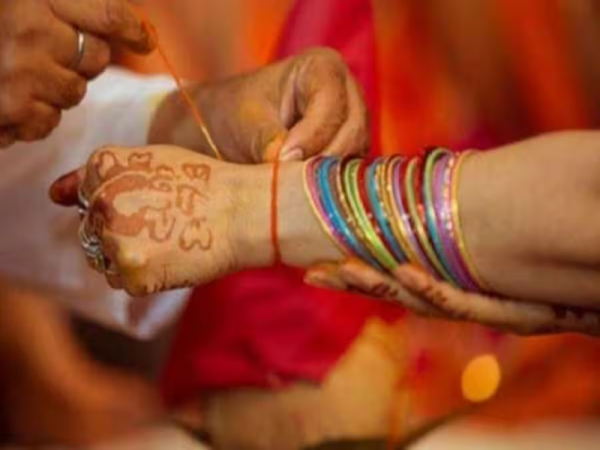
In this era of modern lifestyles and technology, where the new generation is rapidly adapting to changing ways of living, faith in religious traditions also appears to be steadily strengthening. The tradition of tying the *Kalava* (a sacred thread) around the wrist during temple visits, religious events, and rituals is still observed with deep reverence. However, according to religious beliefs, the *Kalava* is not merely a thread; it is considered a symbol of protection, positive energy, and divine grace.

**Referred to as 'Raksha Sutra' in Religious Texts**
In recent years, it has been observed that the youth are also participating enthusiastically in prayers and religious rituals. Devotees often tie the *Kalava* during *havans* (sacred fire rituals), *kathas* (religious discourses), and other ceremonies, praying for happiness, prosperity, and protection in their lives. It is believed that tying the *Kalava* creates an aura of positive energy around the individual, acting as a shield against negative influences and obstacles. Religious texts refer to the *Kalava* as a *Raksha Sutra* (sacred thread of protection). It is believed that the deities Brahma, Vishnu, and Mahesh, along with Goddesses Lakshmi, Saraswati, and Parvati, reside within its threads. This is why any auspicious task, prayer, *yajna*, or religious ritual begins with the tying of the *Kalava*.
**Fostering Positive Thinking**
Elaborating on this, Pandit Deeplal Jaipuri, an astrologer from Ambala, explained that the *Kalava* is significant not only from a religious perspective but also from psychological and spiritual viewpoints. He states that when a person wears the *Kalava* with faith and devotion, it instills positive thinking in their mind. This boosts self-confidence and provides mental strength.
**On Which Hand Should the Kalava Be Tied?**
He noted that, according to religious beliefs, the *Kalava* is also considered a medium to connect the individual with the Divine. He explained that the scriptures prescribe different rules for men and women regarding the tying of the *Kalava*; for instance, it is considered auspicious for unmarried women to wear it on the right hand and for married women to wear it on the left hand. For men, the prescribed practice is to tie the *Kalava* on the right wrist.
**Rules for tying the *Kalava***
It is believed that adhering to these rules yields auspicious results and brings positive changes to one's life. According to religious traditions, one should cover their head with a handkerchief, *dupatta*, or the end of a garment (*pallu*) while having the *Kalava* tied. Additionally, holding rice grains, flowers, or a ritual offering (*dakshina*) in one's fist while the thread is being tied is considered auspicious. The *Kalava* is wrapped and tied three, five, or seven times while the priest chants mantras—a practice regarded as especially auspicious.

**How to remove the old *Kalava***
Religious beliefs also outline rules for removing the old *Kalava*; it should be untied rather than broken off. Tuesdays and Saturdays are considered auspicious days for removing it, and there is a tradition of immersing the removed thread in a holy water body. Religious scholars believe that despite changing times, the *Kalava* remains a vibrant symbol of Indian culture and *Sanatan* tradition. This is why people from all walks of life continue to wear it with reverence and faith.
PC Social Media
-
Maharashtra Govt Clears ₹1,722-Crore Bandra Fort Connector, Approves Nagpur Metro Extension

-
Dharmendra Pradhan Turns 57: Know The Educational Qualification Of India's Education Minister
-
Ramayana Makers Revive Dubai Premiere Plans; Ranbir Kapoor, Sai Pallavi & Yash Expected To Attend In October: Report

-
'The Legacy Continues': Prabhas CONFIRMS Baahubali 3 With Rana Daggubati After 9 Years; Anushka Shetty Makes Rare Appearance - VIDEO

-
AI Deciphers 2,000-Year-Old Herculaneum Papyrus Scroll Burnt In Vesuvius Eruption Without Unrolling It