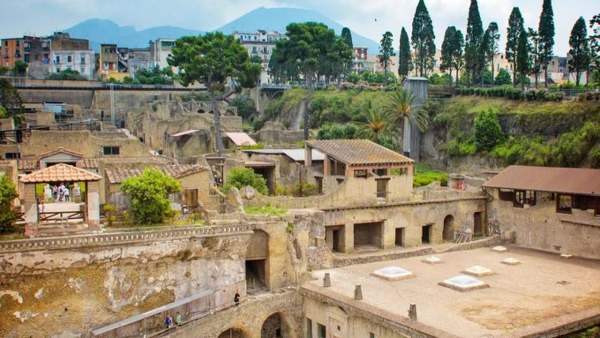
Researchers have used AI to virtually unwrap and decipher a nearly 2,000-year-old Herculaneum papyrus scroll buried in the AD79 Vesuvius eruption. The technique revealed previously hidden Stoic philosophical text without opening the fragile manuscript, marking a major advance in preserving and studying ancient documents.
Naples, June 25: A carbonised papyrus scroll buried during the eruption of Mount Vesuvius nearly 2,000 years ago has been virtually unwrapped and read using artificial intelligence. Researchers uncovered 20 columns of previously hidden text spanning more than a metre of charred papyrus without physically opening the scroll.
The document, known as PHerc 1667, dates to the second or late-third century BC and discusses Stoic philosophy, including ethics, art and human behaviour. It is among the oldest scrolls recovered from a library in Herculaneum, a Roman town destroyed alongside Pompeii in AD 79.
The scroll had suffered significant damage over the centuries. It was broken in half at some point, and earlier attempts to open it caused parts of the outer layers to flake away or disintegrate. Today, only a fragment measuring about 8 cm in height and 2 cm in width survives.
Dr Federica Nicolardi, a papyrologist at the University of Naples Federico II, said, “We don’t have the full scroll, but the surviving object was unwrapped, and that’s a very important result because it shows that we are able to unwrap these objects completely.”
-
Thomas Tuchel should take a cue from Barcelona and start €80m signing Anthony Gordon for England at the World Cup ahead of Marcus Rashford

-
8 held in Ayodhya Ram temple donation embezzlement case; SIT probe widens

-
Passport Fees to Increase From July 1: Check the New Charges Before You Apply
-
Great news for LPG consumers: You can get a gas connection again even after switching to PNG—know the new rules..

-
Refrigerator Temperature During Monsoon: What's the Ideal Setting to Keep Food Fresh?