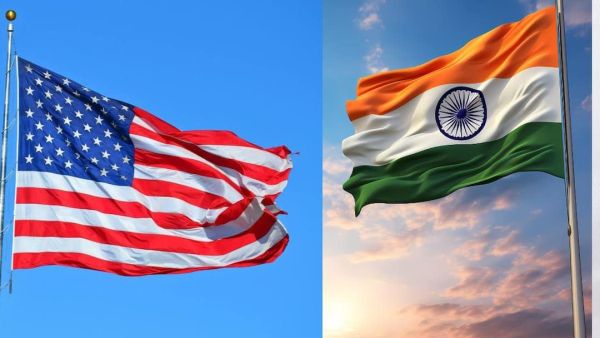
After months of friction over tariffs, visas and diplomatic disagreements, India and the United States are attempting to put their relationship back on a stronger footing.
Prime Minister Narendra Modi and US President Donald Trump used their first face-to-face meeting in 16 months to send a clear message: both sides want a trade deal, and they want it soon.
Meeting on the sidelines of the G7 Summit in France, the two leaders directed officials to work towards what India described as a "balanced, mutually beneficial and commercially meaningful" trade agreement at the earliest, signalling renewed momentum in one of the world's most consequential bilateral relationships.
The discussions come at a critical moment, with both countries seeking to repair strains that emerged over the past year while preserving a partnership that spans trade, defence, technology and geopolitics.
Trade Deal Back At Centre Stage
The biggest takeaway from the Modi-Trump meeting was the renewed push towards a bilateral trade agreement.
According to the Ministry of External Affairs (MEA), both leaders expressed satisfaction with the progress already achieved in negotiations and instructed officials to accelerate efforts towards an interim arrangement.
The next round of talks could begin almost immediately.
US Trade Representative Jamieson Greer is expected to visit India next week, providing fresh impetus to negotiations that have gained urgency amid growing economic uncertainty worldwide.
For both New Delhi and Washington, the trade pact represents more than just tariffs and market access. It is increasingly being viewed as a cornerstone of the broader India-US strategic partnership.
A Relationship Looking To Move Past Recent Tensions
The meeting also reflected a wider effort to stabilise ties after a challenging period.
Relations came under pressure following Washington's decision to impose punitive tariffs on India last year. Additional friction emerged over changes to US immigration policies and higher H1B visa fees, issues that have long been sensitive in India.
The relationship faced another test after President Trump repeatedly claimed that his administration played a decisive role in ending the India-Pakistan military confrontation in May 2025.
New Delhi firmly rejected those assertions, maintaining that the cessation of hostilities resulted solely from direct engagement between India and Pakistan.
Despite these disagreements, both governments have continued to engage behind the scenes, seeking to prevent tactical disputes from overshadowing broader strategic interests.
The latest meeting suggests those efforts may be beginning to bear fruit.
COMPACT Initiative Gains Momentum
Beyond trade, Modi and Trump reviewed progress under the India-US COMPACT initiative, short for Catalysing Opportunities for Military Partnership, Accelerated Commerce and Technology.
Launched during discussions in Washington earlier this year, the framework seeks to deepen cooperation across defence, emerging technologies, energy and economic engagement.
According to the MEA, both leaders welcomed developments across strategic sectors and reaffirmed their commitment to expanding cooperation for the mutual benefit of both countries.
The initiative has increasingly become the umbrella under which much of the next phase of India-US collaboration is being organised.
West Asia Emerges As A Key Talking Point
The conversation was not limited to bilateral issues.
With global attention focused on the proposed US-Iran peace agreement and the reopening of the Strait of Hormuz, West Asia featured prominently in discussions between the two leaders.
Prime Minister Modi praised President Trump's efforts aimed at ending the conflict in the region and restoring stability.
According to the MEA, Modi also underlined the importance of maintaining freedom of navigation and ensuring uninterrupted commercial movement through the Strait of Hormuz, one of the world's most important maritime trade corridors.
The remarks carry particular significance for India, which depends heavily on energy imports from the Gulf.
Any disruption in Hormuz has direct implications for oil prices, inflation and India's import bill, making regional stability an economic priority as much as a strategic one.
Strategic Interests Continue To Align
Despite occasional disagreements, the broader trajectory of India-US relations remains anchored in shared interests.
Both countries have expanded cooperation in defence manufacturing, critical technologies, semiconductor supply chains, artificial intelligence, energy security and Indo-Pacific strategy.
As geopolitical competition intensifies globally, Washington increasingly sees India as a critical partner in Asia, while New Delhi continues to view the United States as an important source of technology, investment and strategic collaboration.
The Modi-Trump meeting reinforced that larger reality.
What Happens Next?
The immediate focus will now shift to trade negotiators.
With Jamieson Greer's visit expected next week, both sides will attempt to convert political intent into a tangible agreement.
Investors, businesses and policymakers will be watching closely for progress on market access, tariff issues and investment flows.
While significant differences remain, the tone emerging from the G7 meeting suggests both governments are prioritising pragmatism over friction.
After a year marked by tariffs, diplomatic sparring and competing narratives, Modi and Trump appear to have opened the door to a fresh phase in India-US engagement, one centred on trade, technology and strategic cooperation.
Whether that momentum results in a breakthrough agreement could become one of the most closely watched diplomatic and economic stories of the year.
-
Perez determined to pursue Michael Olise for Real Madrid despite Bayern’s €200m rejection

-
Referee Announced for Ghana vs Panama Clash at the 2026 World Cup

-
Mango kernels: beneficial for health and beauty

-
Government removed Mamata Banerjee’s PSO! Mahua Moitra called Bengal government shameless, Kalyan Banerjee said this is vindictive attitude
-
Big relief from Supreme Court for 1.86 lakh teachers of UP! One year additional extension granted