“If I went back now, everything will be left unfinished,” Nhi, 31, who lives in Illinois, said.
In 2004, her mother, To Thi Hong, who lived in Phu Dinh Ward, HCMC, was sponsored for U.S. permanent residency by her older sister under the F4 visa category, which allows citizens to sponsor their siblings.
The residency also covered the beneficiary’s spouse and unmarried children under 21. At the time, the family consisted of six members: Hong, her husband, and their four children.
By the time the application was approved in 2019, three of the children had turned 31, 30 and 26 and no longer qualified, and only Nhi, the youngest daughter, was eligible. Though she was 24, she qualified under the Child Status Protection Act, which protects certain children from aging out because of lengthy processing delays.
|
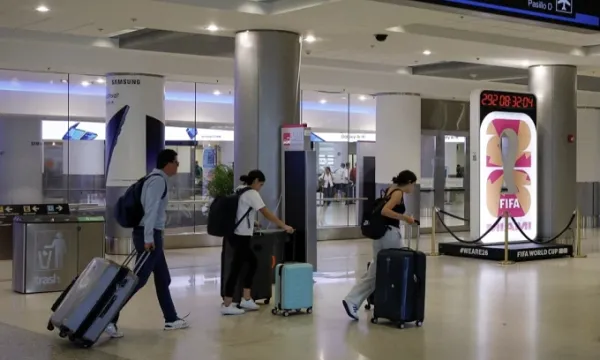
Passengers at Miami International Airport in Florida, the U.S., August 2025. Photo by Reuters |
To bring their three older children into the U.S, Hong and her husband then filed petitions under the F2B category, which covers unmarried adult children of permanent residents. They expected to wait for around five years, but the process has been more tardy than they feared.
On landing in the U.S., the couple spoke little English and had no established careers or source of income, and relied on money sent by relatives in Vietnam.
At first, Hong enjoyed her new life, but the excitement gradually faded. She would take a walk in a nearby park every day before returning home to cook. On weekends, she would wait for her daughter to drive her to an Asian supermarket.
Her husband Minh attempted to learn driving several times, but gave up because he was afraid of driving at high speeds. Without a driver’s license, he described himself as feeling “like a person without legs.” The area where they lived was sparsely populated and had very few Vietnamese residents.
Four years ago, her sister who had sponsored the family died of cancer. Her death weakened the couple’s motivation to remain in the U.S., and they have been visiting Vietnam every six months. Their extended absences have prevented them from meeting the continuous residence requirement for naturalization. Meanwhile, Nhi dropped out of a master’s degree in Vietnam and obtained a second bachelor’s degree in marketing in the U.S to improve her employment prospects.
For more than two decades, her three older siblings have avoided marriage because doing so could affect their eligibility under the family-sponsored immigration process.
Homesick and longing for Vietnam, Nhi has often considered moving back. But, at the end of 2022, an attorney informed the family that her siblings’ cases had entered the processing stage at the National Visa Center. So she decided to stay back and continue waiting.
The family’s plight reflects the reality facing many immigrant families in the U.S. Discussions in online communities show there are innumerable such stories. Some 2.4 million Form I-130 family-based immigration petitions were pending adjudication in 2025, according to data from U.S. Citizenship and Immigration Services.
The average waiting time for them increased from four years and three months in 1991 to eight years and one month in 2018. The F4 category had the longest average wait of 14 years and seven months.
Such delays often mean applicants miss major life events like education, marriage, childbearing, and caring for aging parents, research by the Cato Institute found. Many families accept these lengthy waits because of what economists call the “place premium,” which refers to the income advantage workers can gain simply by living and working in a higher-income country, according to the Center for Global Development (CGD).
Prospects for the next generation are another powerful motivation. A study by the Pew Research Center, a U.S.-based nonpartisan think tank, found that many immigrants view the United States as a place that offers greater social mobility for their children.
Green card holders can access free public education from kindergarten through 12th grade and pay significantly lower university tuitions than international students.
 |
|
José Latour at a seminar on immigration in HCMC. Photo courtesy of José Latour |
José Latour, managing attorney at LatourLaw, an immigration law firm based in HCMC, says only F4 visa cases filed before 2008 are currently being processed.
“In a family-oriented culture like Vietnam’s, these delays create tremendous pressure.”
During his 33 years of helping families prepare U.S. immigration applications, Latour has seen people postpone their children’s education plans, delay retirement, weddings, and graduation ceremonies.
“They don’t know whether they should keep waiting for the opportunity to immigrate or give up and build a stable life in their home country.”
Latour recalled the case of a father who filed an F4 petition and remained ready to board a plane at any moment. Believing his children would eventually study in the U.S, he postponed all long-term investments in Vietnam. By the time he received his visa, however, his children had already turned 21 and no longer qualified to immigrate with him.
One of those children faced a difficult choice: continue pursuing options to preserve the possibility of immigrating to the U.S. or marry and establish a stable life in Vietnam.
Based on such experiences, LatourLaw advises families to proactively prepare educational, career, and financial plans that account for potentially lengthy waiting periods rather than relying on uncertain immigration timelines.
*Names in this article have been changed.
-
US: Skydiving plane crash leaves 12 people dead in Missouri

-
Dhiraj Bommadevara Shines at Archery World Cup with Historic Gold

-
Portugal Team Honors Diogo Jota at FIFA World Cup 2026

-
Curaçao's Historic World Cup Debut: Coach Advocaat Reflects on Team's Performance

-
CBSE 10th Second Board Result 2026: Where can the CBSE 10th Second Board result be checked?