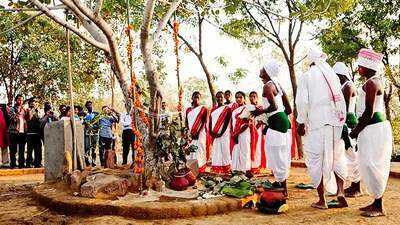
'Be very careful! The Census operation has begun. The enumerators may insist that you mention your religion as Hindu. Never do that. Mention Sarna as your religion. Sarna is the identity of the Adivasis. We must not lose that.’ Even the most casual observer can hear the campaign’s resonance across Jharkhand.
The longstanding demand of Adivasis in Jharkhand and neighbouring states for a separate Sarna code in the Census has acquired renewed urgency with the Union government’s proposal to abolish the ‘Other Religions and Persuasions’ (ORP) category (Code 7). Many Adivasi organisations view this proposal as an extension of demands advanced by the RSS and allied organisations to ‘delist’ Adivasi Christians from the Scheduled Tribe category.
As an Adivasi activist remarked at a street corner meeting in Dumka in mid-May, the move is “an attack on Adivasis who have increasingly been asserting their distinct identity.” In his view, the government is not only rejecting the demand for recognition of Sarna but also eliminating the limited space for indigenous religious self-identification available under the ORP category.
Coupled with the campaign for delisting, the proposal is widely seen as an attempt to weaken both Adivasi identity and constitutional protections. Consequently, the demand for a separate Sarna code has become a broader assertion of ‘Adivasiyat’, or Adivasi peoplehood. The campaign has found support beyond Jharkhand. A massive rally held on 23 May in Jashpur, Chhattisgarh, against delisting echoed the demand.
In contrast, organisations aligned with the government have intensified efforts to push Adivasis to join the broader Hindu fold. On 24 May, the Janjati Suraksha Manch (JSM) organised a rally in New Delhi under the slogan: ‘Tu main ek rakt, vanvasi-gramvasi-nagarvasi, hum sab Bharatvasi (you and I are one blood, forest-dwellers, villagers, city-dwellers, we are all Indians).’
‘Anti-Adivasi mindset’: Rahul Gandhi attacks BJP-RSS over tribal rightsThe use of ‘vanvasi’ — long promoted by Hindu nationalist organisations — instead of Adivasi is significant, as it rejects the indigenous status implied by Adivasi. Home minister Amit Shah, the principal speaker at the event, also consistently used the term vanvasi.
Adivasi apprehensions are, therefore, not unfounded. The proposal to abolish ORP, combined with the campaign to delist and the refusal to recognise a Sarna code, is a deliberate attempt to reshape the politics of identity, representation and power.
Let us look at the demographic background. According to the 2011 Census, about 79.4 lakh Indians — 0.66 per cent of the national population — were enumerated under ORP. The largest concentrations were in Jharkhand (42.4 lakh), Madhya Pradesh (6 lakh), Chhattisgarh (4.9 lakh), Odisha (4.8 lakh) and Arunachal Pradesh (3.6 lakh).
Nationally, Sarna constitutes the largest indigenous religion within the ORP category. Nearly 62.5 per cent of all ORP adherents identified as Sarna followers in 2011. If followers of Sari Dharam, who share the same broad community base (specifically Santal), are included, the proportion is even higher. The next largest categories — Gond/Gondi and Sari Dharma (considered separately) — accounted for only 12.9 per cent and 6.4 per cent, respectively.
The political import of these figures is most evident in Jharkhand. The state recorded 42.4 lakh persons under ORP, representing 12.8 per cent of its population. More than 41.3 lakh identified as Sarna, constituting 97.5 per cent of the state’s ORP population. Among Jharkhand’s Adivasis, Sarna followers substantially outnumber those who identify as Hindu.
This demographic reality has major political implications. Regional parties such as the Jharkhand Mukti Morcha (JMM) have derived much of their legitimacy from questions of identity and self-determination. The demand for a separate Sarna code has emerged as one of the most visible expressions of this assertion. Indeed, identifying with Sarna in Jharkhand is a feature well reflected in the 1991 and 2001 Census.
Rahul Gandhi backs Great Nicobar tribal concerns, vows to raise issue in ParliamentThe continuing electoral success of the JMM-led coalition, despite the broader expansion of the BJP across eastern and central India, demonstrates the enduring political strength of Adivasi identity. In this context, abolishing ORP would do far more than eliminate a census category. If Sarna followers are compelled to identify as Hindus or any other recognised religion, their collective visibility in official statistics will disappear.
Such a move would strengthen the claim that Adivasis are part of the Hindu fold while weakening the demographic basis of political mobilisation around a distinct indigenous identity. In electoral terms, this will work to the BJP’s advantage.
The implications extend beyond Jharkhand. West Bengal — where the BJP has made significant gains among the Adivasis, who share a common cultural, linguistic and clan membership with Jharkhand’s Adivasis — also has a substantial ORP population. According to the 2011 Census, nearly 10 lakh people in the state were enumerated under ORP, with Sarna and Sari Dharam followers comprising the majority.
This points to a contradiction in the BJP’s tribal strategy. While the party has expanded its electoral support among Adivasis, many of these communities continue to maintain religious identities outside Hinduism. The Jharkhand experience demonstrates how demands for religious recognition can evolve into broader claims for cultural autonomy, political representation and indigenous rights, thereby challenging projects of cultural assimilation and political absolutism.
****
Their diversity also creates a potential faultline in Adivasi politics. A movement centred on Sarna can be perceived and presented as just one regional stream of indigenous assertion rather than representing the collective aspirations of all tribal peoples. While Sarna has become the principal symbol of indigenous religious assertion in Jharkhand, Odisha, West Bengal, Bihar and parts of Chhattisgarh, it is not the only indigenous faith tradition. The northeast presents a very different landscape.
In Arunachal Pradesh, nearly 90 per cent of the ORP population identifies with Doni Polo. In Manipur, more than 95 per cent identify as Sanamahi followers. Indigenous communities in Meghalaya follow the Khasi, Niamtre and Songsarek traditions, while Nagaland’s ORP population is dominated by the Heraka tradition. In Sikkim, many indigenous communities identify with Yumasam and related traditions.
These religions are rooted in distinct linguistic, cultural and historical contexts and have evolved independently of the Sarna movement. Consequently, Sarna may not automatically serve as a common religious identity for indigenous peoples across India.
The JSM gathering in New Delhi saw substantial participation from northeast tribal groups. While publicly presented as a celebration of ‘one tribal culture’ and ‘national unity’, it also demonstrated that different tribal communities can be mobilised through frameworks other than indigenous religious assertion.
The strategic significance of such mobilisation is its capacity to accentuate regional distinctions within India’s tribal population. If Sarna is portrayed (and seen) as primarily a Jharkhand-centric project, with communities from the northeast pursuing their own separate trajectories, the prospects for a unified indigenous political platform become considerably weaker. A broad movement for indigenous religious recognition, stretching from Jharkhand to Arunachal Pradesh, would pose a powerful challenge to projects of cultural homogenisation.
The debate over ORP, therefore, concerns much more than census enumeration. It is fundamentally a struggle over how Adivasis will be seen and counted in the Indian nation state. The proposed abolition of ORP advances two interconnected objectives: the absorption of indigenous communities into the Hindu fold and the fragmentation of a possible pan-Adivasi political identity by accentuating regional, ethnic and religious differences among India’s tribal communities.
Irrespective of whether diverse Adivasi traditions can (or should) be brought together within a broader framework of indigenous solidarity, the issue of the religious identity of Adivasis cannot be seen as an exclusive Adivasi concern. It should concern all practitioners of democracy.
Kumar Rana is a research activist
-
Portugal vs Chile – Player Ratings and Match Analysis
-
Ethan Ampadu highlights Leeds United’s Premier League survival as club’s top moment over Old Trafford win

-
Aleksandar Stankovic: Inter Milan starlet’s admiration for Manchester United and Old Trafford revealed

-
Julian Alvarez’s Arsenal Transfer Plans Take Unexpected Turn

-
Iliman Ndiaye: Manchester City look to derail Manchester United’s pursuit of Everton star