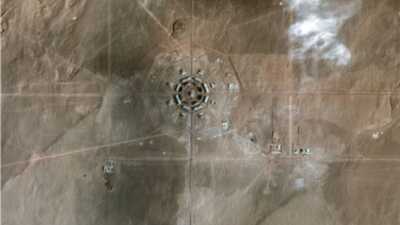
New Delhi: China is carrying out a major military construction project in its northwestern desert region that could help protect its nuclear forces and preserve its ability to respond to a nuclear attack, according to a Reuters report based on satellite imagery reviewed by security experts.
The findings emerged a day before US Defence Secretary Pete Hegseth urged Asian allies to increase defence spending in response to China’s expanding military capabilities.
“There is rightful alarm regarding China’s historic military buildup and the expansion of its military activities in the region and beyond,” he said.
According to Reuters, China already possesses long-range nuclear missiles capable of reaching the United States. New satellite images show the country is building a large network of launch pads, bunkers, communications facilities and support infrastructure near remote missile bases in Xinjiang.
Large-scale military expansionSecurity analysts who reviewed the images for Reuters identifiedmore than 80 locations that could support mobile missile launchers and air-defence systems. The imagery also revealed facilities that may support electronic warfare operations, satellite communications and military command functions.
Hans Kristensen, director of the Federation of American Scientists’ Nuclear Information Project, described the scale of the development as unusual.
“I’ve never seen anything quite like it,” said Kristensen. “It’s an extraordinary effort.”
Experts believe the construction points to a significant expansion of hardened infrastructure designed to support China’s land-based nuclear forces.
Sites located near missile fieldsThe new facilities are centred around two octagon-shaped complexes built over the last six years in eastern Xinjiang. One complex lies about 140 kilometres southwest of the Hami missile fields, while another is around 230 kilometres away.
A third octagonal site south of the Lop Nur nuclear testing area remains under development and appears to serve as a target range. Satellite imagery shows accommodation areas, bunkers, reinforced weapons storage facilities, airfields and rail connections linking the complexes to nearby missile bases.
Questions remain over future roleChina maintains a “no first use” nuclear policy, under which it pledges not to launch a nuclear attack first. However, some Western diplomats and analysts told Reuters that Beijing could use its nuclear capability to deter outside involvement in a potential conflict over Taiwan.
Analysts said some launch pads may support mobile intercontinental ballistic missiles, air-defence systems or electronic warfare equipment. Construction is also underway at what could become a space or microwave communications facility. Although China operates nuclear-capable submarines and aircraft, missile silo fields in Xinjiang and Gansu remain the core of its nuclear deterrent, according to security experts cited by Reuters.
-
Pakistan Army Opens Fire On Protesters In PoK, Internet Suspended

-
Karandeep Kochhar Remains Top Indian Despite Slip To T-10 At Bharath Classic

-
Manoj Bajpayee's Governor Is Not About Politicians, Clarifies Director Chinmay Mandlekar: 'We're Talking About People Working In Backrooms'

-
Actress Dimple Hayathi Defends Janhvi Kapoor As Peddi Faces Criticism Over Female Representation: 'We Deserve Better Filmmaking'

-
Will a Premier League giant hijack Bayern Munich’s move for promising defender Emmanuel Mbemba?