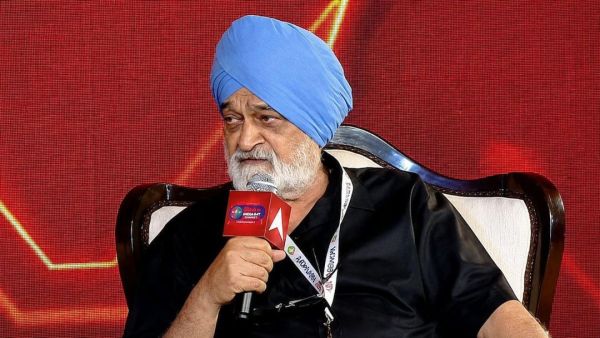
As India pursues its ambition of becoming a developed nation by 2047, one question took centre stage at the ABP Network India @ 2047 Conclave in New Delhi on Tuesday: how should the country finance the massive infrastructure expansion required over the next two decades?
Addressing the issue in the opening session of the conclave, Montek Singh Ahluwalia, former Deputy Chairman of the Planning Commission, said India is facing a global energy crisis, calling the current fuel shock due to the West Asian conflict the worst 'energy crisis in three decades'.
"This crisis will almost certainly raise the CAD (Current Account Deficit) because of the additional price we pay for imported oil, fertiliser. On the other hand, the capital account surplus is going down due to foreign outflows. There is still uncertainty," the policymaker said.
The policymaker was speaking on ‘Reviving PPP: Reimagining Infrastructure Financing’ at the conclave.
No Subsidy On Petrol Prices
Ahluwalia noted that India cannot completely insulate itself from global energy shocks because the country remains heavily dependent on imported fuel.
"When you are importing something, you need to pay the price," he said, arguing that petroleum products should not be viewed in the same category as essential welfare goods that warrant long-term subsidies.
Making a broader point on fuel pricing, he said subsidising petrol consumption was difficult to justify, particularly as the benefits are not always targeted towards those most in need. "Petroleum in itself is not a product that deserves subsidy. It is not like medicines. Someone driving a Mercedes doesn't deserve a subsidy on petrol prices," he remarked.
Call For Greater Transparency In Fuel Pricing
The former Planning Commission Deputy Chairman also called for a more transparent fuel pricing mechanism, suggesting consumers should have a clearer understanding of how global energy prices influence what they pay at the pump.
According to Ahluwalia, a significant portion of the petroleum value chain is managed by government-owned oil marketing companies, making transparency around pricing decisions even more important.
"Most of the stuff is controlled by marketing companies which are owned by the government," he said.
He argued that fuel prices should more closely reflect market realities, particularly given India's reliance on imported crude oil.
"We need much greater transparency in how the petrol prices are determined. Consumers should recognise that since we are 80 per cent dependent on petrol imports, this is a product whose price will rise and fall. We should let the prices rise and fall according to the market so people understand this," Ahluwalia said.
Govt Has Already Absorbed Part Of The Shock
At the same time, Ahluwalia acknowledged that the government has already taken steps to cushion consumers from rising global energy costs.
Referring to recent policy measures, he said the Centre had absorbed part of the burden through reductions in fuel taxes.
"The government has taken a bit of a hit by reducing excise duty," he said, noting that such interventions have helped soften the immediate impact of higher international oil prices on households and businesses.
Energy Shock A Temporary Setback To India’s 2047 Ambitions
Despite warning about the impact of the current energy crisis, Ahluwalia maintained that the challenges facing the economy should be viewed as temporary rather than structural.
Speaking about India's goal of becoming a developed nation by 2047, he said the country would need to navigate the current turbulence before returning to its long-term growth path.
"We should recognise this is a short-term crisis and this will take about 2-3 years to come back on track, maybe 2 years," Ahluwalia said.
The former Planning Commission Deputy Chairman suggested that while higher energy prices, capital outflows and global uncertainty may weigh on growth in the near term, they should not derail India's broader development trajectory.
Why FDI Will Matter In The Next Growth Phase
Ahluwalia also underscored the importance of attracting greater foreign investment as India seeks to sustain high growth rates over the coming decades.
According to him, the current environment presents an opportunity for policymakers to reassess how the country approaches foreign capital and global investors.
"We need to relook our policies towards FDI because we need them," he said.
This is an important policy remark and deserves its own section because it ties directly into India's 2047 growth ambitions, manufacturing strategy and FDI discussion.
Protectionism Alone Cannot Deliver Make In India
Ahluwalia also cautioned against relying excessively on protectionist policies to achieve India's manufacturing ambitions, arguing that competitiveness rather than tariff walls should remain the foundation of industrial growth.
Taking aim at the idea that domestic manufacturing can be built primarily through import barriers, he said such an approach could ultimately prove counterproductive.
"The notion that Make in India can be achieved simply by protectionism is an unmitigated disaster," Ahluwalia said.
He argued that the original vision behind the Make in India programme was not merely to replace imports but to position India as a globally competitive manufacturing hub capable of serving international markets.
According to Ahluwalia, the key question is whether Indian industries can thrive in an environment that encourages competition and efficiency rather than one shielded by excessive protection.
"The logic of it is in an open environment, we make in India and for the world," he said, adding that policymakers must ask whether goods should be produced in a system where Indian manufacturers are required to compete globally.
Combined with his call for a fresh look at foreign direct investment policies, the remarks underscore a broader argument: that India's path to becoming a developed economy by 2047 will depend not only on infrastructure creation and capital investment, but also on maintaining openness, competitiveness and investor confidence.
-
Internet Clashes Over Anushka Sharma’s Homeopathy Post: ‘Unscientific Fraud’ vs ‘It Works’

-
Shubh Laabh: Do you wear old torn clothes, do not even pay attention to office outfit, this habit can stop your success.

-
Forget coconut water! These 5 cheap juices will keep your body as cool as AC in summer

-
What to drink in the scorching heat? From Kokum to Solkadhi, PM Modi mentioned these drinks
-
‘Friends are in danger…’ Now Google AI will catch the fraudsters on the other side of the phone