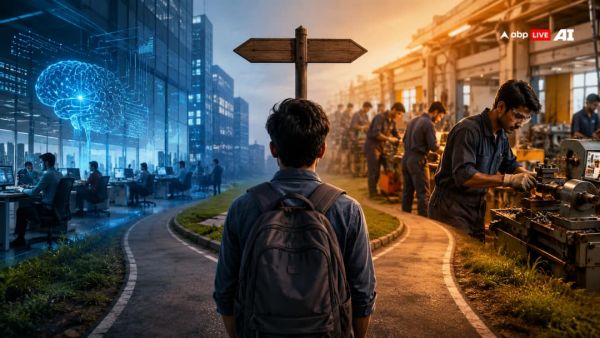
If you are a student choosing a career today, there is a question that previous generations never had to ask: Will this job even exist by the time I graduate?
That question sits at the heart of investor Ritesh Jain's recent article, "An Overlooked AI Trade..." In it, he argues that one of the biggest beneficiaries of artificial intelligence may not be technology companies themselves, but technical and vocational education providers that train workers for skilled trades. Jain is the founder of Pinetree Macro, a global asset allocation fund focused on liquidity cycles, macroeconomic shifts, and international capital flows.
AI Is Challenging Traditional White-Collar Careers
It is the first time in human history that white-collar jobs, especially entry-level roles, are being threatened with complete extinction. AI is already capable of handling much of the mundane and repetitive work that interns and junior employees often do slowly and with mistakes.
This raises a difficult question. Why would someone leaving school today spend years pursuing a degree in finance, business, or even certain science fields when much of the work involving ideation, content creation, research, and data processing can increasingly be done by AI?
AI is only going to improve. What we see today may be comparable to the Nokia keypad phone era of the early 2000s. Impressive for its time, but nowhere close to what came later.
As Jain writes, "the only certainty is that AI will create disruption for workers, and it will happen on a massive scale."
India's Desk Job Dream Faces A New Reality
For decades, India's education system has largely pushed students toward office jobs. Engineering, management, finance, IT, and corporate careers became the preferred path for millions of families seeking economic mobility.
But AI is beginning to challenge that model.
Many workers today sit behind desks, work on laptops, and increasingly use AI tools to perform their daily tasks. Ironically, the same technology helping them work faster could eventually reduce the need for those jobs altogether.
Jain believes AI, automation, robotics, and other emerging technologies could eliminate millions of jobs while boosting corporate productivity and profits.
Whether that prediction fully materialises or not, the possibility alone is already influencing how young people think about their futures.
Could Skilled Trades Make A Comeback?
In this environment, traditional jobs that provide tangible day-to-day value may see a resurgence.
These occupations, often associated with physical labour rather than office work, have historically been viewed as lower status and lower paying. Visit any labour chowk in India, and you will find workers waiting for daily employment opportunities.
Yet the economics are changing.
Across many skilled trades, more workers are retiring than entering the profession. Electricians, welders, mechanics, machine operators, technicians, and maintenance specialists are becoming increasingly difficult to find.
Jain points to similar trends in North America, where labour shortages have become so severe that companies are offering extraordinary incentives to retain skilled workers.
"The earning power is rapidly shifting to those who know how to do things outside of an office cubicle," he writes.
Rising Education Costs Could Accelerate The Shift
The economics of higher education are also changing.
It is already expensive for many Indian students to pursue engineering, medicine, or other professional degrees through private institutions. Government colleges remain highly competitive and simply do not have enough seats.
In such a situation, students may become more willing to avoid taking on large amounts of debt and instead focus on mastering a practical skill that can generate income sooner.
AI could further discourage students from pursuing routine computer-based work that may become increasingly automated over time.
Jain argues that younger people are beginning to recognise this reality and that technical education could see a surge in demand as a result.
The Overlooked AI Opportunity
The most interesting part of Jain's thesis is that the beneficiaries of AI may not only be chipmakers, software firms, or data centres.
They could also be institutions that help workers adapt to a changing economy.
As AI reshapes the labour market, millions of people may need to reskill or change careers. Technical colleges, vocational institutes, certification programmes, and skill-training providers could become increasingly important.
"We need to re-skill people," Jain writes. "I think that the growth in new student applications could be explosive."
The future may not belong exclusively to coders, analysts, or office workers. It may also belong to electricians, technicians, mechanics, welders, and countless other skilled professionals whose work cannot be easily replicated by a chatbot.
That possibility is what makes this, in Jain's words, an overlooked AI trade.
-
Who Should Avoid Egg Yolks? Experts Explain The Risks

-
Maharashtra CM Approves Rs 2 Lakh Farm Loan Waiver Ahead Of Monsoon

-
Melbourne Stars And Renegades Set For Historic Merger Into Single BBL Franchise

-
RCB Title Celebrations Turn Violent, Police Arrest 18 After Fans Vandalise Private Bus In Andhra Pradesh

-
CBSE Re-Evaluation Portal Survives Cyberattack Scare After 1.5 Million Hits Emerge Within 2 Minutes; Over 16,000 Students Complete Submissions