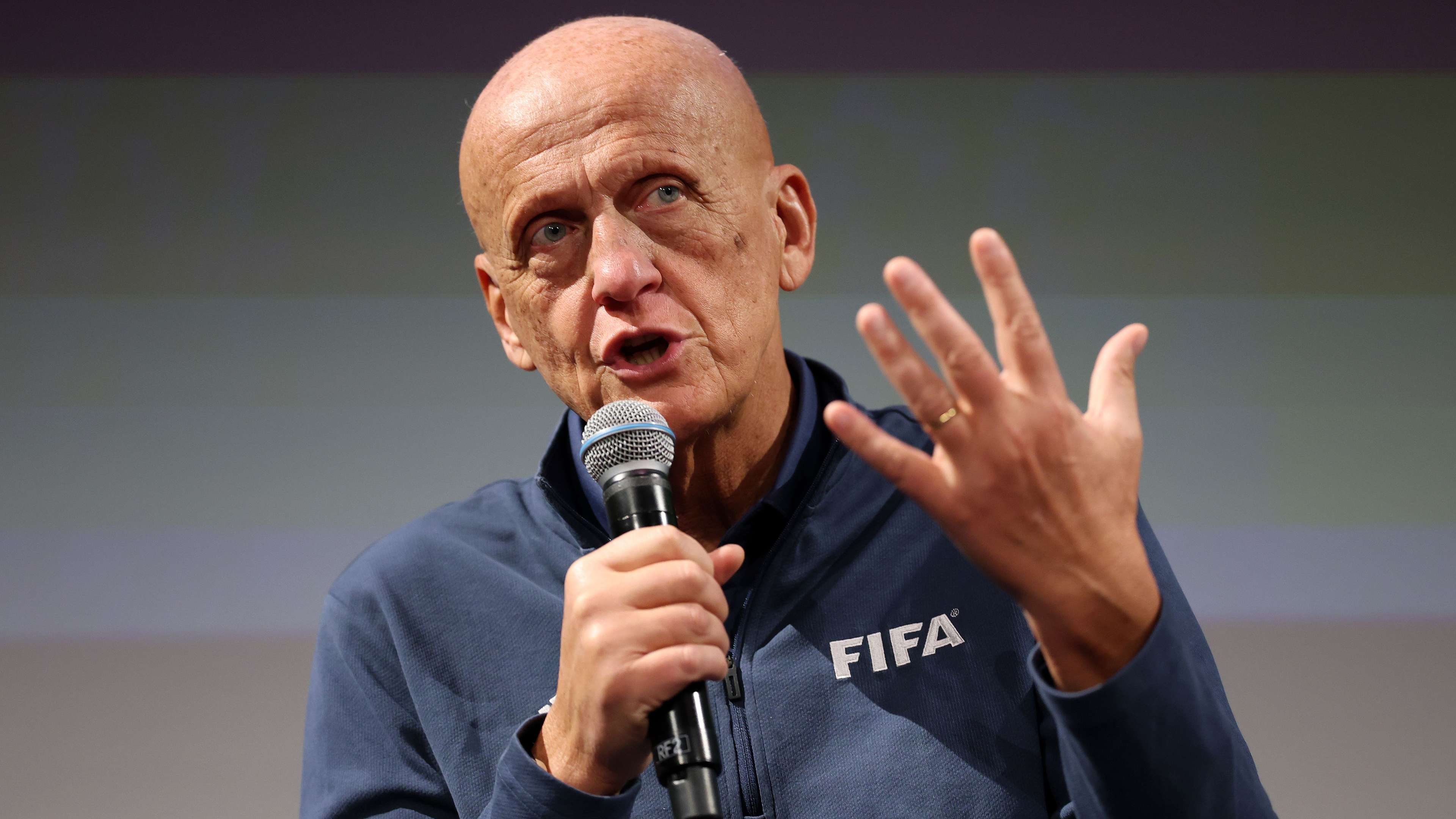
FIFA has announced a fresh set of red-card rules for the 2026 World Cup after two major controversies prompted changes, along with other new measures primarily aimed at reducing time-wasting during matches.
During a media briefing, Pierluigi Collina, the chairman of FIFA’s Referees Committee, revealed that referees will now issue a red card to any player who covers their mouth with their hands, shirt, or any other object while engaging in a heated exchange. He clarified, however, that this will apply only in confrontational situations. “If it’s a friendly exchange – for instance, between players who usually play for the same club but are facing each other in national colours – no action will be taken,” Collina explained.
The rule change follows an incident in February during the first leg of Benfica Lisbon’s Champions League play-off against Real Madrid. In that match, Benfica forward Gianluca Prestianni was accused of racially abusing Vinicius Junior. The Argentine forward, who was not selected for Argentina’s World Cup squad, allegedly directed racial slurs at the Brazilian star while holding his shirt over his mouth, making it impossible for cameras or officials to verify what was said. Though Prestianni was later suspended, he was allowed to complete the game against Real Madrid.
In April, UEFA handed Prestianni a six-match suspension for “discriminatory behaviour.” Two weeks later, FIFA extended this sanction to cover all international competitions, which would have forced him to miss Argentina’s first two group-stage matches at the World Cup had he been selected.
FIFA’s decision also stems from another controversy that occurred shortly before the Prestianni incident. During the Africa Cup of Nations final against Morocco, Senegal’s team, following the instructions of their coach Pape Thiaw, walked off the field to protest two contentious refereeing calls and initially refused to continue the match. Although Senegal went on to win in extra time, the Court of Arbitration for Sport (CAS) later ruled that Morocco were the rightful champions. In response, FIFA has now ruled that any player who leaves the pitch in protest of a referee’s decision will receive a red card, and any coach or staff member who encourages such behaviour will face the same punishment.
FIFA’s upcoming rule adjustments also target time-wasting tactics ahead of the World Cup. A new five-second limit will apply to goal kicks, corner kicks, and throw-ins. Collina, however, emphasised that referees will need to exercise discretion: “If a player is a long-throw specialist and needs to move forward a considerable distance, the countdown should obviously not apply.”
One of the more challenging aspects for officials will be dealing with goalkeepers who feign injuries to allow their coaches to deliver quick tactical instructions. Under FIFA’s medical regulations, a player treated on the pitch cannot return to play until 60 seconds have passed. It remains uncertain how this will be enforced for goalkeepers. “We are also relying on players to recognise the spirit of the rule,” Collina added.
-
Chelsea’s Kendry Paez faces uncertain future as club prepares Stamford Bridge return: report
-
Manchester United fast-track talks to sign £80m-rated Mateus Fernandes following Ederson agreement in potential double summer coup

-
Pep Guardiola says future Manchester City fans may just remember him as ‘the bald guy’

-
World Cup 2026 Group B Preview: A Chance for New Nations to Create History

-
🚑 Medical Car Collides with Player During Ecuador Match