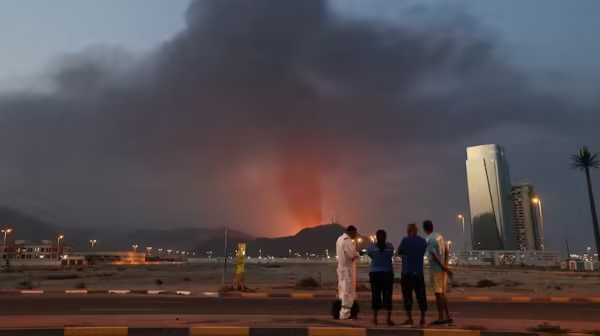
Amidst the ongoing tension in West Asia, a shocking news has emerged which has surprised diplomats and military experts all over the world. According to an investigative report by the American newspaper ‘Wall Street Journal’ (WSJ), just a few days after the US-mediated ceasefire in the month of April, the United Arab Emirates (UAE) entered inside Iran’s border and carried out several retaliatory air strikes. Till now it was publicly believed that the UAE was taking steps very cautiously and behind the scenes in this entire dispute, but this new report has made it clear that the UAE’s role in the military campaign against Iran was very aggressive and deep. These big ‘energy hubs’ of Iran were attacked. According to the report, the UAE Air Force had prepared a very secret and big military plan in collaboration with America and Israel. Under this operation, many of Iran’s most important economic and strategic targets were targeted: Asluyeh Petrochemical Complex: It is considered to be Iran’s largest and huge energy hub. The attack on this had increased concern at the international level. America feared that if Iran’s main energy infrastructure was completely destroyed, a terrible war would break out in the entire region which would be difficult to handle. Due to this fear, America later put pressure on Israel and UAE to stop attacks on energy targets. Lavan Island Refinery: This main oil refinery located in the Persian Gulf was also attacked. Islands of the Strait of Hormuz: The strategically important islands of Qeshm and Abu Musa, as well as the port city of Bandar Abbas were also targeted. This secret war, which has created huge tension between Saudi Arabia and UAE, has also exposed the cracks in the mutual relations between the Gulf countries. Many Gulf countries were avoiding entering into a direct war against Iran out of fear that Iran would retaliate against them. At the beginning of the war, all the Gulf countries had publicly stated that they would not allow their land or airspace to be used against Iran. Story of displeasure with Saudi: The report claims that when Saudi Arabia (Riyadh) flatly refused to be a part of this military operation, UAE President Mohammed bin Zayed became extremely angry. He had lodged his strong objection to Saudi Crown Prince Mohammed bin Salman. After this, Saudi Arabia contacted Washington (America) and said that due to these aggressive attacks by UAE, there is a danger of retaliatory attacks by Iran on the oil and energy targets of the entire Gulf region. Saudi had urged America to stop these attacks immediately. UAE had to suffer a terrible price in the counterattack. Saudi Arabia’s fears proved to be completely correct. In response to the covert attacks by the UAE, Iran launched a volley of ballistic missiles, cruise missiles and suicide drones on the UAE. Despite the presence of US military bases in the UAE and modern air defense systems (THAAD and Patriot), Iran’s attacks caused huge losses to the UAE in terms of life, property and economy. Damage caused to UAE due to Iran’s counterattack (At a Glance) Area of damage Area affected / Description Scale of damage Weapons fired Missiles, cruise missiles and suicide drones More than 2,800 projectiles fired Loss of life and property Local and foreign personnel 13 deaths (2 Emirati soldiers, 10 foreigners), 224+ injured Dubai Airport (1 March) Missile attack on Terminal 3 Temporary closure, loss of $1 million per minute Energy and Shipping Fujairah Petroleum Hub and Jebel Ali Port, two large oil storage tanks kept burning for several days. Stock Market (Stock Market) Dubai and Abu Dhabi Stock Exchange lost about $120 billion of capital. This war shook the shining economy of UAE and its biggest pride i.e. real estate and tourism sector. Due to frequent missile attacks and air warnings, investors rapidly started withdrawing their money from UAE markets. The loss of millions of dollars and destruction of infrastructure due to the closure of Dubai Airport’s runway has proved that no matter who wins in modern wars, both sides have to pay a heavy price.
-
PM talks about Chola-era copper plates in 'Mann Ki Baat'
-
IPL 2026: 'I see it as an advantage' Shubman Gill on playing IPL final in Ahmedabad

-
[WATCH] 'Give him the freedom' - Sachin Tendulkar's massive statement on Vaibhav Sooryavanshi's future as Test batter

-
The kitchen foil will run away from the thief! Try this magic trick on door handles today

-
What is the solution in Hindu scriptures to save marriage during divorce? Know