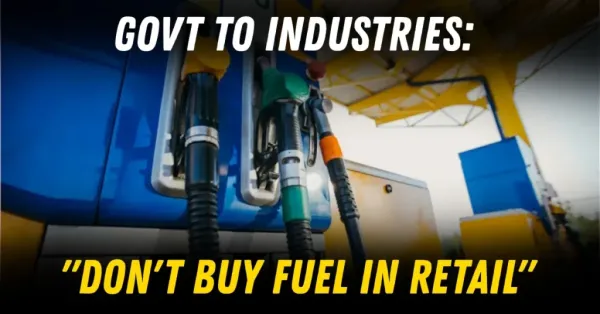
The government has issued a clear warning to industrial consumers: stop buying petrol and diesel from retail fuel outlets and return to bulk procurement channels. The directive comes after a review meeting involving chief secretaries of states and Union Territories, along with industry bodies such as FICCI and CII.
The reason is simple. Some industrial consumers are moving away from bulk fuel purchase channels and buying from retail pumps run by public sector oil marketing companies. Retail fuel prices are being cushioned to protect ordinary consumers during the current global energy disruption. Industrial fuel, however, is meant to be priced differently, in line with actual international market-linked costs.
The shift has become large enough for the government to intervene. Bulk customer volumes of public sector oil marketing companies have fallen by about 29 percent in the current month. Private oil marketing companies have seen a sharper decline of about 38 percent in high-speed diesel offtake across retail and bulk customers. That volume is now moving toward PSU retail pumps.
The government’s point is that retail price support is meant for households, two-wheeler riders, farmers and ordinary car users. It is not meant to become a cheaper procurement channel for factories, large commercial users and bulk buyers.
Public sector oil marketing companies are currently absorbing losses of around Rs 550 crore per day on petrol, diesel and domestic LPG. This is being done to avoid passing the full pressure of international prices to retail consumers. When industrial buyers purchase from retail pumps, they effectively capture a benefit intended for the common consumer.
This creates two problems. First, it transfers the benefit of controlled retail pricing to users who are not meant to receive it. Second, it concentrates demand at fuel pumps and creates the appearance of local shortage. The government has said there is no actual scarcity of petrol or diesel in the country. The problem is not supply. It is arbitrage.
For the ordinary consumer, the most visible result is longer queues at fuel stations and local stock-outs that feel like a shortage. But the national supply picture does not support that fear.
India has an installed refining capacity of 258.1 million tonnes per year across 22 operational refineries. Domestic petroleum product consumption stood at 243.2 million tonnes in FY 2025-26, while petroleum product exports were 61.5 million tonnes. That means the country has enough refining strength to meet domestic demand.
The local tightness is being created by the wrong category of buyers using the wrong channel. A retail pump is designed for smaller, more distributed consumer demand. When larger commercial users start using the same channel to take advantage of price differences, the outlet-level pressure rises quickly.
This is why the government has also asked citizens not to panic-buy or believe rumours. Panic buying can make a local queue worse even when supply is adequate.
The Petroleum and Natural Gas Ministry has asked industry associations to inform members about the consequences of using retail channels improperly. States and Union Territories have also been asked to form special squads.
These squads are expected to act against hoarding, black marketing, unauthorised stocking and diversion of retail fuel. Action can be taken under the Essential Commodities framework and control orders. The tone is no longer merely advisory. It is a compliance warning.
For industries, the message is direct. Bulk fuel users must buy through bulk channels even if that means paying a higher market-linked price. The retail pump is not meant to become a backdoor discount route for commercial fuel procurement.
This episode also shows why dual pricing creates pressure points. When retail fuel is cushioned and bulk fuel is priced closer to international levels, the gap becomes an incentive. Industrial buyers naturally look for the cheaper route. The government’s view is that this behaviour undermines the purpose of retail price protection.
The policy challenge is delicate. If retail prices rise sharply, households and small users feel the pain immediately. If prices are cushioned, public sector oil companies absorb losses. If industrial users then shift to retail pumps, the burden becomes even larger and the benefit is diluted.
That is why the government is trying to draw a hard line between retail consumption and industrial procurement. The daily commuter, the family car owner and the farmer at the pump are the intended beneficiaries. Bulk consumers are not.
For the consumer, the practical takeaway is straightforward. A queue at a fuel station does not necessarily mean the country is running out of petrol or diesel. In this case, the government is saying the pressure is manufactured by bulk buyers gaming a pricing gap. The enforcement action is meant to protect retail supply for the users it was designed to serve.
Source notes: PTI and ThePrint reported the Gurugram advisory, its May 23 effective date, and the instruction not to stop vehicles carrying women, children or elderly passengers for routine checking. NDTV Auto reported Gurugram Traffic Police’s March helmet-drive data, including 19,603 riders booked and Rs 1.96 crore in penalties. (ThePrint)
________________________________________
Story 3
Hero MotoCorp To Launch India’s First 100 Percent Ethanol Motorcycle On June 3
Hero MotoCorp will launch its first flex-fuel motorcycle on June 3, marking an important step for alternative fuels in India’s commuter two-wheeler market. The company has not officially confirmed the model name yet, but flex-fuel versions of the HF Deluxe and Splendor have already received regulatory clearance. That makes one of these two commuter motorcycles the most likely candidate.
The headline figure is the fuel capability. Hero’s upcoming motorcycle is expected to run on E100, which means 100 percent ethanol. That is a step above current flex-fuel motorcycles already sold in India, such as the Suzuki Gixxer SF 250 and Honda CB300F, which are designed for ethanol-petrol blends up to E85.
For a mass-market company like Hero, this matters because ethanol technology is being taken into a price-sensitive commuter space rather than remaining limited to premium or experimental products.
Why E100 Is A Bigger Step Than E85
An E85 motorcycle can run on fuel containing 85 percent ethanol and 15 percent petrol. An E100 motorcycle can run on pure ethanol, with no petrol component. That requires the engine, fuel system, sensors and calibration to handle a much wider ethanol range.
A flex-fuel engine is designed to automatically detect the ethanol content in the fuel and adjust engine operation accordingly. The system can change fuel injection quantity, ignition timing and air-fuel mixture depending on the blend being used. This is important because petrol and ethanol behave differently inside an engine.
Ethanol has a lower energy density than petrol. Denatured ethanol contains about 30 percent less energy per gallon than petrol. In practical terms, this means fuel economy on E100 is likely to be lower than on petrol, unless engine tuning and fuel pricing compensate for the difference.
At the same time, ethanol has a higher octane rating, which allows engines to run with more knock resistance. Manufacturers can use this advantage through engine calibration, although the final real-world benefit will depend on the specific motorcycle, riding style and ethanol availability.
A Commuter-Fuel Story, Not Just A Technology Story
The likely use of a commuter platform is important. Hero’s HF Deluxe and Splendor are not niche motorcycles. They represent the type of simple, affordable two-wheeler used for office travel, rural mobility, small business work, college commutes and family errands.
If Hero prices the flex-fuel version close to the regular petrol model, the technology could become relevant for cost-conscious buyers. But the pricing gap will be critical. If the flex-fuel motorcycle costs significantly more, the buyer will calculate whether the fuel saving is enough to recover the higher upfront cost.
The fuel-price backdrop makes this launch more interesting. Petrol in Delhi crossed Rs 102 per litre after the latest round of fuel-price hikes in May 2026, while diesel moved above Rs 95 per litre. In such a market, any credible alternative to petrol will attract attention.
However, the story is not only about the motorcycle. It is also about ethanol availability. A flex-fuel vehicle makes sense only when the right fuel is accessible. India has already moved strongly toward E20 petrol, and the government has also been preparing standards for higher ethanol blends. But E100 availability at regular pumps will be the key factor for everyday users.
Why Hero’s Timing Is Significant
Hero MotoCorp CEO Harshavardhan Chitale has indicated earlier that the ability to scale flex-fuel vehicles could be higher than the ability to penetrate the market with electric vehicles in the near term. The logic is clear. Electric mobility needs batteries, chargers, charging access and new ownership habits. Ethanol can use parts of the existing liquid-fuel ecosystem if supply and distribution are developed.
That does not make ethanol a direct replacement for EVs. It is a different pathway. EVs reduce tailpipe emissions and can be cheaper to run when home charging is available. Ethanol can reduce petrol dependence and support agricultural feedstock demand, but its mileage, pricing, availability and environmental impact need closer scrutiny.
For India’s two-wheeler market, the practical appeal lies in continuity. A flex-fuel commuter motorcycle feels familiar to a petrol-bike owner. It does not require charging behaviour, range planning or battery replacement worries. If ethanol is available and priced attractively, the switch may feel less disruptive than moving to an EV.
The Launch Will Decide The Real Case
The June 3 launch will answer the most important questions. Which model is being used? What is the price premium? What fuel blends will it officially support? What mileage is claimed on petrol, E20, E85 and E100? What warranty terms apply? Will there be any separate service requirement? And where will buyers actually find E100 fuel?
These details will decide whether the motorcycle is a serious mass-market product or an early technology showcase.
For now, Hero’s move is important because it brings flex-fuel discussion into the commuter segment. India’s two-wheeler market is highly cost-sensitive, and fuel expense is one of the biggest ownership concerns. If Hero can keep the price sensible and if ethanol supply improves, a 100 percent ethanol motorcycle could become a meaningful alternative for buyers who want lower dependence on petrol but are not ready to move to electric.
The technology is promising. The business case will depend on price, mileage and pump availability.
Source notes: Business Today, Bussiness and Overdrive reported Hero MotoCorp’s June 3 flex-fuel launch plan, E100 capability, and the HF Deluxe/Splendor regulatory-clearance context. US Department of Energy data supports the point that denatured ethanol has about 30 percent lower energy content than petrol. Recent fuel-price reports support the Delhi petrol and diesel price context. (businesstoday.in)
-
Arsenal urged to strengthen after Champions League heartbreak – Martin Keown predicts new signings and potential Viktor Gyokeres upgrade

-
What Lies Ahead for Roberto De Zerbi? Marseille Collapse Shows the Ex-Brighton Manager May Not Be Ready for the Big Stage

-
Live Result: Brazil vs Panama – Full Squad List for the 2026 World Cup Featuring Argentina, Portugal, Japan and More

-
RCB vs GT, IPL 2026 Final: Washington Sundar’s Controversial ‘Not Out’ Call Sparks Umpiring Debate

-
Karnataka Road Accident: Five Killed In Bagepalli Highway Crash Involving Thar And Auto