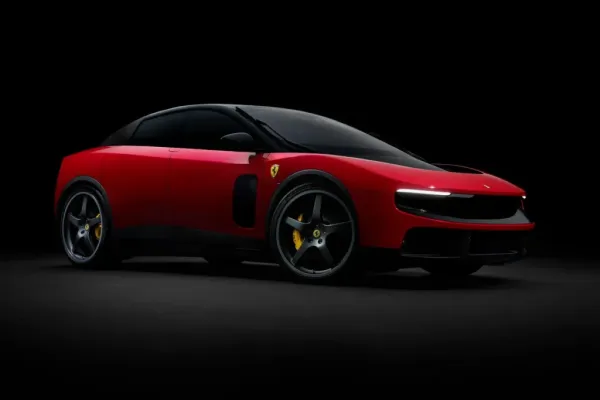
Ferrari has spent decades building an identity around noise, speed and mechanical drama. Its cars were never simply transport for wealthy buyers. They represented a very specific idea of driving, one tied closely to petrol engines, racing heritage and emotional attachment. That is why the arrival of Ferrari’s first fully electric vehicle has triggered such a fierce reaction across the car industry and online communities alike.
The new Ferrari Luce, unveiled in Italy this week, marks one of the biggest changes in the company’s history. It is not only Ferrari’s first fully electric car, but also its first five-seater and only the second four-door production vehicle the company has ever produced. The car arrives with a price tag of roughly €550,000 and specifications that place it firmly in supercar territory. Yet most of the conversation has not centred on acceleration figures or battery range. Instead, the debate has focused on whether Ferrari still looks and feels like Ferrari at all.
The Luce arrives during a difficult moment for the electric vehicle market. Carmakers around the world are facing uneven demand, slowing sales growth and growing uncertainty about how quickly wealthy buyers are willing to abandon combustion engines. Some luxury manufacturers have delayed electric plans altogether, while others have moved back toward hybrids after discovering that enthusiasm for high-end EVs remains uneven across markets.
Ferrari, however, chose not to approach electrification cautiously. Instead of quietly releasing an electric version of one of its existing sports cars, the company introduced something that breaks sharply from its past. The Luce is taller than many traditional Ferraris, has a roomy rear cabin, and adopts styling that many people online compared more to a luxury technology product than a racing machine.
Part of that reaction comes from the people behind the design itself. Ferrari worked with LoveFrom, the design company led by former Apple executives Jony Ive and Marc Newson. Their influence appears throughout the car. The exterior avoids the aggressive vents and exposed aerodynamic elements usually associated with Ferrari. The interior moves away from large touchscreens and instead leans heavily on physical buttons and tactile controls.
For some observers, that restraint feels refreshing at a time when many car interiors increasingly resemble oversized tablets. Others see it as a betrayal of Ferrari’s identity. Social media criticism arrived almost immediately after the launch event, with online forums filling with comments describing the car as awkward, unattractive or disconnected from Ferrari’s racing roots.
The criticism has not been confined to internet culture. Luca di Montezemolo, the former Ferrari chairman who led the company for more than two decades, publicly questioned the direction of the company without directly naming current management. Italy’s transport minister Matteo Salvini also mocked the design publicly, asking what company founder Enzo Ferrari would have thought of the car.
The reaction matters because Ferrari occupies a rare position in the automotive industry. Most car companies can survive criticism about styling or design trends. Ferrari’s business depends heavily on emotion, heritage and exclusivity. Buyers are not simply purchasing transport or engineering. They are buying into a mythology carefully built over decades.
Ferrari’s EV Push Reflects Pressure Across the Luxury Car Industry
The Luce did not appear in isolation. The car reflects wider pressure facing luxury manufacturers as governments tighten emissions rules and buyers gradually become more comfortable with electric vehicles. Ferrari had already introduced hybrid models years earlier, but a fully electric car represented a larger psychological barrier for both the company and its customers.
Electric technology changes the traditional formula that built the supercar business. Petrol-powered Ferraris rely heavily on engine sound, mechanical feel and gear changes to create emotional attachment. Electric motors remove much of that theatre. They offer instant acceleration and quieter operation, but they also risk making expensive sports cars feel technically similar to one another.
That problem has pushed luxury manufacturers into difficult territory. Speed alone no longer guarantees exclusivity because electric powertrains make rapid acceleration easier to achieve. Even relatively affordable electric vehicles can outperform older sports cars in straight-line speed tests. Carmakers are therefore searching for new ways to justify premium prices and preserve brand identity.
Ferrari’s answer appears to involve design, driving feel and emotional experience rather than raw numbers alone. The Luce still delivers enormous power. Ferrari says the vehicle produces more than 1,000 horsepower and can reach 100 kilometres per hour in around 2.5 seconds. Yet the company also placed heavy attention on interior experience, physical controls and visual identity.
The company even developed artificial sound systems to recreate some sense of drama normally associated with petrol engines. That choice highlights one of the stranger realities facing luxury electric vehicles. Carmakers are attempting to remove combustion engines while simultaneously reproducing parts of the emotional experience those engines once created.
There are also practical reasons behind the Luce’s unusual shape. Electric vehicles require large battery packs placed underneath the cabin floor. That arrangement changes vehicle proportions and often raises the height of the car itself. Ferrari’s engineers appear to have prioritised interior space and battery packaging over traditional low-slung sports car styling.
That decision may also reflect changing customer expectations. Ferrari is no longer selling only to traditional sports car collectors. Wealthy buyers in China, the Middle East and parts of North America increasingly expect luxury cars to function as daily vehicles rather than occasional weekend machines. A larger cabin and extra seating widen the market, even if doing so risks alienating purists.
The Luce Reveals a Wider Cultural Divide Around Electric Cars
The backlash surrounding the Luce says as much about public attitudes toward electric cars as it does about Ferrari itself. Electric vehicles have increasingly become part of broader cultural arguments that stretch far outside the automotive industry. In several countries, criticism of EVs now overlaps with political identity, nostalgia for traditional engineering and frustration with changing consumer trends.
Ferrari’s electric move landed directly inside that tension. The company built its reputation around mechanical emotion and racing history. For many enthusiasts, removing the combustion engine feels symbolic, almost like ending a tradition rather than launching a new product.
At the same time, there are buyers who appear interested precisely because the Luce breaks from convention. Some reviewers praised the cleaner design and cabin layout, arguing that Ferrari avoided copying the oversized screens now common across luxury vehicles. Others viewed the car as an attempt to create something different in a market where many electric vehicles increasingly resemble one another.
Even Pope Leo XIV briefly became part of the discussion after Ferrari executives presented the car during a visit to Castel Gandolfo near Rome. Images of the Pope sitting inside the vehicle quickly spread online, although the unusual meeting did little to calm criticism surrounding the launch.
Financial markets also reacted cautiously. Ferrari shares dipped following the unveiling, though market reactions immediately after major product announcements are often volatile. Investors appear to be weighing whether Ferrari can preserve its pricing power and exclusivity while entering an electric market that remains uncertain even for much larger manufacturers.
The company itself seems aware that the Luce will divide opinion. Ferrari chief executive Benedetto Vigna reportedly described the car as intentionally polarising. That may sound risky, but Ferrari rarely depends on mass approval. The company produces relatively small numbers of vehicles and relies heavily on wealthy collectors willing to pay for rarity and status.
-
The season of choice will tell you what kind of person you are! The research revealed surprising information

-
Read Mobility: It doesn’t matter that people hate the Ferrari Luce
-
Opportunity of self enumeration in this first census, how to fill the form? Need any documents?

-
Tendulkar Speaks On Vaibhav Sooryavanshi’s Future In Test Cricket

-
Asian U20 Athletics: India end campaign with 19 medals – Complete list of medallists