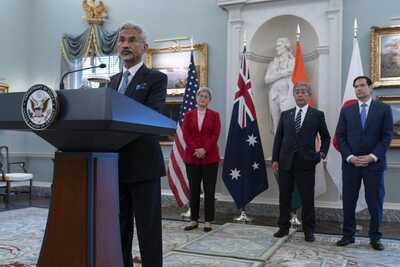
New Delhi: The four-nation Quad grouping appeared to shift from broad strategic messaging to more concrete economic and infrastructure coordination as its members met in New Delhi on Tuesday. The talks brought together Indian External Affairs Minister S. Jaishankar, US Secretary of State Marco Rubio, Japanese Foreign Minister Toshimitsu Motegi and Australian Foreign Minister Penny Wong.
Drawing up new principlesNew points of priorities have come out from the Quad meeting held on Tuesday. A focus on trade resilience, energy security, critical minerals and maritime infrastructure across the Indo-Pacific was seen as priorities. A larger commitment to work together on such goals was also seen, less in rhetoric and more in action.
“India, Australia, Japan and the United States of America are united by a common vision for a free and open Indo-Pacific, underpinned by robust economic and energy systems. Recognizing shifts in the global energy landscape and escalating geopolitical complexities, we are accelerating collaboration to ensure energy stability and security. Our leaders have expressed a clear collective intent to cooperate on energy security and resilience,” the official statement post-meeting read.
Important points coming out of meetThe meeting came at a time of rising concern over global supply chain and energy disruptions linked to the ongoing unrest in West Asia. Instability around global maritime choke points and growing competition over critical minerals was also on agenda.
In context to such developments, officials announced a new Indo-Pacific Energy Security initiative and a framework for coordinating policies and investments around critical minerals supply chains. The Quad also unveiled its first joint infrastructure project, the development of a port in Fiji, aimed at improving connectivity and maritime capacity in the Pacific region.
Country-specific concerns and priorities were also reflected during the discussions. Addressing the media after the Quad Foreign Ministers’ meeting, India’s External Affairs Minister Dr S Jaishankar said that the Quad nations had agreed on the need for “zero tolerance” towards terrorism while reaffirming their commitment to a free and open Indo-Pacific.
The United States focused on resilient supply chains for strategic technologies and critical minerals.US Secretary of State Marco Rubio announced several new Quad initiatives, including the launch of the Indo-Pacific Maritime Surveillance Cooperation Initiative to improve information-sharing among member countries. He also confirmed the expansion of the Indo-Pacific Maritime Domain Awareness Initiative, which will provide near-real-time maritime tracking data to countries across the region.
Japan highlighted the importance of secure maritime commerce and stable sea lanes for energy imports. Australia, meanwhile, stressed cooperation on clean energy partnerships and regional infrastructure financing in the Indo-Pacific. The ministers also discussed ways to improve coordination during disruptions affecting commercial shipping and energy transportation.
In line with the current global crisis, the discussions additionally focused heavily on maritime security, resilient supply chains and commercial shipping routes across the Indo-Pacific. Indian officials highlighted concerns over regional economic stress and vulnerabilities exposed by the Iran conflict, especially around energy flows and logistics corridors. The ministers also discussed maritime surveillance cooperation and real-time information sharing to strengthen domain awareness across regional waters.
The Quad, formally known as the Quadrilateral Security Dialogue, includes India, United States, Japan and Australia. China was not directly named in many of the official announcements, but the strategic backdrop remained clear. The Quad countries have repeatedly stressed support for a “free and open Indo-Pacific,” while China has long criticised the grouping as an attempt to contain Chinese influence in the region.
-
Delhi: 17-year-old shot at Amar Colony eatery after argument over touching chair

-
Aam Ki Guthli Benefits: Read this before throwing away mango seeds, its benefits will surprise you.
-
How to make Matka Kulfi at home

-
Angry Walmart shopper hit with dynamic price in real time

-
The great war has not stopped! America-Iran dispute flares up again due to Trump’s move, closure of Hormuz will create outcry across the world