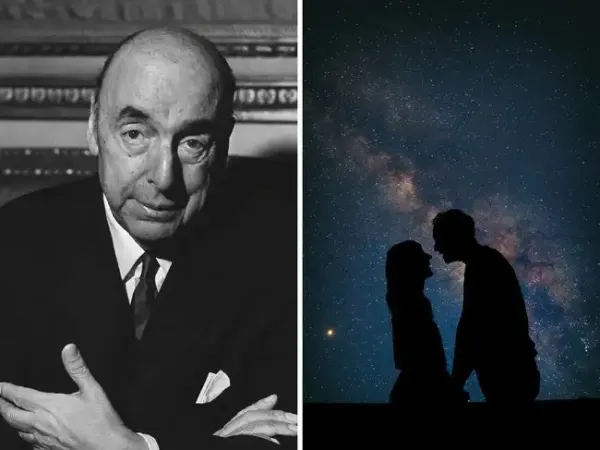
The meaning of true love can never be summed up in a single definition. Reason? No two people experience romance the same way. The feeling is open to interpretation and shaped by individual perspectives. But poets and literary figures have long attempted to capture the depth, beauty, and mystery of love through timeless verses, offering words that continue to resonate across generations and inspire countless romantic souls. One such poet from Chile, whose idea of love weaved whimsy with magic and a sprinkle of surrealism, was Pablo Neruda.
Pablo Neruda’s poem was a reflection of his life
One of Pablo Neruda’s soul-stirring lines, ‘I love you as certain dark things are to be loved in secret, between the shadow and the soul,’ finds a mention in Sonnet XVII, featured in his celebrated work 100 Love Sonnets published in 1959. Interestingly, the entire collection is dedicated to his third wife, Chilean singer and pediatric physical therapist Matilde Urrutia.
Their love story began in the late 1940s when Pablo Neruda, a prominent communist senator, was forced into hiding and eventual exile in 1948 due to political persecution. During this time, he ran into Matilde in Santiago and later reunited with her in Europe. They kept their relationship a secret for years and would meet discreetly at various places.
So, when Pablo Neruda writes about loving ‘in secret, between the shadow and the soul’, he is not just unleashing his poetic side but describing the literal reality of his early relationship with Matilde, where they had to live in a shadow world of secrecy, hiding an intense, soulful connection from the public eye.
Pablo Neruda's timeless poetry: Deeper meaning and modern relevance
Through his poem, Pablo Neruda suggests that the deepest forms of love often exist beyond public display and grand declarations. The ‘dark things’ are not sinister; rather, they symbolize emotions that are intimate, mysterious, and difficult to explain. By comparing love to something cherished in secret, Neruda highlights its private and deeply personal nature. In today’s world of social media, where relationships are frequently showcased online, the verse serves as a reminder that genuine affection does not require validation from others. Some of the strongest emotional bonds are nurtured quietly, away from public scrutiny, rooted in trust, understanding, and authenticity.
The quote also elevates love from a mere emotion to a spiritual connection. The ‘shadow’ represents the hidden, imperfect, and vulnerable aspects of a person, while the ‘soul’ signifies their truest essence. Neruda’s words imply that real love embraces both the flaws and the beauty, the uncertainties and the strengths. In a modern context, where people often feel pressured to present idealized versions of themselves, the line remains profoundly relevant. It speaks to the importance of being accepted for who we truly are. True love, according to Neruda, flourishes when two people connect beyond appearances and cherish each other’s deepest selves.
More about Pablo Neruda
Pablo Neruda, whose real name is Neftalí Ricardo Reyes Basoalto, was born on 12 July, 1904, in the town of Parral in Chile. His father was a railway employee, and his mother, who died shortly after his birth, was a teacher. Neruda displayed a remarkable talent for writing from an early age, composing poetry by the time he was 10. After completing his education in Temuco in 1920, he began publishing poems in local newspapers before gaining wider recognition in literary magazines in Santiago.
Pablo Neruda’s debut collection, Crepusculario (1923), introduced his lyrical style, while Twenty Love Poems and a Song of Despair (1924) established him as a major literary voice. Inspired by personal heartbreak, the collection is celebrated for its vivid imagery, emotional intensity, and exploration of youthful love and longing. Over the following years, Neruda continued to experiment with form and theme through several poetry collections, including Attempt of the Infinite Man and Rings.
Pablo Neruda’s time abroad also influenced the creation of Residence on Earth, one of his most acclaimed works. Today, Neruda’s poetry remains widely read across the world, with many of his major collections available in English translation and several previously unpublished poems discovered and released decades after his death.
Pablo Neruda’s poem was a reflection of his life
One of Pablo Neruda’s soul-stirring lines, ‘I love you as certain dark things are to be loved in secret, between the shadow and the soul,’ finds a mention in Sonnet XVII, featured in his celebrated work 100 Love Sonnets published in 1959. Interestingly, the entire collection is dedicated to his third wife, Chilean singer and pediatric physical therapist Matilde Urrutia.
Their love story began in the late 1940s when Pablo Neruda, a prominent communist senator, was forced into hiding and eventual exile in 1948 due to political persecution. During this time, he ran into Matilde in Santiago and later reunited with her in Europe. They kept their relationship a secret for years and would meet discreetly at various places.
So, when Pablo Neruda writes about loving ‘in secret, between the shadow and the soul’, he is not just unleashing his poetic side but describing the literal reality of his early relationship with Matilde, where they had to live in a shadow world of secrecy, hiding an intense, soulful connection from the public eye.
Pablo Neruda's timeless poetry: Deeper meaning and modern relevance
Through his poem, Pablo Neruda suggests that the deepest forms of love often exist beyond public display and grand declarations. The ‘dark things’ are not sinister; rather, they symbolize emotions that are intimate, mysterious, and difficult to explain. By comparing love to something cherished in secret, Neruda highlights its private and deeply personal nature. In today’s world of social media, where relationships are frequently showcased online, the verse serves as a reminder that genuine affection does not require validation from others. Some of the strongest emotional bonds are nurtured quietly, away from public scrutiny, rooted in trust, understanding, and authenticity.
The quote also elevates love from a mere emotion to a spiritual connection. The ‘shadow’ represents the hidden, imperfect, and vulnerable aspects of a person, while the ‘soul’ signifies their truest essence. Neruda’s words imply that real love embraces both the flaws and the beauty, the uncertainties and the strengths. In a modern context, where people often feel pressured to present idealized versions of themselves, the line remains profoundly relevant. It speaks to the importance of being accepted for who we truly are. True love, according to Neruda, flourishes when two people connect beyond appearances and cherish each other’s deepest selves.
More about Pablo Neruda
Pablo Neruda, whose real name is Neftalí Ricardo Reyes Basoalto, was born on 12 July, 1904, in the town of Parral in Chile. His father was a railway employee, and his mother, who died shortly after his birth, was a teacher. Neruda displayed a remarkable talent for writing from an early age, composing poetry by the time he was 10. After completing his education in Temuco in 1920, he began publishing poems in local newspapers before gaining wider recognition in literary magazines in Santiago.
Pablo Neruda’s debut collection, Crepusculario (1923), introduced his lyrical style, while Twenty Love Poems and a Song of Despair (1924) established him as a major literary voice. Inspired by personal heartbreak, the collection is celebrated for its vivid imagery, emotional intensity, and exploration of youthful love and longing. Over the following years, Neruda continued to experiment with form and theme through several poetry collections, including Attempt of the Infinite Man and Rings.
Pablo Neruda’s time abroad also influenced the creation of Residence on Earth, one of his most acclaimed works. Today, Neruda’s poetry remains widely read across the world, with many of his major collections available in English translation and several previously unpublished poems discovered and released decades after his death.