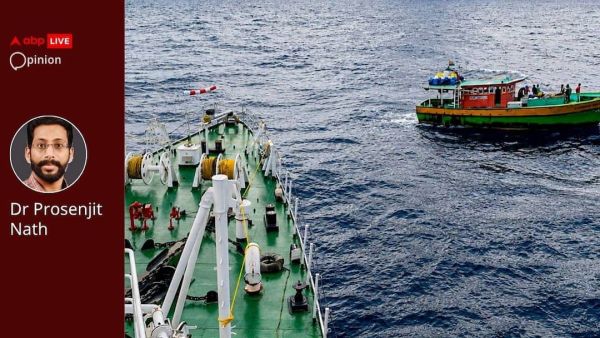
India’s decision to transform Great Nicobar Island into a major transhipment hub, military-logistics centre, and economic gateway is not merely another infrastructure project. It is a declaration of intent. In an era where maritime power increasingly determines geopolitical influence, the Great Nicobar project represents one of the most ambitious strategic moves undertaken by India since independence.
As former Brigadier Sanjay Iyer rightly observed, the project gives India “a persistent presence in the eastern Indian Ocean rather than the occasional visit.” That statement captures the essence of the initiative. For decades, India has geographically occupied a commanding position in the Indian Ocean but has failed to fully leverage it strategically. Great Nicobar could finally change that equation.
Located near the Malacca Strait, one of the busiest and most critical maritime chokepoints in the world, the island sits at the crossroads of global trade routes connecting the Pacific and Indian Oceans. Nearly one-third of global shipping traffic passes through this corridor. Any nation with sustained logistical, surveillance, and naval capabilities in this region automatically acquires significant strategic leverage. China understands this. The United States understands this. India can no longer afford hesitation.
India’s Maritime Shift in the Indo-Pacific
The Great Nicobar project is therefore not simply about ports and airports; it is about India’s emergence as a decisive maritime power in the Indo-Pacific.
For years, India’s strategic thinking remained overwhelmingly continental, shaped by land threats from Pakistan and China. Maritime affairs were often treated as secondary. Yet the 21st century has fundamentally altered global geopolitics. Economic power now flows through sea lanes, supply chains, energy corridors, and strategic ports. Nations that dominate maritime trade routes shape global commerce and diplomacy.
China recognised this transformation earlier than India. Through the Belt and Road Initiative and the so-called “String of Pearls” strategy, Beijing has invested heavily in ports stretching from Gwadar in Pakistan to Hambantota in Sri Lanka and Kyaukpyu in Myanmar. These projects are not purely economic ventures; they are geopolitical assets designed to expand Chinese influence across the Indian Ocean Region.
India’s response had long been reactive and fragmented. Great Nicobar signals a shift toward proactive strategic planning.
Economic and Commercial Importance of Great Nicobar
The proposed international container transshipment terminal is especially significant. Currently, a large portion of India’s cargo is transshipped through foreign ports such as Singapore, Colombo, and Port Klang. This dependency weakens India’s economic efficiency and strategic autonomy. A world-class transhipment port at Great Nicobar could reduce that dependence while positioning India as a regional maritime logistics hub.
The island’s proximity to Southeast Asia also offers enormous commercial potential. As global supply chains diversify away from excessive dependence on China, India has an opportunity to integrate more deeply with Indo-Pacific trade networks. Great Nicobar could become a gateway linking India with ASEAN economies, East Asia, and Australia.
Strengthening India’s Defence and Surveillance Capabilities
Equally important is the defence dimension.
The Andaman and Nicobar Command is India’s only tri-service military command, yet for years it suffered from inadequate infrastructure and limited operational reach. Expanding facilities in Great Nicobar would strengthen India’s ability to monitor naval activity in the eastern Indian Ocean and the Malacca Strait. In an age of intensifying Chinese naval expansion, such capabilities are no longer optional.
China’s growing presence in the Indian Ocean is a strategic reality. Chinese research vessels frequently enter the region. PLA Navy deployments have become increasingly common. Beijing’s influence in Sri Lanka, Myanmar, Bangladesh, and the Maldives has expanded steadily over the last decade. India therefore needs permanent surveillance and rapid-response capabilities in the region.
Great Nicobar provides precisely that strategic depth.
The proposed airport and supporting military infrastructure would allow faster deployment of naval and air assets. Enhanced radar and intelligence systems would improve maritime domain awareness. In crisis scenarios, the island could function as a forward operating base for India’s eastern maritime theatre.
Environmental Concerns and Execution Challenges
Critics argue that the project risks environmental damage and threatens indigenous communities such as the Shompen tribe. These concerns deserve serious consideration and cannot simply be dismissed in the name of development. Great Nicobar is ecologically sensitive, home to unique biodiversity, tropical forests, and fragile coastal ecosystems. India must ensure that strategic ambition does not become ecological recklessness.
However, environmental concerns should not become an excuse for strategic paralysis.
Every major nation balances environmental protection with national security priorities. The key question is whether development can proceed responsibly, scientifically, and sustainably. India has the technological and institutional capacity to minimise ecological disruption if the project is implemented with transparency and accountability.
The real challenge lies in execution. India’s infrastructure history is filled with projects delayed by bureaucratic indecision, regulatory confusion, and political hesitation. Strategic projects cannot be allowed to stagnate indefinitely under endless procedural debates. China’s infrastructure rise was built on speed and long-term planning. While India rightly functions within democratic constraints, it must also develop the capacity for timely strategic execution.
Redefining India’s Indo-Pacific Vision
Another important dimension of the Great Nicobar initiative is its symbolism.
For decades, India’s island territories remained psychologically and administratively distant from the mainland imagination. The Andaman and Nicobar Islands were often viewed primarily through the lens of tourism or colonial history. The new project redefines them as central pillars of India’s Indo-Pacific vision.
This transformation aligns with India’s broader geopolitical evolution. Under its Indo-Pacific strategy, India is increasingly deepening partnerships with countries such as Japan, Australia, France, and the United States. The Quad framework itself reflects the growing importance of maritime security in the region. Great Nicobar could become a strategic anchor supporting these partnerships.
Japan, in particular, has shown strong interest in Indo-Pacific infrastructure collaboration. As democratic nations seek alternatives to Chinese-controlled supply chains and maritime networks, India’s strategic geography becomes increasingly valuable. Great Nicobar strengthens India’s credibility as a serious Indo-Pacific actor rather than merely a regional power confined to South Asia.
Strategic Confidence and India’s Maritime Future
There is also a psychological aspect to the project that should not be underestimated. Nations rise not only through economic growth but through strategic confidence. Large-scale infrastructure projects often reflect national ambition and geopolitical self-belief. The Great Nicobar initiative sends a message that India is willing to think beyond immediate electoral cycles and invest in long-term strategic capabilities.
Yet ambition alone is insufficient.
India must ensure that local communities benefit from development rather than becoming victims of displacement or exclusion. Sustainable urban planning, environmental safeguards, disaster preparedness, and transparent governance must accompany strategic expansion. The island lies in a seismically sensitive zone, and infrastructure planning must incorporate resilience against earthquakes and tsunamis.
If executed intelligently, Great Nicobar could become for India what Singapore became for Southeast Asia a critical maritime and logistics node with outsized strategic importance.
The stakes are therefore enormous. This is not just an infrastructure project buried in bureaucratic paperwork. It is a test of whether India can finally align geography, strategy, economics, and political will into a coherent national vision.
The Indian Ocean is rapidly becoming the centre of global geopolitics. Energy routes, trade flows, naval competition, and strategic rivalries increasingly converge in these waters. India sits naturally at the heart of this geography, but geography alone guarantees nothing. Strategic advantage must be built, defended, and sustained.
Great Nicobar offers India that opportunity.
If India succeeds, the island may one day be remembered as the place where the country truly embraced its maritime destiny.
(The writer is a technocrat, political analyst, and author)
-
Arsenal consider selling Myles Lewis-Skelly as Manchester United monitor situation

-
Man United Women Announce Strong Line-up for World Sevens Tournament

-
Borussia Dortmund Face Major Transfer Blow as Liverpool Snatch Top Young Target

-
FC Bayern Munich Could Cash In as Min-Jae Kim Draws Transfer Interest from Fenerbahce

-
Gary Pallister urges Manchester United to sign Sandro Tonali as Casemiro’s successor this summer