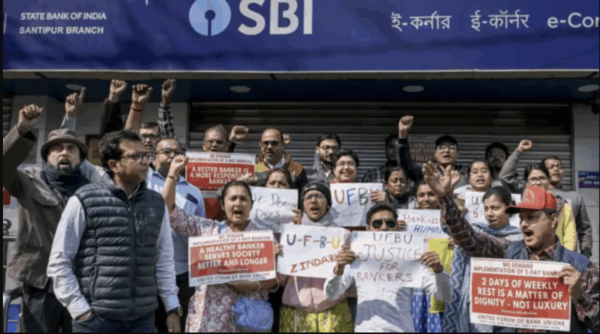
India’s largest public sector bank is now facing growing internal unrest over allegations of widespread mis-selling practices allegedly driven by aggressive business targets from senior management.
The All India State Bank of India Staff Federation (AISBISF) has openly accused SBI management of pressuring employees to sell insurance policies, mutual funds, and investment-linked products to customers — even when those products may not suit customer needs.
The issue has now become one of the core triggers behind the federation’s planned two-day nationwide strike scheduled for May 25 and 26.
Union leaders claim the pressure has intensified sharply over the past few years as banks increasingly focus on fee-based income and third-party financial product sales.
Employees Claim Unrealistic Targets Are Being Imposed
According to union statements, branch employees are allegedly being forced to meet aggressive daily and monthly sales targets for:
- Insurance products
- Mutual funds
- Investment schemes
- Third-party financial products
Workers allege that failure to achieve these targets often leads to internal pressure, performance scrutiny, humiliation during review meetings, and career disadvantages.
The federation specifically described the situation as “mis-selling in the name of cross-selling,” arguing that many employees are being pushed into convincing customers to buy financial products they may not fully understand or actually require.
Union leaders say the pressure is especially severe in retail banking branches where front-line staff interact directly with senior citizens, rural customers, salary account holders, and first-time investors.
The Bigger Backstory: How Indian Banking Shifted Toward Product Sales
The controversy reflects a much larger transformation happening across India’s banking sector.
Traditionally, public sector banks primarily focused on:
- Deposits
- Loans
- Savings accounts
- Government banking services
However, over the last 15 years, banks increasingly shifted toward becoming “financial supermarkets.”
Banks now aggressively sell:
- Insurance
- SIPs
- Mutual funds
- Credit cards
- Wealth products
- Investment-linked schemes
This transition happened because traditional lending margins became tighter while fee-based commissions from third-party product sales became highly profitable.
As competition intensified, cross-selling targets reportedly became deeply embedded into branch performance systems across the industry.
Why Mis-Selling Became Such A Sensitive Issue
Mis-selling is considered one of the most controversial problems in banking globally.
In many cases, customers — especially elderly or financially inexperienced individuals — may not fully understand:
- Lock-in periods
- Market risks
- Insurance exclusions
- Charges and commissions
- Investment volatility
Bank employees are often trusted heavily by customers, particularly in public sector banks like SBI.
This creates a situation where customers may purchase products assuming they are safe bank-backed savings instruments, even when they are actually market-linked or insurance-based financial products.
Several banking experts have warned for years that aggressive sales culture can blur the line between genuine financial advisory and commission-driven selling.
Unions Say Ethical Banking Practices Are Being Damaged
The SBI staff federation has now elevated the issue beyond employee welfare, framing it as an “ethical banking” concern.
Union representatives argue that excessive pressure to sell products is:
- Damaging customer trust
- Increasing stress among employees
- Distracting branches from core banking work
- Creating reputational risks for public sector banking
The federation also linked the issue to staff shortages, arguing that overworked employees are simultaneously handling operational banking responsibilities while being pushed to achieve aggressive sales numbers.
This Isn’t The First Time Banks Faced Mis-Selling Allegations
India’s banking sector has witnessed multiple controversies involving alleged mis-selling over the years.
Customers across several banks have previously complained about:
- Insurance products being sold as fixed deposits
- Market-linked products being presented as “safe”
- Hidden lock-in clauses
- Unclear commission structures
- Unauthorized policy conversions
Regulators including the Reserve Bank of India and Insurance Regulatory and Development Authority of India have periodically issued warnings and compliance guidelines around customer transparency and product suitability.
However, employee unions now claim that commercial pressure inside branches continues to grow despite these regulations.
Strike Could Become Bigger Than A Wage Protest
Interestingly, the upcoming SBI strike is not being positioned only as a salary or staffing issue.
The federation’s 16-point charter includes:
- Staffing shortages
- Outsourcing concerns
- Pension disputes
- Branch security
- Employee rights
- And increasingly, ethical banking and mis-selling concerns.
This gives the agitation a broader institutional angle rather than a purely labour-focused one.
If the issue gains wider public traction, it could reopen national conversations around how aggressively financial products are being sold through India’s banking system — especially inside public sector banks trusted by millions of ordinary customers.
-
Tata Sierra EV QWD Offroad Review: Way More Capable Than You Think!

-
'We Didn't Want This Game': Didier Deschamps Insists France Must Beat England To Secure FIFA World Cup Bronze In Emotional Farewell | Video

-
'I Couldn't Stay In Good Conscience': Researcher Alex Turner Explains Why He Quit Google DeepMind

-
MNS Accuses Navi Mumbai Municipal Corporation Of Administrative Failures Across Multiple Key Departments

-
'Hum Saansein Daba Denge...': Aamir Khan Receives Threat From Bishnoi Gang After Third Marriage To Gauri Spratt Over 'Love Jihad' Allegations