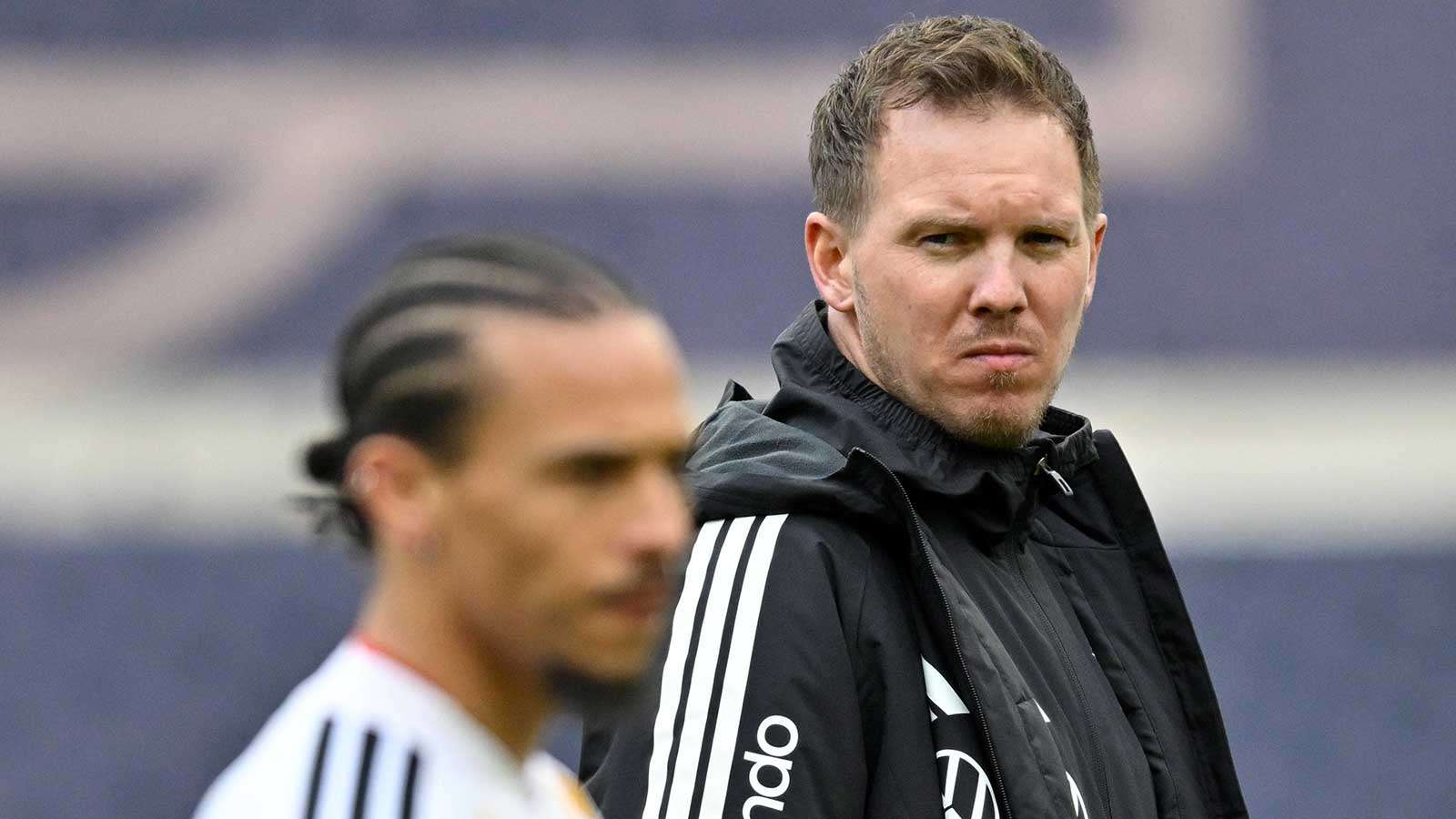
The heatmap was not the only element raising questions about Shootingstar Said El Mala’s readiness. Julian Nagelsmann’s decision to include Leroy Sané in his World Cup squad remains a bold move.
Germany head coach Julian Nagelsmann has opted to name Leroy Sané in his World Cup squad even though he believes the winger’s goal output has been “insufficient.” For Nagelsmann, the 30-year-old’s intangible qualities—like his influence within the team—carry more weight than raw statistics, something that Said El Mala currently lacks.
Nagelsmann anticipated the scrutiny. “He’s a player who splits opinions,” the coach admitted, before citing Sané’s recent numbers. “In our last four matches, he’s been involved in five goals,” he pointed out, defending his choice to select the Galatasaray attacker.
“That’s a very, very good record,” Nagelsmann acknowledged, yet he was quick to add, “But his club record isn’t strong enough, especially in 2026.” Sané has scored once and provided three assists, with no direct goal involvement since April 12. Overall, he concludes his debut season in Istanbul with seven goals and nine assists across 43 competitive appearances.
After Sané’s transfer to Istanbul, Nagelsmann had set clear expectations: “He needs to make a bigger impact. I need a certain ratio.” Initially, that target was missed, resulting in Sané being excluded from the September and October training camps. However, his recent improvement has earned him a World Cup recall, signaling that he has met the national coach’s criteria.
During Thursday’s press conference in Frankfurt, Nagelsmann explained that his decision to pick Sané over Said Benrahma, Chris Führich, and Karim Adeyemi went beyond statistics. “What works in his favour is the immense respect he commands within the dressing room,” he said, naming several teammates “who share a very close bond with him.”
Leroy Sané has, therefore, edged out Said El Mala in this selection battle.
It’s natural that a 19-year-old like El Mala, still uncapped at senior level for Germany, can’t yet compete with that. Yet the explosive 1. FC Köln forward, who was playing in the third division just last season, has scored 13 goals and delivered five assists in 34 Bundesliga matches. His contribution accounts for nearly 37% of Köln’s total goals—the highest ratio among all top-flight players.
Statistically, El Mala’s output surpasses Sané’s. Whether he deserved the World Cup call-up more than the veteran is debatable. Over the full season, El Mala has been in superior form compared to Sané, who spent periods on Galatasaray’s bench despite his greater experience.
Nagelsmann chose to overlook a youngster who would have treated his first senior cap as a privilege and given his all for the national jersey. Instead, he went with Sané, who has even faced boos from his own fans after coming on as a substitute against Ghana. “He’s a player where you increasingly see what he doesn’t bring, because sometimes his aura overshadows other things,” Nagelsmann commented.
Said El Mala: Performance statistics for the 2025/26 season
With Sané, the coach emphasised, “there is a synergy within the team dynamic.”
Rather than introducing a debutant, Nagelsmann has relied on Sané’s experience, hoping his presence will enhance team cohesion. “A symbiosis develops within the team structure when he’s in the squad,” the coach explained.
He reiterated that point, noting that while other nations might boast more individual stars, past World Cup champions have always succeeded through collective balance and chemistry.
This logic, Nagelsmann said, also explains El Mala’s omission. “He fits perfectly into Cologne’s system. The question is whether he also fits into ours, considering our attacking setup,” he remarked. “If you analyse Cologne’s heatmap, you’ll see it’s close to their own goal line, giving him more space for counter-attacks.”
Nagelsmann asserts that Sané is ready to compete.
Dortmund’s Maximilian Beier is expected to capitalise during the tournament; like El Mala, he has 18 points in league play. “You have to weigh everything carefully,” Nagelsmann explained. “You need to look at the big picture and decide which players combine effectively and how often they’ve played together.”
He also highlighted Sané’s technical prowess. “He still possesses something unique in tight spaces,” he said, before revealing that the former Bayern Munich winger is set to begin in a challenger role. “Given his less-than-ideal club form, he’ll start as an impact option. He can change games against deep defences or late in matches with his speed, technical quality, and link-up play.”
For Sané, this opportunity could be decisive, possibly his last with the national team. The winger himself acknowledged in a recent interview with Turkish agency DHA: “I would be thrilled to play in another World Cup toward the end of my career. It’s football’s biggest platform; every player dreams of being part of it.”
Nagelsmann knows he’s taking a calculated risk by backing Sané.
How the winger performs will remain one of the lingering uncertainties surrounding him. Nagelsmann is aware of it. “Let’s be honest— with him, we can never be 100 percent sure what we’ll get on the pitch,” he told kicker in March.
By selecting the 74-cap winger, the Germany coach is making a measured gamble. “I’ve known him for years and share an excellent understanding with him,” Nagelsmann said. “I’m confident I can motivate him so that, after the World Cup, people will be talking more positively than negatively about him.”
Leroy Sané: Performance statistics for the 2025/26 season
-
Germany's Squad for FIFA World Cup 2026: Full List of Players Heading to USA, Mexico, and Canada
-
All You Need to Know About the Historic First WSL Promotion Play-off and League Expansion
-
Bayern Munich’s Raphaël Guerreiro reportedly mulling immediate retirement from football
-
The 13 Football Managers Who Have Lifted Three or More European Trophies: Unai Emery Surpasses Guardiola and Ferguson

-
Neymar sidelined once more! Santos forward suffers calf injury, sparking fresh doubts over World Cup readiness