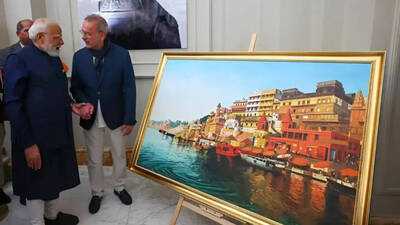
On May 20, 2026, during a visit to Rome by the Indian Prime Minister, an Italian artist in his seventies, Giampaolo Tomassetti, gifted a stunning oil-and-acrylic painting titled 'Holy Varanasi' to Narendra Modi. This artwork, depicting the Ganga's ghats illuminated by the morning sun, reflects Tomassetti's deep connection with Indian sacred texts, cultivated over four decades. His journey from a small town in Italy to becoming a prominent European painter of the Mahabharata is a remarkable story.
From Terni to Transformation A Boy In Terni, and A Play That Changed Him
Born on March 8, 1955, in Terni, Umbria, Tomassetti displayed artistic talent from a young age. Initially pursuing science, he shifted his focus to spiritual literature. At seventeen, he experienced a pivotal moment while watching Peter Brook's acclaimed adaptation of the Mahabharata, which led him to explore the Bhagavad Gita, Srimad Bhagavatam, and Ramayana, forever altering his path.
A Spiritual Journey in Florence Florence, Bhaktivedanta, and The Monastic Years
In 1981, while illustrating for a publishing house in Florence, Tomassetti was tasked with creating illustrations for Vedic literature for the Bhaktivedanta Book Trust. This project ignited a passion, leading him to join ISKCON, where he adopted the spiritual name Jnananjana Dasa and spent nine years as a Vaishnava monk. He was also a founding member of the International Vedic Art Academy at Villa Vrindavan, which has been promoting Vedic-inspired art for nearly fifty years.
Merging Techniques and Traditions A Renaissance Technique Meets An Indian Epic
What sets Tomassetti apart is his unique blend of European artistic techniques with Indian themes. Initially, he honed his skills by replicating Old Masters in museums, mastering Renaissance techniques. When he began depicting Indian subjects, he infused his European craftsmanship into his work. His paintings of Arjuna and Krishna exhibit the anatomical precision and chiaroscuro typical of Italian Baroque art, while remaining true to Indian iconography and narratives. In 1997, he won Italy's national historical painting contest with a monumental piece now displayed in Modica Town Hall, Sicily.
A Decade Dedicated to the Mahabharata Twelve Years On The Mahabharata
Tomassetti's most recognized project began in the mid-2000s. He dedicated approximately five years to studying the Mahabharata before starting to paint. Between 2008 and 2013, he created a series of large oil paintings—twenty-three to twenty-five in total—illustrating key moments from the epic, such as Kunti receiving the boon from Surya and Krishna guiding Arjuna during the Kurukshetra battle. This series was crafted in his studio in Città di Castello, Perugia, and is intended for the Museum of Sacred Art at Villa Vrindavan.
Significance of the Rome Presentation Why The Rome Meeting Matters
The brief presentation of 'Holy Varanasi' to Modi in Rome carries profound significance. Tomassetti represents a small yet impactful lineage of European artists and scholars who have devoted their lives to Indian sacred themes, often with more dedication than some contemporary Indian artists. The painting gifted to Modi was created by a former Italian monk who first encountered the Mahabharata at seventeen and has been inspired by it for over four decades. The bridge symbolized in his painting reflects the connections he has built throughout his artistic journey.
-
Michael Carrick responds after reports that Jose Mourinho wants to sign Diogo Dalot for Real Madrid

-
Erling Haaland Urges Manchester City to Channel Frustration After Missing Out on Premier League Title

-
Hall of Fame: Michel Platini – The King Who Brought Glory to Juventus and France

-
The real challenge begins for Michael Carrick: Six key tasks awaiting the new permanent Manchester United manager at Old Trafford

-
Chelsea Must Snap Out of Their Slump as Revived Man Utd Threaten to Leave Blues Behind if Liam Rosenior Fails to Halt Their Decline