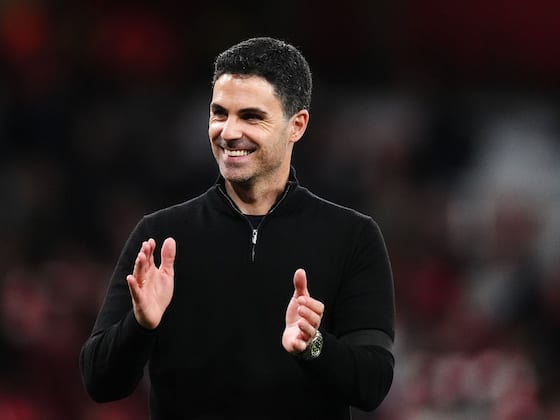
As Mikel Arteta finally gets to enjoy the moment he has long dreamed of, he keeps returning to a phrase that dominated his thoughts all season. “Twenty-two years,” he would tell anyone who cared to listen. “Twenty-two years. That’s far too long for a club like Arsenal.”
Now, after more than two decades of anticipation, frustration, and near-misses, Arteta and his team can finally say the wait is over. On Sunday, the Spaniard will lift the Premier League trophy – Arsenal’s first since 2004, and their 14th overall.
Few understood the strain of that long drought better than Arteta himself. Throughout the campaign, he could sense the pressure building, that familiar anxiety creeping in whenever things seemed on the brink of collapse – as many had predicted.
One of the defining features of Arsenal’s season was how Arteta managed that tension, keeping his players calm and the team in control.
That sense of control, however, was sometimes fragile. There were at least four moments during the season when emotions reached a breaking point and Arteta felt compelled to step in. His constant message to the players was to shift perspective – to remember that being in the fight was a privilege, not a burden.
Their ability to respond to pressure became a testament to their resilience – something often questioned in previous years.
Yet, in a twist, it was one of his players who had to remind Arteta himself to take a step back and see things differently.
Kai Havertz’s goal in the narrow win over Burnley was one of several defining moments, but it was what happened after the 2-1 home defeat to Bournemouth that truly changed the course of the season. The loss came just before a daunting trip to Manchester City – the fixture that had loomed over them for months.
At that stage, Arsenal’s issues weren’t just mental. The players were physically drained. The demanding schedule, coupled with Arteta’s intense training sessions, had taken a toll. His instinct after setbacks was always to double down in training – admirable in spirit, but potentially punishing for athletes at their physical limits. The recurring injuries every April were testament to that.
That’s when Eberechi Eze, one of the newer and more relaxed members of the squad, approached his manager. In essence, he told Arteta, “We can do this, but we need some breathing space.”
Arteta listened.
He eased the workload. Training intensity was reduced, and days off became more frequent. In the week leading up to their title-clinching moment, the team even enjoyed three days off followed by a barbecue.
At the training ground, Arteta banned sports news and TV coverage, replacing them with music from the 1990s and early 2000s – a nod to the club’s last golden era.
These seemingly small decisions often make the crucial difference in high-pressure title races, especially for a team operating within such fine margins as Arsenal.
There remains a broader debate about the style and aesthetics of the new champions, but at its heart, this season was defined by control – a manager maximising every detail within his reach.
While Arsenal may not have always dazzled with attacking flair, their balance and consistency made them the most complete side in the league – and ultimately, champions.
It also reinforces a truth sometimes overlooked in discussions about Arsenal: this title was built on overperformance. Despite facing a Manchester City side with a wage bill £80 million higher – roughly equivalent to five Bukayo Sakas – Arteta’s team outsmarted, rather than outspent, their rivals.
To level the playing field, Arteta, together with Tim Lewis and Andrea Berta, crafted strategies to gain small but critical advantages on and off the pitch.
This led to an emphasis on set-pieces and physical strength. Arteta recognised the direction modern football was heading and adapted accordingly. Players like Oleksandr Zinchenko were moved on because they didn’t fit the evolving physical profile.
The shift was also visible in their transfer dealings. After painful near-misses in previous seasons, Arteta identified depth and injury management as key areas for improvement. He wanted reliable cover in every position, knowing how gruelling the new schedule had become.
There was even early consideration of signing Alexander Isak, whom Arteta admired, but the price tag and doubts over his ability to maintain intensity twice a week made the move impractical – a decision that, in hindsight, proved correct.
Viktor Gyokeres, who has scored 21 goals this season, offered the depth and unpredictability Arteta desired. The manager relished being able to approach games with lineups that opponents couldn’t anticipate. Even minor injuries were kept secret, with media instructed not to photograph returning players.
Yet, beyond the tactics, what ultimately defined this triumph was Arteta’s obsessive attention to detail. He even had the team train at the Emirates Stadium to perfect their pressing using the stands for spatial reference. Described by staff as “a probabilities guy,” Arteta calculated that maintaining around 2.0 xG per game while limiting opponents to 0.5, keeping clean sheets, and scoring from set-pieces would be enough to deliver the title.
It produced a campaign that often felt methodical, even mechanical, with only flashes of the free-flowing football from 2022–23. But as Arteta’s supporters would argue, he did what was necessary.
There were still key emotional moments: the 2-1 comeback at Newcastle United in September set a psychological marker, with Gabriel’s winning set-piece goal becoming symbolic of their season. The 4-1 win over Aston Villa at Christmas was hailed by Arteta as their best performance, the players jokingly chanting “set-piece again” in celebration.
Other pivotal results included a 4-0 win at Leeds United following a 3-2 home loss to Manchester United, and a decisive 4-1 victory at Tottenham Hotspur after a frustrating 2-2 draw with Wolves.
As the season wore on, the mental toll became apparent. Rivals noted Arsenal’s tension, while insiders observed how much more relaxed the team appeared in the Champions League – a reflection of the relentless competitiveness of the Premier League itself.
By mid-April, fatigue had set in. Martin Zubimendi, brought in to stabilise midfield control, looked visibly drained. Injuries piled up, and the squad seemed stretched to its limits.
That’s when Arteta fully embraced Eze’s earlier advice. The timing proved crucial, coming just after the 2-1 defeat to City. Though painful, it didn’t break them. In fact, City’s exuberant celebrations almost fuelled Arsenal’s renewed belief. Declan Rice’s defiant words – “this is not over” – became a rallying cry.
The team rediscovered its confidence, helped by their Champions League form and the emergence of young talent like Myles Lewis-Skelly, whose energy reinvigorated the squad. Key players returned, and by the time they edged past Burnley, Arteta had close to a full-strength team again.
That win encapsulated their season – a set-piece goal, a 1-0 scoreline, a VAR controversy, but most importantly, no collapse. If any side faltered under pressure, it was City, whose 3-3 draw with Everton shifted the momentum decisively.
In the end, Arteta restored not just Arsenal’s resilience but their identity. They are once again a formidable force – and, at long last, Premier League champions.
-
‘I left my seven-figure Barclays job at 21 without another offer’: LSR graduate shares why her ‘perfect on paper’ life didn’t feel right

-
3 ingredients, 15 minutes: Fitness influencer shares how to make mango mochi at home. This tasty and healthy Japanese summer dessert is light, fresh and juicy

-
Bengaluru: Govt gets 2-month breather to hold civic polls amid concerns of setback in Congress

-
Google I/O 2026: It’s AI everywhere, from Gemini upgrades to smart glasses

-
Investment firm Oister Global launches Rs 500 crore ACE Fund III