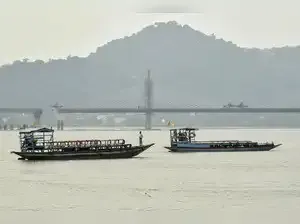
Guwahati: PM Narendra Modi-led Union Government is scaling up efforts to transform the Brahmaputra into a multi-functional economic corridor, with Union Minister for Ports, Shipping and Waterways (MoPSW), Sarbananda Sonowal spearheading an integrated push that combines transport, trade, tourism and river management.
The push was reviewed at the High-Powered Review Board (HPRB) meeting of the Brahmaputra Board here today, where ministers, technical experts and state representatives deliberated on strengthening scientific river basin planning, flood control and sustainable utilization of water resources across the Northeast. The meeting also emphasized greater coordination among basin states and the adoption of advanced technologies such as GIS, LiDAR and hydrological modelling.
Sonowal said, “At the heart of this strategy is the recognition of the Brahmaputra not merely as a river, but as a critical national asset capable of driving connectivity and economic growth across the Northeast. The Inland Waterways Authority of India (IWAI) has been working towards realizing the true potential of Brahmaputra, declared as the National Waterway 2 (NW2), as it provides a vital inland transport corridor linking Assam, along with the other parts of Northeast, to Kolkata and Haldia ports through the Indo-Bangladesh Protocol Route (IBPR), reviving an environmentally sustainable, economic and efficient mode of transportation.”
In Assam, projects worth around Rs 751 crore have already been completed, including key terminals at Pandu, Dhubri and Jogighopa, along with floating jetties and upgraded shore facilities. Ongoing works exceeding Rs 1,100 crore include fairway development along the Brahmaputra, ship repair facilities, tourist jetties and the establishment of a Regional Centre of Excellence in Dibrugarh.
Sonowal welcomed the move by the Union Government to launch State Water Reforms Framework (SWRF) to strengthen sustainable water governance and reform initiatives across states.
“Developing the Brahmaputra is about creating a resilient and sustainable river ecosystem that supports connectivity, commerce and communities. Integrated river basin planning—combining flood management, erosion control, dredging and infrastructure development—is essential to ensure year-round navigability and long-term economic growth. With the adoption of modern technologies such as GIS-based planning and digital monitoring, we are working towards transforming our waterways into efficient, green and future-ready transport corridors while preserving the ecological balance of the region, as envisioned by our dynamic Prime Minister Shri Narendra Modi ji,” argued Sonowal while advocating strongly for Integrated River Development Strategy at the meet.
The government is also investing in a future pipeline of projects worth nearly Rs 4,800 crore across the Northeast, including community jetties, cargo vessels, dredgers and cruise terminals. These initiatives are expected to strengthen last-mile connectivity, improve logistics efficiency and generate employment in riverine regions.
At the policy level, the Brahmaputra Board is being repositioned as a modern, technology-driven river basin organisation. Plans include digital governance systems, data-driven project monitoring and the revitalisation of research institutions such as the North Eastern Hydraulic and Allied Research Institute (NEHARI).
The Modi government also views the river as a “strategic lever for its Act East Policy”, enabling cross-border connectivity and regional trade, added Sonowal. Inland waterways are increasingly being positioned as a cost-effective and environmentally sustainable alternative to road and rail transport, reducing congestion, fuel consumption and emissions.
Under PM Narendra Modi’s government since 2014, the inland water transport in India—and particularly in the Northeast— has witnessed rapid growth. Cargo movement on national waterways has increased from 18 million metric tonnes in 2014 to over 218 million metric tonnes in 2025-26, underscoring the sector’s expanding role in the logistics chain.
In the ensuing period, the inland waterways sector in the NER region likely to witness development of 79 community jetties, expansion of key facilities such as the Regional Centre of Excellence (RCoE) in Dibrugarh and the ship repair facility at Pandu, and construction of supporting infrastructure for Customs and Immigration at strategic river ports. The plan also envisages procurement of dredgers, survey vessels and cargo fleets, alongside the introduction of urban water transport systems and cruise terminals in Assam. Officials said these investments are aimed at improving navigability, enhancing logistics efficiency and unlocking the economic potential of river-based transport, even as technical challenges such as heavy sediment load, shifting channels and recurring floods necessitate a scientific and integrated river basin management approach.
The push was reviewed at the High-Powered Review Board (HPRB) meeting of the Brahmaputra Board here today, where ministers, technical experts and state representatives deliberated on strengthening scientific river basin planning, flood control and sustainable utilization of water resources across the Northeast. The meeting also emphasized greater coordination among basin states and the adoption of advanced technologies such as GIS, LiDAR and hydrological modelling.
Sonowal said, “At the heart of this strategy is the recognition of the Brahmaputra not merely as a river, but as a critical national asset capable of driving connectivity and economic growth across the Northeast. The Inland Waterways Authority of India (IWAI) has been working towards realizing the true potential of Brahmaputra, declared as the National Waterway 2 (NW2), as it provides a vital inland transport corridor linking Assam, along with the other parts of Northeast, to Kolkata and Haldia ports through the Indo-Bangladesh Protocol Route (IBPR), reviving an environmentally sustainable, economic and efficient mode of transportation.”
In Assam, projects worth around Rs 751 crore have already been completed, including key terminals at Pandu, Dhubri and Jogighopa, along with floating jetties and upgraded shore facilities. Ongoing works exceeding Rs 1,100 crore include fairway development along the Brahmaputra, ship repair facilities, tourist jetties and the establishment of a Regional Centre of Excellence in Dibrugarh.
Sonowal welcomed the move by the Union Government to launch State Water Reforms Framework (SWRF) to strengthen sustainable water governance and reform initiatives across states.
“Developing the Brahmaputra is about creating a resilient and sustainable river ecosystem that supports connectivity, commerce and communities. Integrated river basin planning—combining flood management, erosion control, dredging and infrastructure development—is essential to ensure year-round navigability and long-term economic growth. With the adoption of modern technologies such as GIS-based planning and digital monitoring, we are working towards transforming our waterways into efficient, green and future-ready transport corridors while preserving the ecological balance of the region, as envisioned by our dynamic Prime Minister Shri Narendra Modi ji,” argued Sonowal while advocating strongly for Integrated River Development Strategy at the meet.
The government is also investing in a future pipeline of projects worth nearly Rs 4,800 crore across the Northeast, including community jetties, cargo vessels, dredgers and cruise terminals. These initiatives are expected to strengthen last-mile connectivity, improve logistics efficiency and generate employment in riverine regions.
At the policy level, the Brahmaputra Board is being repositioned as a modern, technology-driven river basin organisation. Plans include digital governance systems, data-driven project monitoring and the revitalisation of research institutions such as the North Eastern Hydraulic and Allied Research Institute (NEHARI).
The Modi government also views the river as a “strategic lever for its Act East Policy”, enabling cross-border connectivity and regional trade, added Sonowal. Inland waterways are increasingly being positioned as a cost-effective and environmentally sustainable alternative to road and rail transport, reducing congestion, fuel consumption and emissions.
Under PM Narendra Modi’s government since 2014, the inland water transport in India—and particularly in the Northeast— has witnessed rapid growth. Cargo movement on national waterways has increased from 18 million metric tonnes in 2014 to over 218 million metric tonnes in 2025-26, underscoring the sector’s expanding role in the logistics chain.
In the ensuing period, the inland waterways sector in the NER region likely to witness development of 79 community jetties, expansion of key facilities such as the Regional Centre of Excellence (RCoE) in Dibrugarh and the ship repair facility at Pandu, and construction of supporting infrastructure for Customs and Immigration at strategic river ports. The plan also envisages procurement of dredgers, survey vessels and cargo fleets, alongside the introduction of urban water transport systems and cruise terminals in Assam. Officials said these investments are aimed at improving navigability, enhancing logistics efficiency and unlocking the economic potential of river-based transport, even as technical challenges such as heavy sediment load, shifting channels and recurring floods necessitate a scientific and integrated river basin management approach.