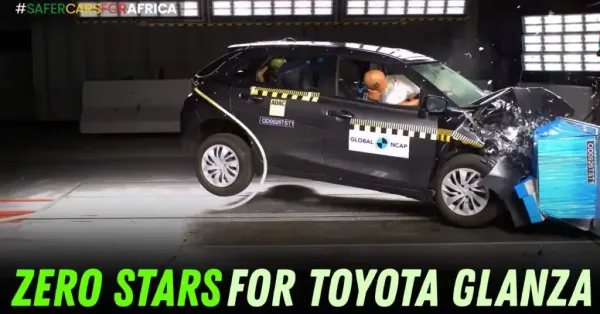
As per Global NCAP, the Toyota Starlet which was crash tested was the outgoing version, which had dual front airbags as standard and Electronic Stability Control (ESC) as standard. It did not have curtain airbags, side chest airbags, and side head protection airbags. In its official report, Global NCAP has highlighted that although the frontal impact protection was respectable.
The Starlet’s side impact performance showed an extremely high risk of head and chest injuries. This result is more worrying because the Toyota Starlet is one of the most popular hatchbacks in South Africa. It is popular amongst private buyers, as well as being a very common vehicle in rental and corporate fleets.
Global NCAP, however, has also confirmed that Toyota has already updated the South African-spec Starlet with additional airbags and the revised model, which is currently undergoing fresh crash testing.
As mentioned above, the Toyota Starlet sold in South Africa is based on the Maruti Suzuki Baleno platform. It is produced in India and exported to South Africa. In India, Maruti Suzuki sells it as the Baleno. Meanwhile, Toyota sells the rebadged version as the Glanza. As per the Global NCAP tests, the Starlet scored a 0-star rating in adult occupant protection tests.
It highlighted that the vehicle offered weak side impact protection, an unstable bodyshell structure, and it lacked side airbags. Additionally, the structural integrity of this vehicle is also a major concern, stated Global NCAP. The organisation stated that the footwell area was unstable, the bodyshell was unstable, and the structure was “not capable of withstanding further loadings”.
The frontal offset crash test offered some positive observations, as the driver head protection has been rated as adequate to good, and the same is the case for the passenger head protection. Meanwhile, the chest protection in frontal crashes has been rated adequate.
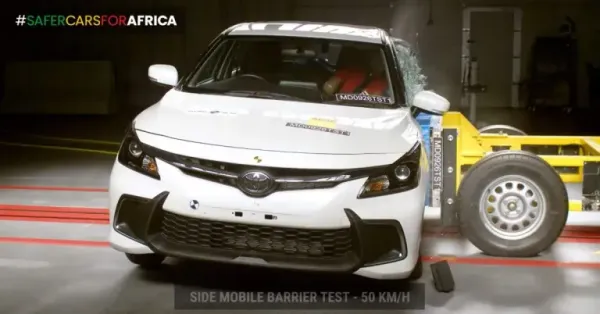
On the negative side, however, it has been highlighted that occupants could hit dangerous structures behind the dashboard fascia. Also, the structural instability is a major concern, even though frontal protection was relatively acceptable. Global NCAP highlighted that the side impact performance was the biggest issue of the outgoing Starlet.
In the side impact crash, it stated that the head protection was poor, and the chest protection has also been rated poor, along with abdomen protection rated adequate. Due to the absence of standard side head airbags, the side pole impact test was not conducted. Global NCAP has also specifically mentioned that there is an extremely high risk of head and chest injury during side crashes.
The Toyota Starlet, in the child occupant protection tests, managed to receive a decent 3-star rating. It scored 29.33 out of 49 points. It highlighted that the head of the 3-year-old dummy hit the vehicle interior, and the chest protection was low. Meanwhile, in the side impact, the head of the 3-year-old dummy was exposed to impact.
During the transportation and testing process of Global NCAP, Toyota informed the organisation that the Starlet is being updated for South Africa. The newly updated model now gets side head airbags, side body airbags, and additional safety features as standard. The updated version is already available in the South African market.
Global NCAP has also confirmed that it has anonymously purchased the revised model, and fresh crash testing will be conducted soon. After which, the results will allow consumers to compare both versions directly.
Richard Woods, Chief Executive Officer of Global NCAP, stated, “This is a shocking zero-star result from Toyota. The Starlet, one of the most popular cars sold in South Africa, had an unstable bodyshell, as well as poor head and chest protection, which are both a cause for serious concern.” He added, “Toyota has updated this model in the South African market. It now comes with new safety features fitted as standard. We welcome this improvement in safety equipment, and we will put the revised model to the test very soon.”
Meanwhile, Bobby Ramagwede, Chief Executive Officer of the Automobile Association of South Africa, stated, “The Toyota Starlet is one of South Africa’s most popular vehicles, and its poor performance in the GNCAP testing means that Starlet owners remain at risk of serious injury in the case of an accident.” He added, “These entry-level vehicles are also readily available in vehicle rental and corporate fleets, which further multiplies the risk to motorists. Safety equipment and vehicles that are manufactured to a high standard of structural safety should never be an optional extra or a feature that is reserved for markets outside of Africa, nor should manufacturers be hiding behind the unfortunate lack of stringent vehicle-safety legislation locally. You cannot put a price on the life of the South African consumer.”
-
June Horoscope 2026: 3 big Rajayoga are going to be formed in June, luck of these 4 zodiac signs will change, huge wealth will come home.

-
Aishwarya Rai and Aaradhya’s black twinning created a stir on the internet, Cannes look went viral

-
Are you troubled by the scattered kitchen utensils and utensils lying on the counter? These 8 magical gadgets will change the look of your kitchen in minutes

-
Hong Kong actress Charlene Choi dismisses breakup rumors weeks after marriage

-
Varun Dhawan in talks for Hollywood debut