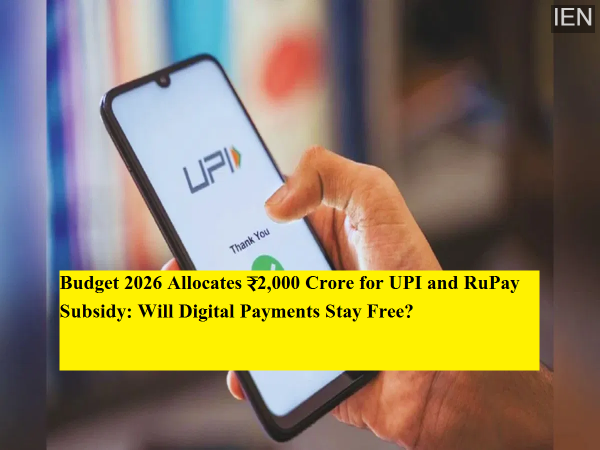
The Union Budget 2026–27 has once again brought digital payments into focus, with the central government announcing a ₹2,000 crore subsidy for low-value UPI and RuPay debit card transactions. While the allocation aims to support India’s rapidly growing digital payments ecosystem, it is lower than last year’s payout, triggering questions about the future of free UPI transactions.
UPI (Unified Payments Interface) has become the backbone of everyday digital payments in India, powering everything from grocery purchases and fuel payments to peer-to-peer transfers. The latest budget decision has therefore drawn close attention from banks, fintech firms, merchants, and millions of users who rely on UPI for zero-cost transactions.
What the Budget Announcement Says
For the financial year 2026–27, the government has earmarked ₹2,000 crore as subsidy for small-value digital transactions carried out through UPI and RuPay debit cards. In comparison, the government had paid ₹2,196 crore under the same scheme in the previous year.
This subsidy is paid to banks and payment service providers to compensate them for processing transactions without charging users or merchants any fees. The support is specifically designed to keep UPI and RuPay transactions affordable and widely accessible.
Who Gets the Benefit of This Subsidy
The subsidy applies only to transactions below ₹2,000. These include:
-
Small merchant payments
-
Daily retail purchases
-
Person-to-person transfers
-
Routine household expenses
By limiting the subsidy to low-value transactions, the government aims to ensure that digital payments remain inclusive, particularly for small merchants, kirana stores, and users in semi-urban and rural areas.
Why the Digital Payments Industry Is Concerned
Despite the continued support, the reduction in subsidy amount has raised concerns across the digital payments ecosystem. Industry stakeholders argue that UPI usage has expanded exponentially over the past few years, and infrastructure costs have increased accordingly.
Banks and payment companies incur expenses related to:
-
Technology infrastructure
-
Cybersecurity
-
Fraud prevention
-
Transaction processing
-
Customer grievance handling
With transaction volumes rising sharply, many industry players believe that lower subsidy support may put financial pressure on service providers, especially smaller banks and fintech firms.
Will UPI Transactions Stop Being Free?
For now, there is no announcement indicating that UPI transactions will become chargeable. The government has not proposed any user fee or merchant discount rate (MDR) for UPI payments in Budget 2026.
However, experts caution that if subsidy support does not keep pace with rising transaction volumes, banks and payment service providers may revisit their cost structures in the long term. Any future policy shift could potentially impact merchants or high-value transactions, though everyday users are unlikely to be affected immediately.
Government’s Broader Digital Payments Strategy
The government has consistently promoted digital payments as a key pillar of financial inclusion and transparency. UPI has been positioned as a public digital infrastructure, enabling seamless, low-cost payments across the country.
By continuing the subsidy—despite fiscal constraints—the government has signaled that free or low-cost digital payments remain a priority. At the same time, the reduced allocation reflects a balancing act between supporting innovation and managing budgetary pressures.
What This Means for Consumers and Merchants
-
Consumers: Small-value UPI transactions under ₹2,000 are expected to remain free in the near term.
-
Small merchants: Continued subsidy support helps keep acceptance costs low.
-
Banks and fintech firms: Margin pressure may increase if transaction volumes grow faster than subsidy support.
The digital payments sector believes that sustained government backing is crucial to maintaining trust, scalability, and seamless user experience.
The Road Ahead
India processes billions of UPI transactions every month, making it one of the world’s largest real-time payment systems. While the ₹2,000 crore subsidy ensures continuity, industry experts say future budgets may need to reassess funding levels to match the scale and importance of digital payments.
For now, UPI transactions remain free for users, but the debate over long-term sustainability and cost-sharing has clearly intensified following Budget 2026.
-
ABP LIVE Doc Talk | Monsoon Fever Isn't Always Dengue: Here's What You Need To Know

-
OPINION | How RBI's AI Governance Framework Could Strengthen Investor Trust
-
'1,100 Days In Custody, No Contact': Imran Khan's Son Seeks Global Help
-
Mikel Merino Shares Photo Of His Dog Wearing FIFA World Cup 2026 Winner's Medal After Spain's Triumph

-
'Ban NEET': MK Stalin Intensifies DMK’s Fight Against Medical Entrance Exam, Vows Campaign Will Continue Until Its Abolition