As India gears up to introduce the Global Navigation Satellite System (GNSS) that will replace the FASTag system, a notification from the Ministry of Road Transport and Highways (MoRTH) said owners of private vehicles with GNSS will be able to drive up to 20 km on national highways without paying any toll.
The toll will be only charged if the driving distance on national highways is more than 20 km, as per the new notification – National Highways Fee (Determination of Rates and Collection) Amendment Rules, 2024.
“A driver, owner or person in charge of a mechanical vehicle other than a National Permit vehicle who makes use of the same section of the national highway, permanent bridge, bypass or tunnel, as the case may be, shall be levied a zero-user fee up to twenty kilometres of the journey in each direction in a day under Global Navigation Satellite System based user fee collection system and if the distance travelled is more than twenty kilometres, then the fee will be charged for actual distance travelled,” the order issued by the ministry said.
What are the revised national highway fee rules?
Rule 6 of the 2008 regulations has been altered to create exclusive lanes at toll plazas for vehicles with GNSS devices, eliminating the need for them to stop for manual toll payment.
The ministry clarified that vehicles not registered in India or those without functioning GNSS devices will continue to be charged standard toll rates.
What is the Global Navigation Satellite System?
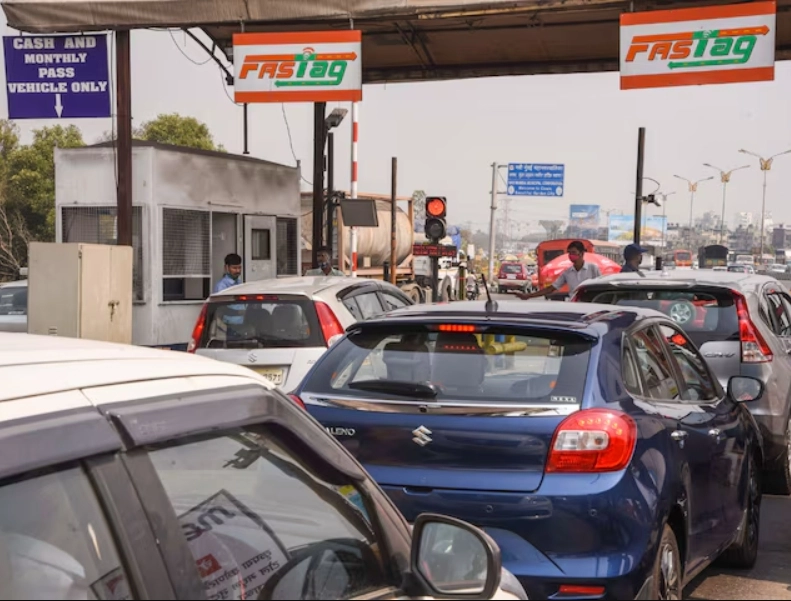
The GNSS will effectively end the use of FASTags while eliminating the need for toll plazas on national and state highways. It further claims to streamline the process as there would be no need to purchase a FASTag sticker and validate it.
The GNSS-enabled tags will transmit the location and speed data of the relevant vehicle to the centralized system. This will calculate the toll based on the distance travelled and speed at which this distance was covered.
Digital image processing records highway coordinates, while CCTV cameras installed on gantries ensure compliance by verifying vehicle positions, enabling seamless toll collection.
The system will initially be rolled out on key highways and expressways.
The onboard units (OBUs) or tracking devices will be available through government portals, similar to FASTags. They will need to be externally installed on vehicles, though manufacturers may begin offering vehicles with pre-installed OBUs. The toll charges will be deducted from the linked bank account based on the distance driven.
According to MoRTH, as of March 2024, more than 98% of user fee payments are made through FASTag at Toll Plazas.
What Can Be the Challenges?
While India can embrace digital technologies, significant infrastructure upgrades will be needed to make the transition to the GPS-based toll system.
India has about 6.67 million km of road network, which is the second largest in the world.
Meanwhile, the total toll length in the country has risen from 25,996 km in FY19 to 45,428 km as of November-end of FY24. Toll length stood at 29,666 km in 2019-20, 34,071 km in 2020-21, 38,315 km in 2021-22 and 42,595 km in 2022-23.
The replacement of the current FASTag infrastructure with the new system may potentially lead to higher toll costs for drivers.
Road Accidents in India
At the 64th annual conference in Delhi on September 10, Union Road Transport and Highways Minister Nitin Gadkari urged all stakeholders to focus on reducing road accidents in India.
“There are nearly 53 accidents and 18 deaths every hour in the country. Just imagine. 45% of the accidents because of two-wheelers, 20% in pedestrians,” HT Auto quoted Gadkari as saying to Original Equipment Manufacturers (OEMs) during SIAM’s annual event.
The ‘India Status Report on Road Safety 2024’, prepared by the TRIP Centre at IIT Delhi, analysed road safety in India, using data from FIRs from six states and audits of state compliance with Supreme Court directives on road safety governance.
It highlights disparities in road traffic deaths across states, including the vulnerability of motorcyclists and the high rate of fatal crashes involving trucks.
In 2021, road traffic injuries were the 13th leading cause of death in India and the 12th leading cause of health loss (measured in Disability-Adjusted Life Years, or DALYs). In six states (Haryana, Jammu and Kashmir and Ladakh, Punjab, Rajasthan, Uttarakhand, Uttar Pradesh), road traffic injuries ranked among the top 10 causes of health loss, according to a report by The Hindu quoting the TRIP Centre analysis.
Tamil Nadu, Telangana, and Chhattisgarh recorded the highest death rates, at 21.9, 19.2, and 17.6 per 1,00,000 people, respectively. In contrast, West Bengal and Bihar had the lowest rates, at 5.9 per 1,00,000 in 2021. Six states — Uttar Pradesh, Maharashtra, Madhya Pradesh, Karnataka, Rajasthan, and Tamil Nadu — account for nearly half of all traffic fatalities in India, the report said.
The most common victims of road accidents were pedestrians, cyclists and motorized two-wheeler riders, while trucks are responsible for the “highest proportion of impacting vehicles”, as per the report.
The report highlighted that most states lack basic traffic safety measures such as traffic calming, markings, and signage.
Where Does India Stand in Global Road Governance?
The report points out a comparison between India and developed countries such as Sweden and other Scandinavian countries. In 1990, an Indian was 40% more likely to die in a road accident than someone in these countries. By 2021, this figure had soared to 600%, indicating a sharp rise in road fatalities, the report added.
Given that two-wheeler riders, cyclists, and motorcyclists represent the majority of road fatalities, the report questions whether better-equipped vehicles with more advanced safety features are the solution.
-
Key details on HMRC personal tax allowance update after Reeves decision

-
'All lines closed' after incident at UK train station shuts down network

-
Investigation launched after United Airlines jet 'strikes light pole' during landing

-
Eternal's Triple Bet Faces Profitability Test
-
Fashion quote of the day - "Fashion is the armor to survive everyday life." — Bill Cunningham