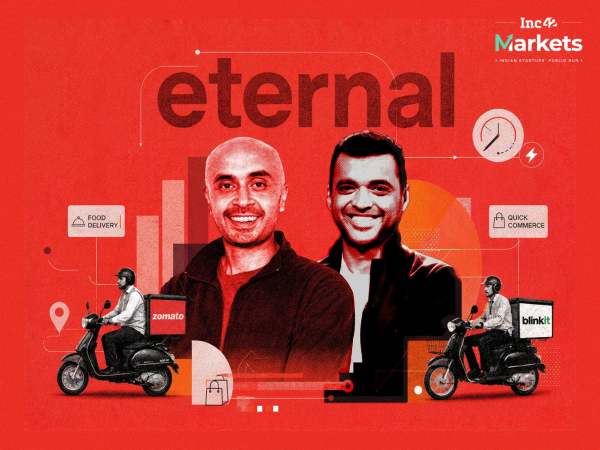
Deepinder Goyal stepped down as group CEO of Eternal, effective February 1, 2026, handing over the reins to Albinder Dhindsa. Over 18 years, Goyal built the company from scratch into a platform that processed over $10 Bn in transactions in FY26. With Dhindsa taking charge a few months ago, all eyes naturally were on the company’s Q4 FY26 results.
Eternal’s consolidated net profit surged 4.5X YoY to ₹174 Cr in Q4 FY26, up from ₹39 Cr a year ago. On a sequential basis, profit rose 71% from ₹102 Cr. Operating revenue jumped 196% YoY and 6% QoQ to ₹17,292 Cr. Including other income of ₹342 Cr, the total income stood at ₹17,634 Cr for the quarter.
The numbers in Dhindsa’s first results as CEO were strong, at least on the surface. Excluding other income, the company would have reported a loss for the quarter, highlighting the gap between headline growth and underlying profitability. Total expenses climbed a massive 185% YoY to ₹17,406 Cr.
Eternal’s Q4 FY26 numbers signal momentum, but also expose a structural tension at the heart of the business. While headline growth remains strong, profitability is increasingly dependent on non-operating income, even as costs surge alongside expansion.
Under Dhindsa, the company is balancing three distinct verticals, each at a different stage of maturity. While quick commerce is driving scale without meaningful margins, food delivery is steady but not a cash engine, and going-out remains an early, loss-making bet. For Dhindsa, it is going to be about translating scale into margins.
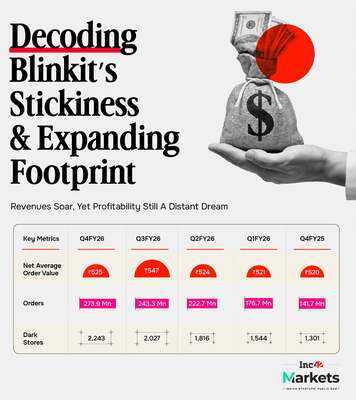
Blinkit’s Sprint Slows DownBlinkit remains the core of Eternal’s growth story. In Q4 FY26, it reported a net order value of ₹14,386 Cr, nearly doubling year-on-year. Monthly transacting users rose to 27.2 Mn, while its network of dark stores crossed 2,200.
At first glance, this looks like market leadership. But there are a few pressure points masked by the growth. For instance, despite its scale, Blinkit reported an adjusted EBITDA of just ₹37 Cr, with a margin of around 0.3%.
Average order value (AOV) has remained largely flat, even as order volumes have grown. At the same time, orders per store have not increased meaningfully. This suggests that growth is coming from adding more users and expanding the store network, rather than earning more from each customer or store.
As of now, Eternal has set a broader three-year goal of 60% CAGR for quick commerce, giving it room to adjust as the market evolves.
Food Delivery Is Holding SteadyZomato continues to be the foundation of Eternal’s business. It is growing steadily and maintaining stable contribution margins, even as competition and pricing pressures evolve.
But steady does not mean highly profitable. That is largely by design. Eternal is not focused on improving margins in the traditional sense.
“The objective is to optimise for growth of absolute profit, not the margin percentage,” Goyal said on the Q4 earnings call. In simple terms, the company is choosing to reinvest gains back into the business rather than maximise margins.
This approach shows up in pricing. Platform fees have gone up, but discounts are still being used carefully across select user segments and locations. The aim is to increase revenue per order while continuing to drive growth.
At the same time, Zomato is pushing into more affordable segments to bring in new users. It is testing lower minimum order values, especially for price-sensitive customers. But this comes with a trade-off. As more users place smaller orders, AOV remains under pressure.
As per industry experts, growth in food delivery is now being driven more by volume through discounts or low-priced needs, which keeps AOV low. Growth is coming more from changing consumer habits than from new demand.
Competition, meanwhile, remains largely stable. Market share has not shifted significantly, and Eternal does not see a need to respond aggressively.
Moreover, Zomato is not yet generating the kind of strong, consistent profits needed to fund Eternal’s newer bets. It remains a reliable business, but not the cash engine the company may eventually need.
District: Eternal’s Third BetEternal’s third vertical, District, has yet to ripen. In Q4 FY26, the going-out platform reported a net order value of ₹2,736 Cr, with revenue of ₹277 Cr, while posting an adjusted EBITDA loss of ₹81 Cr. Losses have reduced compared to the previous quarter, but not enough to change the broader picture.
Unlike Blinkit or Zomato, where usage is frequent and habit-driven, District operates in a more occasional category. Demand depends on movie releases, live events, and overall discretionary spending — all of which can fluctuate. The company acknowledges factors like “seasonality” and “different consumption patterns”, highlighting how uneven this business can be from quarter to quarter.
This uncertainty is shaping Eternal’s strategy. District is not being positioned as an immediate growth driver, and the company is not rushing into new categories. Experiments like Bistro are still early, while areas like travel are not a near-term focus. Instead, the emphasis is on improving execution, tightening unit economics, building stronger supply partnerships, and making demand more predictable.
The market for going out is already dominated by established players with strong supplier ties and brand recall.
But what District offers is better margin potential than quick commerce. Revenue streams such as commissions, advertising, and partnerships could make it more scalable over time.
“Quick commerce also faced scepticism early on, but is now seen as a strong opportunity. District is the next one to watch,” said Ambareesh Baliga, an independent market analyst.
Investors, for now, are willing to back this optionality, but cautiously. Most brokerages remain positive, though expectations are measured.
CLSA continues to hold a strong view, while Jefferies has retained a “Buy” rating on the stock despite lowering its price target, citing improving quick commerce profitability. Goldman Sachs sees near-term momentum from Blinkit and food delivery, while HSBC remains constructive but flags volatility. Macquarie has a more cautious stance on the company.
Baliga believes margins should not be the immediate concern. “PAT margins could rise to around 3% by FY28, driven by stronger consumer and brand stickiness. But Eternal still needs to deepen its presence in underserved markets and focus on reliability. It has to become the default choice for consumers — that’s when premium margins will follow,” he said.
With heavy investments continuing in quick commerce, margins will take time to improve. However, a sharper rise — a J-curve — could emerge around FY29 or FY30, Baliga added.
At the same time, competition is expected to intensify. As players like Amazon and Flipkart scale up in quick commerce, discounting could increase, putting pressure on existing players.
As Deepinder Goyal wrote in his shareholder letter, Eternal took 18 years to reach $10 Bn in annual net order value. The next doubling to $20 Bn is expected in less than two years. Profitability timelines are also compressing, with a target of $1 Bn in adjusted EBITDA by FY29. As of now, the mandate for Dhindsa is clear — scale faster, but build a more sustainable business.
MARKETS WATCH: NEW ISSUES, POST-IPO JOURNEY & MOREKissht IPO Sees Slow Start: The lending tech startup’s public issue saw a muted start and was subscribed 24% on Day 1, led by QIB interest as retail demand lagged. The ₹850 Cr issue values the company at ₹2,881 Cr, with proceeds aimed at strengthening its NBFC arm and supporting future growth plans.
IdeaForge Returns To Profit In Q4: The drone maker returned to profit in Q4 FY26 with ₹59.9 Cr PAT, driven by record revenue growth. Strong order execution, defence expansion into combat drones, and early global traction helped the dronetech firm narrow annual losses and signal a broader turnaround.
IndiaMART Profit Plunges 72%: the B2B ecommerce major’s Q4 FY26 profit plunged 72% YoY to ₹50.2 Cr, hit by higher costs and a loss in other income, despite steady revenue growth. Subscriber additions slowed after pricing changes, even as collections rose and AI-led platform improvements remained a key focus.
ICRA Downgrades Ola Electric’s OEM Arm: The ratings agency downgraded Ola the EV maker’s OEM arm, citing weak sales, revenue miss, and market share decline amid rising competition. While operations are stabilising, recovery in demand remains slow. The agency is positive on its battery unit, highlighting long-term strategic importance despite near-term risks.
Fino Payments Bank Profit Slumps 70%: The payments bank’s Q4 FY26 profit fell 70% YoY to ₹7.1 Cr amid a sharp drop in core revenues, especially digital payments. Despite higher deposits and CASA growth, sustained earnings pressure and weak fee income continued to weigh on its overall financial performance.
Edited by Shishir Parasher
Creatives by Varshita Srivastava
The post Eternal’s Triple Bet Faces Profitability Test appeared first on Inc42 Media.
-
No time to prepare the roast! Then make Crispy Onion Thalipeeth in 10 Minutes, Note Instant Recipe
-
New Glass Bridge in Telangana: Thrill and Employment Opportunities

-
Arunachalam Muruganantham became the world’s hero! ‘Padman’ nominated for Nobel Peace Prize
-
Zebronics Zeb-PixaPlay 77G Smart Projector Launched; You will get many best features

-
Emergency Alert- Alert will be received before earthquake or cyclone, indigenous emergency alert system launched