- End the licensing process
- Cars will be cheaper and safer
- The foundation of a self-driving future
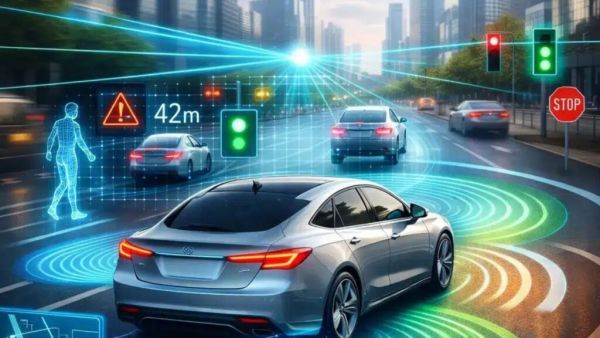
Self driving car technology India license rules : The central government has taken a revolutionary decision to take the automotive sector in India into a new and modern era. To increase safety on the country’s roads and make Indian vehicles world-class, the government has introduced the Automotive Radar System (Automotive Radar Systems) and state-of-the-art ADAS technology has completely removed the licensing requirement. According to the new rules issued by the Department of Telecommunications, vehicle companies will no longer need any government approval or lengthy licensing process for radar sensors operating in the 77 gigahertz (GHz) to 81 GHz frequency band. Although this decision may seem technical, it will change the car travel experience and safety of the common man in the future.
Until now, to introduce a radar-based safety system in any new vehicle in India, vehicle manufacturers (OEMs) had to go through a complicated maze of permits and approvals. The process used to waste huge amounts of time and money for the companies, which was directly borne in the pocket of the consumers who ultimately bought the car. Now that this complicated process is over, it will be easier to bring globally used advanced hardware directly to the Indian market. Due to this decision, it would not be wrong to say that India has taken a big leap in the automobile sector along with developed countries like America and Europe.
Click here to read news to world affairs: NEO brainchip: China’s ‘Mission Mind Control’! The first commercial brain-chip made by Elon Musk; Tested on 9 patients
ADAS will no longer be a luxury item, but a safety net for the common man
Until some time ago, the technology of ‘Advanced Driver Assistance Systems’ i.e. ADAS was limited only to Audi, Mercedes, BMW or very expensive and luxurious cars in the premium category. Radar-based features such as automatic emergency braking (braking automatically if someone suddenly comes in front of the car), adaptive cruise control (controlling its own speed according to the speed of the vehicle ahead) and blind spot monitoring (getting early warning of a vehicle around an unseen corner) are very useful. This technology works through precise coordination of radar sensors and cameras.
credit – social media and Twitter
One of the biggest positives of the removal of the stringent licensing requirement is that now automobile companies like Maruti Suzuki, Tata Motors, Mahindra and Hyundai can easily include these high-tech features in their mid-size SUVs and even affordable budget cars. In today’s highly competitive market, companies will now try to offer maximum security features at minimum cost to attract customers and survive the competition. This will directly benefit the common customers who will get to drive a safe car of international standards even in a low budget.
A strong foundation has been laid for driverless and automated cars
This decision is not only limited to the features in today’s vehicles but has been taken with great foresight considering the Indian transport system in the next decade. Along with radar systems, the government has also delicensed systems operating in the 5.9 GHz (GHz) band. This band supports vehicle-to-everything (V2X) communication. This simply means that vehicles plying on India’s roads in the future will not only drive, but will also be able to ‘communicate’ directly with each other and with roadside traffic signals or infrastructure.
For example, if there is an accident at the next turn or an ambulance is coming from behind, your car will already get a digital warning. This technology is considered to be the main foundation for future fully automatic i.e. Self-Driving Cars. This is a clear indication that the Indian government has opened the doors of the country to welcome this futuristic technology by simplifying the rules.
Click here to read news to world affairs: Project Nimbus: Rada at Stanford University during Google CEO Sundar Pichai’s speech; Hundreds of students boycotted the meeting
Government’s ‘masterstroke’ to control road accidents
The statistics of road accidents in India are very shocking and alarming. According to an official statistics, nearly 500,000 road accidents occur in the country every year and unfortunately more than 1,77,000 people lose their lives. Often these accidents occur due to human error, fatigue or lack of visibility of the road at night. In such situations, ADAS and radar sensors provide an additional layer of safety, where human vision or responsiveness is impaired, these sensors make split-second decisions to avoid accidents.
This historic policy will not only give Indian companies such as Tata, Maruti or Mahindra, but also global technology suppliers like Bosch and Qualcomm a great opportunity to research and manufacture in India. Eased regulations and reduced costs will accelerate the development of a ‘Safer Car Culture’ in India, saving thousands of innocent lives.
-
The potential of geothermal energy for US homes

-
Bengal: CBI team visits RG Kar Hospital to have a relook at rape-murder case
-
JEECUP 2026 Result Date: Candidates with low scores in the UP Polytechnic exam will also get an opportunity for admission..

-
The altered version of the 'Dancing Girl' of Mohenjo-daro in the new NCERT Class 9 Art Education book..

-
Ration Dealer Not Giving Full Food Grains? Here's How You Can File a Complaint Easily