Why Are ATMs Running Dry When India Has Over ₹42 Lakh Crore in Cash?
In recent weeks, many bank customers across India have encountered a familiar but frustrating sight: "No Cash" notices displayed outside ATMs. The growing number of cash shortages has raised concerns among the public, especially in areas where digital payment options are not always convenient.
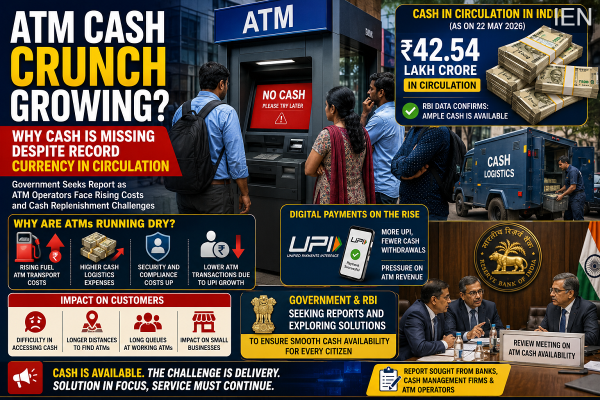
What makes the situation puzzling is that India is not facing a shortage of currency. According to data from the Reserve Bank of India (RBI), the total currency in circulation reached approximately ₹42.54 lakh crore as of May 22, 2026. This indicates that sufficient cash exists within the financial system, yet many ATMs are struggling to remain stocked.
The issue has prompted discussions among banks, service providers, regulators, and government authorities, who are now examining the reasons behind the growing gap between available cash and ATM accessibility.
Cash Is Available—So Why Are ATMs Running Empty?
The current challenge is not a lack of currency but a disruption in the process of moving cash from banks to ATM machines.
A significant portion of ATM operations depends on specialized cash management and cash-in-transit (CIT) companies. These firms are responsible for transporting cash securely from bank vaults to ATM locations across the country.
Industry experts say that rising operational expenses have made this process increasingly difficult. As a result, cash replenishment cycles are being affected, causing some ATMs to run out of money more frequently than before.
Rising Costs Are Putting Pressure on Service Providers
One of the major factors behind the problem is the increasing cost of ATM cash management.
Several expenses have risen sharply over the past few years, including:
-
Fuel and transportation costs
-
Security expenses
-
Vehicle maintenance
-
Cash handling operations
-
Employee salaries and compliance requirements
The implementation of labor-related reforms and higher operating costs have further increased financial pressure on companies involved in ATM cash logistics.
These additional expenses have reduced profitability for cash management firms, making ATM servicing more challenging in certain regions.
Digital Payments Are Changing the Economics of ATMs
India's rapid adoption of digital payments has transformed consumer behavior.
Platforms based on Unified Payments Interface (UPI) have become the preferred payment method for millions of users. While this shift has accelerated financial inclusion and convenience, it has also reduced the number of cash withdrawals at many ATM locations.
For ATM operators, lower transaction volumes can translate into reduced revenue.
As maintenance, rent, security, and operational costs continue to rise, some operators are finding it increasingly difficult to recover expenses from ATM operations alone.
This changing economic model is creating challenges for maintaining large ATM networks, especially in low-usage areas.
Impact on Customers
The consequences of these operational challenges are being felt directly by consumers.
People who rely heavily on cash transactions may face:
-
Difficulty accessing cash during emergencies
-
Longer travel distances to locate functioning ATMs
-
Increased waiting times at busy machines
-
Inconvenience in semi-urban and rural areas
Small businesses, local traders, and individuals who depend on cash for daily transactions may be particularly affected if ATM cash shortages become more frequent.
Government and RBI Monitoring the Situation
With complaints regarding ATM cash availability increasing, authorities are paying closer attention to the issue.
Government agencies and banking regulators are reportedly assessing the challenges faced by ATM operators and cash logistics companies. The objective is to identify solutions that ensure uninterrupted cash availability for the public.
Industry stakeholders have suggested that operational costs, service charges, and ATM business models may need to be reviewed to make cash distribution more sustainable.
Is India Facing a Cash Crisis?
Experts emphasize that the current situation should not be mistaken for a nationwide cash shortage.
The RBI's data clearly indicates that ample currency remains in circulation across the country. The challenge lies in efficiently transporting and replenishing that cash at ATM locations.
In other words, the issue is largely one of distribution and operational economics rather than an actual lack of money within the banking system.
What Happens Next?
As digital transactions continue to grow, the banking sector faces the challenge of balancing modern payment systems with traditional cash requirements.
While UPI and online payments are becoming increasingly popular, millions of Indians still depend on cash for everyday expenses. Ensuring reliable ATM services remains an essential part of the country's financial infrastructure.
The government, RBI, banks, and service providers are expected to explore measures that can improve ATM cash management and maintain smooth access to cash for consumers. Until then, occasional "No Cash" signs at ATMs may continue to be a concern for many users across the country.
-
Fake citations, nonexistent studies: Five times AI hallucinations put governments in a spot

-
8th Pay Commission: When Will Salaries Actually Rise? Expected Timeline for Fitment Factor and Pay Hike Explained

-
What this boy did during martial arts training in an Indian school is winning hearts online; many say it is great upbringing: Watch

-
Why Are Bank Lockers in High Demand Across India? The Real Reasons Behind the Surge
-
Best Post Office Schemes Offering High Interest Rates in 2026: Safe Investments With Strong Returns