
More Than 11 Million Central Government Employees and Pensioners Are Waiting for the Next Major Salary Revision
The 8th Pay Commission remains one of the most closely watched developments for central government employees and pensioners across India. With discussions around the fitment factor, revised pay scales, and pension increases gaining momentum, millions are eager to know when the final recommendations could arrive and when higher salaries may start reflecting in their bank accounts.
While expectations are high, historical trends suggest that employees may still need to wait some time before the new salary structure becomes a reality. A look at the timeline of previous pay commissions offers useful clues about what may happen next.
Why the 8th Pay Commission MattersThe Central Pay Commission is generally constituted once every decade to review the salaries, allowances, and pension benefits of central government employees.
Its recommendations aim to:
-
Align salaries with inflation and economic conditions
-
Improve employee welfare
-
Revise pension structures
-
Maintain competitiveness in public sector compensation
Since these revisions affect millions of households, every recommendation carries significant financial implications.
Looking Back at the 7th Pay CommissionUnderstanding the timeline of the 7th Pay Commission helps estimate when the next major salary revision could take shape.
The 7th Pay Commission was constituted on February 28, 2014. However, it took approximately 21 months to complete its review process and submit its final report.
The commission eventually presented its recommendations on November 19, 2015.
The experience showed that preparing salary revision proposals, consulting stakeholders, analyzing economic data, and finalizing recommendations can be a lengthy process.
Timeline of the 8th Pay CommissionThe 8th Pay Commission was constituted on November 3, 2025.
According to the government's mandate, the commission has been given approximately 18 months to prepare and submit its report.
Based on this schedule:
-
Formation Date: November 3, 2025
-
Expected Completion Period: 18 months
-
Tentative Submission Timeline: May 2027
However, if the commission follows a timeline similar to the previous pay commission, the process could take slightly longer.
Some projections suggest the final report could be submitted around mid-2027, potentially extending into July 2027.
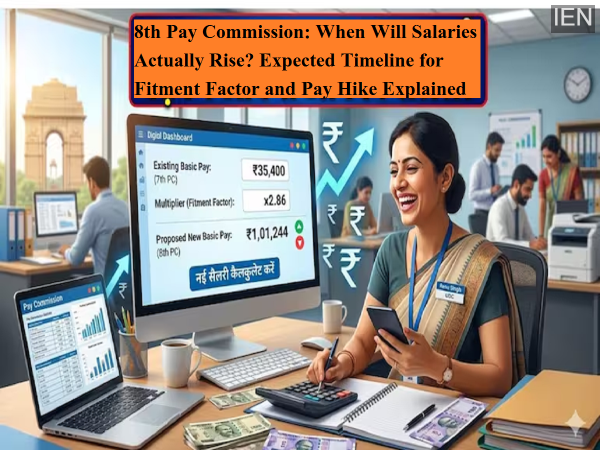
What Is the Fitment Factor?For government employees, the fitment factor is one of the most important elements of any pay commission.
It is a multiplier used to convert an employee's existing basic salary into a revised pay structure.
The formula is straightforward:
New Basic Pay = Existing Basic Pay × Fitment Factor
The higher the fitment factor, the larger the increase in basic salary.
How the 7th Pay Commission Changed SalariesUnder the 7th Pay Commission, the fitment factor was fixed at 2.57.
As a result:
-
Minimum basic salary increased from ₹7,000
-
Revised minimum basic salary became ₹18,000
This single multiplier significantly reshaped the salary structure of central government employees.
What Fitment Factor Could Be Expected This Time?As of now, no official fitment factor has been finalized for the 8th Pay Commission.
However, various employee organizations, analysts, and media reports have discussed a wide range of possibilities.
Current estimates suggest the multiplier could fall anywhere between:
-
2.28
-
2.57
-
2.86
-
3.00
-
Up to 3.83 in some projections
The final figure will ultimately depend on:
-
Inflation trends
-
Fiscal considerations
-
Government finances
-
Employee demands
-
Economic growth conditions
Because the fitment factor directly determines salary increases, it remains the most closely monitored aspect of the commission's work.
Salary Revision Methods Have Changed Over TimeInterestingly, the concept of a fitment factor was not always used in the way it is today.
Earlier Pay Commissions relied on more complex methods involving:
-
Pay rationalization
-
Merger of Dearness Allowance (DA) with basic pay
-
Cost-of-living assessments
-
Wage structure reviews
Over time, the fitment factor evolved into a simpler and more transparent mechanism for determining revised pay scales.
Although the methodology has changed, the primary objective remains the same: ensuring government employees receive compensation that reflects economic realities and inflationary pressures.
Who Will Be Affected?The recommendations of the 8th Pay Commission are expected to impact more than 1.1 crore beneficiaries.
This includes:
-
Central government employees
-
Pensioners
-
Family pension recipients
-
Dependent family members indirectly benefiting from higher income
Given the large number of people involved, the commission's recommendations are likely to have a substantial effect on consumer spending and the broader economy.
When Can Employees Expect Higher Salaries?Based on current timelines, employees may have to wait until 2027 for clarity on the final fitment factor and revised salary structure.
Once the commission submits its report, the government will review the recommendations before taking a final decision on implementation.
While speculation continues regarding the exact salary increase, the official fitment factor and revised pay scales will only become clear after the commission submits its recommendations and the government announces its implementation plan.
For now, central government employees and pensioners will be closely watching developments as the 8th Pay Commission moves toward one of the most important salary revisions of the decade.
-
Indian Men's Hockey Team Falls Short Against Netherlands in Close Match

-
DG Shipping directs firms to restrict deployment of Indian seafarers in Gulf zone
-
Meet Swara Jadhav: The 13-Year-Old Spinner Taking Mumbai Cricket by Storm

-
Tu Hi Re Dil Mein actor Abrar Qazi gets candid about his role; says 'Playing a good character is tough since one has to bring authenticity'

-
Viswanathan Anand's son Sai Akhil Anand showcases art inspired by nature in Bengaluru