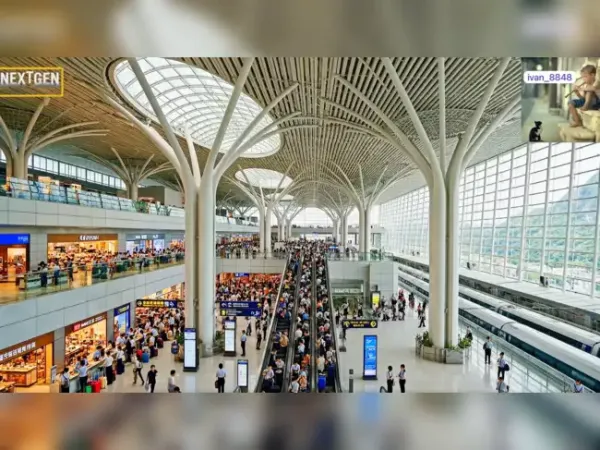
China has completed the construction of the Chongqing East Railway Station in just 38 months with the help of robot army on the top of a mountain, a project being described as the world’s largest high-speed railway station by area.
ALSO READ: 'Not fond of Indians': Taiwan candidate Lee Hung-Yi's billboards banning turban man, upside-down Indian flag spark concern
Located in Chongqing in southwest China, the mega station spans around 1.2–1.22 million square metres and has been developed as a major high-speed rail hub. The project cost is estimated at around $7.8 billion, according to reports shared on social platforms and media updates.
ALSO READ: Santy Sharma says Cockroach Janata Party 'feels more like internet drama than a serious movement'
According to reports and visual updates shared online, the terrain was mapped in 3D before excavation. Controlled blasting was also used to remove sections of rock, while extensive groundwork prepared the site for construction.
Welding robots and 24-hour monitoring robots were also used on-site, while AI-enabled systems helped improve efficiency, reduce labour costs, and speed up operations.
One of the most complex engineering steps involved the station roof. A 16,500-tonne steel roof structure was first assembled at ground level and then hydraulically lifted and slid 57 metres upward into position.
The roof rests on massive 41-metre tree-shaped steel columns, known as “Huangjue” columns, designed to improve earthquake resistance and structural stability. Stainless steel cladding was also installed at heights of nearly 57 metres along the mountain slope.
Once fully operational, it is expected to become one of the most important transportation hubs in China’s high-speed rail system and a symbol of large-scale infrastructure engineering.
ALSO READ: 'Not fond of Indians': Taiwan candidate Lee Hung-Yi's billboards banning turban man, upside-down Indian flag spark concern
Located in Chongqing in southwest China, the mega station spans around 1.2–1.22 million square metres and has been developed as a major high-speed rail hub. The project cost is estimated at around $7.8 billion, according to reports shared on social platforms and media updates.
ALSO READ: Santy Sharma says Cockroach Janata Party 'feels more like internet drama than a serious movement'
Built on a mountain, not flat land
One of the most remarkable aspects of the project is its location. The station was built on mountainous terrain, requiring engineers to first cut, level and reshape an entire mountain before construction could begin.According to reports and visual updates shared online, the terrain was mapped in 3D before excavation. Controlled blasting was also used to remove sections of rock, while extensive groundwork prepared the site for construction.
Massive capacity and scale
The station features 29 platforms and 15 railway tracks and is designed to handle up to 16,000 passengers per hour during peak periods. It also has a multi-level structure with up to eight floors, according to news agency Xinhua. The platforms are more than 400 metres long, designed to accommodate extremely long high-speed trains as part of China’s expanding rail network.Advanced robotics and AI used in construction
The project used advanced technology, including AI systems, 5G networks, and multiple types of construction robots. Laser-guided screed robots were deployed to level concrete surfaces with high precision. Glass installation robots lifted and positioned panels weighing up to 800 kg, improving speed and reducing accident risk significantly.Welding robots and 24-hour monitoring robots were also used on-site, while AI-enabled systems helped improve efficiency, reduce labour costs, and speed up operations.
Mega engineering feats
The construction used nearly 2 million cubic metres of concrete and around 366,000 tonnes of steel, with approximately 40,000 workers involved at peak construction, according to reports.One of the most complex engineering steps involved the station roof. A 16,500-tonne steel roof structure was first assembled at ground level and then hydraulically lifted and slid 57 metres upward into position.
The roof rests on massive 41-metre tree-shaped steel columns, known as “Huangjue” columns, designed to improve earthquake resistance and structural stability. Stainless steel cladding was also installed at heights of nearly 57 metres along the mountain slope.
Key transport hub in China’s rail network
The Chongqing East Station is part of China’s expanding high-speed rail network and will connect southwest China to 14 major cities, including Chengdu, Wuhan, Xi’an, Kunming, Beijing, Shanghai, Guangzhou, Changsha and Zhangjiajie.Once fully operational, it is expected to become one of the most important transportation hubs in China’s high-speed rail system and a symbol of large-scale infrastructure engineering.