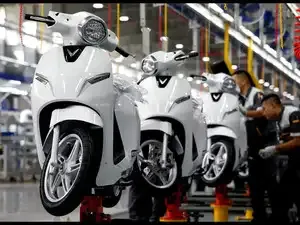
Mumbai: Expensive petrol is doingwhat years of incentives and climate messaging could not — nudging urban Indian households towards owning at least one electric vehicle (EV).
As the West Asia conflict stokes fuel price rise and volatility in crude markets, India’s EV story is getting a boost. While the broader automobile market weakens, there are signs of renewed traction for electric two-wheelers.
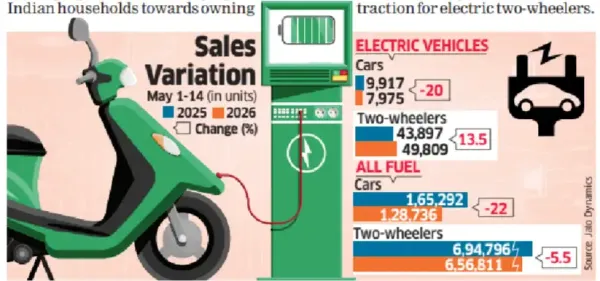 In the first fortnight of May, electric two-wheeler registrations rose 13.5%on-year, while overall two-wheeler sales fell 5.5%. EVs are gaining share in a shrinking market. What is changing this time is behaviour. “Till recently, it was held that every house should have a petrol vehicle,” said Ravneet Singh Phokela, chief business officer at Ather Energy.
Also read: Rs 3 a litre fuel price hike cuts losses by 25 per cent; daily loss drops to Rs 750 crore
“Now, it is to have at leastone EV in the house,” said Phokela of Ather.
Increasingly, the EV is not replacing the primary family car, but it is becoming the second vehicle in multi-car households. The use case is clear: short, repetitive urban trips where fuel costs are most visible.
“For a household that already has one petrol vehicle,the second vehicle is increasingly an EV scooter for the daily school run, office commute or grocery trip,” said Vasudha Madhavan, founder of Ostara Advisors, an electric mobility-focused investment bank. “You charge overnight, skip the petrol pump, and at roughly 30–50 paise a km, the running cost math just becomes hard to argue with,” she said.
This week’s latest Rs 3 hike in petrol prices just gave another fillip to that argument. India imports 87% of its crude oil needs, so domestic fuel prices remain exposed to geopolitical shocks and supply disruptions. The ripple effects are now visible beyond vehicle demand. Consultants and charging ecosystem companies say entrepreneurs and mid-sized traders in metro cities are actively evaluating EV charging franchises, with investments usually in the Rs 30–40 lakh range.
Also read: State Banks & insurers told to cut global travel, switch to EVs in austerity push
“Many are looking at it seriously because there is a visible gap in charging infrastructure,” said a consultant advising charging operators.
According to Jato Dynamics, total EV registrations hit 1.97 million units in FY25, up 16.9% YoY. But the growth is uneven, concentrated in scooters and fleet led segments, while passenger electric cars remain constrained. “There are enquiries and an uptick in demand for EVs,” said Sai Giridhar of the Federation of Automobile Dealers Association.
Passenger EV adoption continues to be held back by pricing. Industry executives concur that there are still too few compelling electric cars below the Rs 10 lakh threshold, where India’s mass-market demand is concentrated. “The real traction is happening between Rs 15 lakh and Rs 30 lakh,”said Ravi Bhatia, president, Jato Dynamics. “Until a genuinely compelling electric hatchback arrives where India’s largest buyer cohort actually shops, the passenger car transition will remain largely an upper-middle class phenomenon.”
Even where demand exists, execution hurdles remain. In major cities, housing societies are increasingly becoming a bottleneck for EV adoption, with residents struggling to install home chargers.
As the West Asia conflict stokes fuel price rise and volatility in crude markets, India’s EV story is getting a boost. While the broader automobile market weakens, there are signs of renewed traction for electric two-wheelers.
More households opting for at least 1 electric vehicle for short trips; e-scooters in demand
Also read: Rs 3 a litre fuel price hike cuts losses by 25 per cent; daily loss drops to Rs 750 crore
“Now, it is to have at leastone EV in the house,” said Phokela of Ather.
Increasingly, the EV is not replacing the primary family car, but it is becoming the second vehicle in multi-car households. The use case is clear: short, repetitive urban trips where fuel costs are most visible.
“For a household that already has one petrol vehicle,the second vehicle is increasingly an EV scooter for the daily school run, office commute or grocery trip,” said Vasudha Madhavan, founder of Ostara Advisors, an electric mobility-focused investment bank. “You charge overnight, skip the petrol pump, and at roughly 30–50 paise a km, the running cost math just becomes hard to argue with,” she said.
This week’s latest Rs 3 hike in petrol prices just gave another fillip to that argument. India imports 87% of its crude oil needs, so domestic fuel prices remain exposed to geopolitical shocks and supply disruptions. The ripple effects are now visible beyond vehicle demand. Consultants and charging ecosystem companies say entrepreneurs and mid-sized traders in metro cities are actively evaluating EV charging franchises, with investments usually in the Rs 30–40 lakh range.
Also read: State Banks & insurers told to cut global travel, switch to EVs in austerity push
“Many are looking at it seriously because there is a visible gap in charging infrastructure,” said a consultant advising charging operators.
According to Jato Dynamics, total EV registrations hit 1.97 million units in FY25, up 16.9% YoY. But the growth is uneven, concentrated in scooters and fleet led segments, while passenger electric cars remain constrained. “There are enquiries and an uptick in demand for EVs,” said Sai Giridhar of the Federation of Automobile Dealers Association.
Passenger EV adoption continues to be held back by pricing. Industry executives concur that there are still too few compelling electric cars below the Rs 10 lakh threshold, where India’s mass-market demand is concentrated. “The real traction is happening between Rs 15 lakh and Rs 30 lakh,”said Ravi Bhatia, president, Jato Dynamics. “Until a genuinely compelling electric hatchback arrives where India’s largest buyer cohort actually shops, the passenger car transition will remain largely an upper-middle class phenomenon.”
Even where demand exists, execution hurdles remain. In major cities, housing societies are increasingly becoming a bottleneck for EV adoption, with residents struggling to install home chargers.