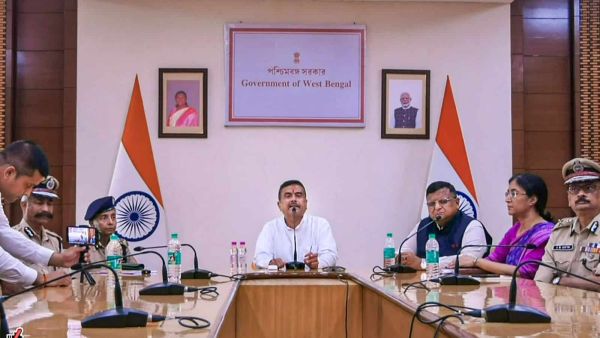
Kolkata: Signalling a sharp policy shift, the West Bengal cabinet on Monday, May 18, decided to discontinue religion-based assistance to imams and others, roll out the ‘Annapurna’ financial support scheme for women and set up two panels to look into cases of corruption and crimes against women during the TMC rule.
The cabinet, chaired by Chief Minister Suvendu Adhikari, also approved free travel for women on government-run buses, the scrapping of the existing state OBC list and the constitution of the Seventh State Pay Commission to revise state employees’ salaries upward.
Announcing the state government’s decisions, Women, Child, and Social Welfare Minister Agnimitra Paul said all decisions will take effect starting June 1.

Later, Adhikari announced the formation of two commissions headed by retired judges of the Calcutta High Court to probe alleged institutional corruption and atrocities against women and girl children during the previous TMC regime. The chief minister said the panels would also begin functioning starting June 1.
Religion-based schemes discontinued, scholarships exempted
“The cabinet has approved the discontinuation of schemes based on religious categorisation. A notification on this will be issued,” Paul said. She, however, added that none of the existing scholarship schemes for students would be discontinued.
Following a Rs 500 hike in honorarium for religious leaders by the erstwhile Mamata Banerjee government in March this year, Imams of registered mosques in Bengal were granted a monthly stipend of Rs 3,000, while muezzins and purohits were provided Rs 2,000.
According to a notification from the previous TMC-led government, the assistance to religious leaders -sanctioned under budgetary provisions of the Departments of Information and Cultural Affairs, and Minority Affairs and Madrasa Education- aimed to support their socio-economic standing.
Women get Rs 3,000 monthly assistance, free buses
Acting on the BJP’s pre-poll promises of enhanced financial assistance for Bengal’s women, the cabinet approved the ‘Annapurna’ scheme, which provides Rs 3,000 in monthly support. This scheme will replace the Mamata Banerjee government’s existing Lakshmir Bhandar scheme, which offers Rs 1,500 in monetary assistance to women. “Those currently receiving assistance under the previous government’s Lakshmir Bhandar scheme will be automatically entitled to the Annapurna Yojna. There is no need to reapply for it. Money will be sent through direct bank transfer,” Paul said.
The government would soon launch a web portal to facilitate fresh applications for the programme from those who had yet to receive the assistance, she added.
“Women who applied for citizenship under the CAA and those who approached the tribunals for inclusion of names in voter rolls will also be entitled to receive the Annapurna scheme benefit,” the minister clarified.
Paul said the cabinet approved a proposal allowing free travel for women on government-run buses starting June 1, but added there were no immediate plans to increase the fleet size.
Panel to probe corruption, atrocities against women
Later, while announcing the twin panels, Adhikari said, “We took these decisions in the cabinet today. During the election period, Union Home Minister Amit Shah had declared a chargesheet against the previous state government. There were two commitments made in the larger public interest of the people of the state.”
Adhikari said that the panel to probe institutional corruption will be headed by retired Calcutta High Court judge Justice Biswajit Basu, with an ADG-rank IPS officer, Jayraman, as member secretary.
He said the panel would examine alleged irregularities in central and state welfare schemes, public construction works and service delivery systems.
“It will look into corruption, cut money, bribery, misappropriation of government funds and cases where common people have been cheated. Government officials, panchayat representatives, brokers, contractors, NGOs and cooperative bodies will all come under its ambit,” Adhikari said.
He said complaints could be filed by members of the public and agencies involved in public works, and recommendations are expected within 30 days of the commencement of work.
“Based on their recommendations, FIRs will be registered, and action will be taken under the Bharatiya Nyaya Sanhita (BNS). We will also try to recover misappropriated government funds,” he said.
The other panel, which will investigate atrocities against women and girl children, will be chaired by retired judge Justice Samapti Chatterjee, with IPS officer Damayanti Sen as member secretary.
“This commission will look into atrocities committed over the past several years in the state, particularly against women and children, including those from SC, ST and minority communities,” Adhikari said.
He said the commission would operate a dedicated complaint system, including a portal, WhatsApp and email channels, and would also take up pending FIRs and general diary entries.
“The members will conduct field visits to police stations and districts, record statements and hold public hearings at the local level,” he said.
Adhikari said the commission would also examine pending recommendations of institutions, including the National Human Rights Commission and other constitutional commissions, and could recommend reopening of cases, fresh FIRs, supplementary chargesheets and stronger prosecution measures where necessary.
Existing OBC list cancelled
Meanwhile, Paul said that the new BJP government would cancel the existing OBC list of the state in accordance with a 2024 Calcutta High Court judgment.
“The cabinet has decided on a revision of the state list of the OBCs, in cancellation of such categorisation of classes in such list and percentage of reservation for OBCs in the services and posts under the Government of West Bengal, as per the judgment of a division bench of the Calcutta High Court on May 22, 2024,” she said.
The minister announced that the state will set up a panel to decide quota eligibility under the OBC category.
The state’s OBC list controversy centres on the inclusion of 77 communities, 75 of which are Muslim, into the state’s Other Backwards Classes (OBC) list, a process initiated during the TMC regime.
The decision sparked major political and legal battles, with the Calcutta High Court striking down the notice and invalidating nearly 5 lakh caste certificates issued by the state since 2010.
Seventh State Pay Commission to increase state employees’ salaries
On the constitution of the Seventh State Pay Commission for upward revision of salaries of its employees, Paul said the scope of pay hike would also extend to the staff of statutory entities like civic bodies, local bodies, education boards and those working in state-run education institutions.
“The details of the commission’s set-up will be duly notified,” she said, without specifying its date of implementation.
In his pre-election campaigns, Prime Minister Narendra Modi had pledged that the new pay commission would be implemented within 45 days of the formation of the BJP government in Bengal.
She, however, confirmed that the issue of granting increased dearness allowance (DA) to state employees was not on the agenda of Monday’s meeting.
-
The modern innovations of the 20th century that give Kannauj attars their famed fragrances
-
Southwest monsoon to reach Kerala around May 26: IMD

-
Jennifer Paes: Much more than just tennis icon Leander's mother

-
Investigation Launched After Missing Ballot Papers in Himachal Pradesh Elections

-
Police Capture Drug Trafficker with Heroin in Nurpur