The roughly 40-km trip currently takes two to three hours under heavy congestion, a chronic problem on the Ho Chi Minh City-Long Thanh-Dau Giay Expressway and National Highways 1 and 51, the main routes between the city and the country’s biggest-airport-to-be.
Long Thanh, a VND336.63 trillion (US$12.8 billion) project that broke ground in 2021 on more than 5,000 hectares in Dong Nai, is scheduled to begin commercial operations by the end of this year. Once fully operational, it is projected to handle around 80% of international passenger traffic for the HCMC area, relieving pressure on the overstretched Tan Son Nhat airport in the city center.
But its biggest obstacle has long been connectivity. Without faster routes into HCMC, Vietnam’s flagship aviation project risks the isolation problem that has dogged airports built far from urban cores elsewhere in the world.
A cluster of road projects is now lining up to close that gap. The Bien Hoa-Vung Tau Expressway has begun temporary operation on the section from the Long Thanh interchange to Vung Tau, and the entire route opens in May.
Ho Chi Minh City Ring Road 3 is expected to be largely complete and in operation by June. The Ben Luc-Long Thanh Expressway is being accelerated to open in full by September. The existing Ho Chi Minh City-Long Thanh-Dau Giay Expressway is being expanded from 4 to 8-10 lanes, with most components wrapping up by the end of 2026 and the gating Long Thanh Bridge section finishing in the second quarter of 2027.
“With this series of projects completed, the connection from central administrative Ho Chi Minh City to Long Thanh airport will take only about 30 minutes,” Tuan said at an oversight session on May 14.
He added that the corridor between HCMC and Dong Nai is critical, serving roughly 75% of the airport’s passenger traffic.
|
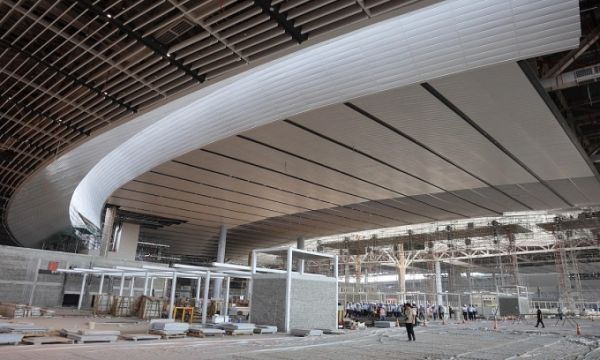
Inside the unfinished Long Thanh airport passenger terminal on the morning of May 14, 2026. Photo by Read/Phuoc Tuan |
The 30-minute target was set by Party General Secretary To Lam during a working session in HCMC on Feb. 9, when the country’s top leader warned that the airport’s development must move in step with synchronized transport infrastructure.
Beyond the expressways, local authorities are advancing investment procedures for two metro lines that would eventually give travelers a rail option into the airport: the Thu Thiem-Long Thanh line and the Suoi Tien-Bien Hoa-Long Thanh line. The metro projects, however, are not expected to be operational until the 2030s.
At the May 14 session, Vu Pham Nguyen An, director of the Long Thanh Airport Project Management Board, said the airport’s main contract packages have been rescheduled to meet the revised end-of-2026 completion target. About 95% of imported equipment has been delivered to the site, and 80% has been installed.
The passenger terminal alone has about 3,000 engineers and workers on site, but current staffing meets only 60% of demand, An said. Contractors are also facing rising fuel costs that have squeezed margins.
Long Thanh is designed to become one of Southeast Asia’s major aviation hubs, eventually handling 100 million passengers and 5 million metric tons of cargo a year across three planned construction phases. The first phase will handle 25 million passengers annually.
-
Women’s T20 World Cup 2026: Pakistan team announced for T20 World Cup 2026, captain making fifty on 15 balls

-
Feeling of electric current after touching metallic things in office, number of patients increased, understand in the video, doctors told these reasons.

-
IRCTC’s explosive Kashmir tour package, travel from Srinagar to Pahalgam in just Rs 30 thousand, know how to book?

-
How did puja happen in ‘Bhojshala’ after the court’s decision, what did people say?

-
BMW’s craziest SUV yet? XM soundmachine comes with rooftop DJ stage and massive speakers