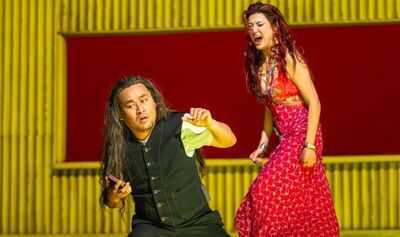
Samson et Dalila (whom we know better as Delilah) is a curiously patchy work by the French composer Camille Saint-Saëns. Written in 1893, it was originally conceived as an Oratorio, sung but not acted, but it was immediately turned, rather unconvincingly, into a fully-staged opera. Richard Jones' 2022 production, of which this is the first revival, shows clear signs of this confused origin.
The Old Testament Book of Judges tells the story of Delilah's love then betrayal of the Israelite hero Samson, tricking him into revealing the source of his great strength so that he can be captured by the Philistines. Curiously, the story told in the opera is a shortened and simplified version of the Biblical tale and together with the mostly undramatic music of Saint-Saëns, this offers little in the early acts to capture the attention of the audience.
The exception to this lies in the glorious singing and acting of the title roles, South Korean tenor SeokJong Baek and Russian soprano Aigul Akhmetshina. Unusually for a tenor, Baek began his operatic career as a baritone but exploited his impressive higher range, retraining as a tenor. Usually, transition is in the other direction as a voice deepens with age, but Baek now demonstrates an impressive versatility for both sonorous low notes and romantic upper register.
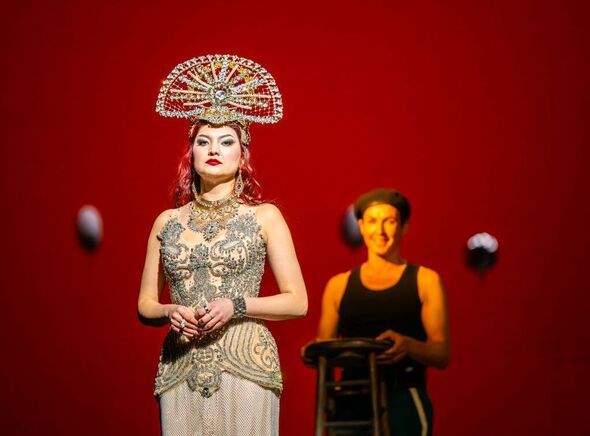
This blends beautifully with the combined singing and acting skills of Akhmetshina, who has recently impressed the world in the role of Carmen and is now showing perfect control as she turns from Samson's lover into the killer slut from Hell, seducing him into revealing the secret of his strength. Curiously, this is never explicitly revealed as his hair, but after his capture, he does appear blinded and shorn. I assume Saint-Saëns and his librettist supposed that we knew the story and though it unnecessary to spell it out.
Musically, the high point of the opera comes towards the end of the second act when Dalila sings the glorious aria Mon cœur s'ouvre à ta voix (My heart opens to your voice) to lure Samson into telling her what she wants. Her seductiveness and duplicity are superbly combined, as Baek exposes Samson's gullibility turning the aria into one of the great love duets in all opera.
This apart, the music is generally unexciting and the staging even more so. The set design is minimal and the attempt to make it striking in the final act is rather misguided. Depicting the Philistine God Dagon as a red-nosed fruit machine carrying poker chips just looks odd, only adding to a feeling that Samson's enemies are portrayed unconvincingly throughout.
Samson's revenge by bringing down the temple on the Philistines at the end also misses an opportunity: a few bent and rattling ceiling beams hardly depicts the wholesale carnage of the event.
- Samson et Dalila will be performed at the Royal Opera House on various dates until 3 June 2026. Box Office and details: rbo.org.uk or 020 7304 4000