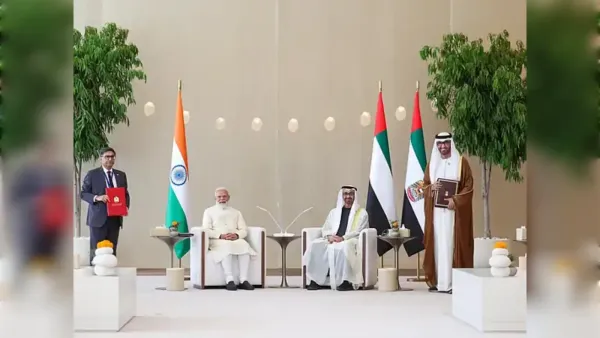
Prime Minister Narendra Modi on Friday, May 15, said maintaining a “free, open and safe” Strait of Hormuz was India’s highest priority as he held talks with UAE President Sheikh Mohamed bin Zayed Al Nahyan amid escalating tensions in West Asia.
Speaking during delegation-level talks in Abu Dhabi, Modi said the impact of the ongoing conflict in West Asia was being felt globally and stressed that dialogue and diplomacy remained the best path to resolving crises.
“Maintaining a free, open and safe Strait of Hormuz is our highest priority. In this regard, adherence to international law is essential,” Modi said during the meeting.

The Indian prime minister also strongly condemned recent attacks on the UAE and attempts to violate the country’s sovereignty and territorial integrity.
Modi reaffirmed India’s support for the UAE, saying New Delhi would continue to stand “shoulder-to-shoulder” with Abu Dhabi in efforts aimed at restoring peace and stability in the region.
The meeting took place during Modi’s brief stop in the UAE as part of his five-nation tour covering the Netherlands, Sweden, Norway and Italy. The visit comes amid heightened tensions surrounding Iran, growing security concerns in the Strait of Hormuz and volatility in global energy markets.
UAE fast-tracks Fujairah oil pipeline to bypass Strait of Hormuz
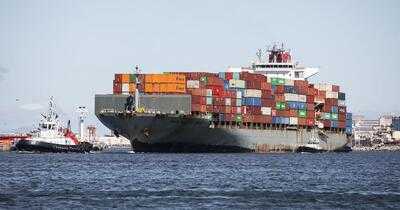
The United Arab Emirates (UAE) will accelerate construction of a new oil pipeline aimed at doubling its export capacity through Fujairah by 2027, significantly expanding its ability to bypass the Strait of Hormuz amid growing regional tensions.
According to the Abu Dhabi Media Office (ADMO), UAE Crown Prince Sheikh Khaled bin Mohamed bin Zayed directed the Abu Dhabi National Oil Company (ADNOC) to fast-track the West-East Pipeline project during an executive committee meeting on Friday.
The pipeline, which is currently under construction, is expected to become operational in 2027.
Once completed, the project will increase the UAE’s capacity to transport crude oil directly to the port of Fujairah on the Gulf of Oman, reducing dependence on the Strait of Hormuz, one of the world’s most critical oil shipping routes.
US offers USD 15M reward over IRGC drone network
The regional developments coincided with a US announcement offering rewards of up to USD 15 million for information on six individuals allegedly linked to the drone-production wing of Iran’s Islamic Revolutionary Guard Corps (IRGC).
The US State Department said the individuals were associated with the Kimia Part Sivan Company (KIPAS), identified by Washington as part of the IRGC Quds Force’s drone operations.
Israel warns villages in southern Lebanon
Israel’s military issued evacuation warnings for residents of five villages in southern Lebanon ahead of expected strikes targeting Hezbollah positions despite an existing ceasefire agreement.
Israeli military spokesperson Avichay Adraee accused Hezbollah of violating the ceasefire and warned that Israeli forces would respond “forcefully”.
Russia and China call for dialogue
Russian Foreign Minister Sergey Lavrov called for an immediate halt to the conflict involving Iran and stressed the importance of avoiding disruptions in the Strait of Hormuz.
China’s Foreign Ministry also urged all parties to pursue negotiations quickly, warning that the conflict had created serious regional repercussions and threatened global energy security.
Oil prices rise amid Hormuz fears
Oil prices climbed more than one percent amid continued concerns over shipping security in the Strait of Hormuz, one of the world’s most important energy transit routes.
Brent crude futures rose above USD 106 per barrel, while US West Texas Intermediate crude climbed above USD 102 per barrel as traders monitored developments in the Gulf region.
No military solution to conflict, says Iran’s Araghchi
Iranian Foreign Minister Abbas Araghchi said there was “no military solution” to the ongoing conflict and urged the United States to recognise that force would not resolve the crisis.
Speaking to Iranian state media, Araghchi said Washington had already tested military approaches more than once and had itself concluded that such strategies would not work.
He also accused the US of sending “mixed and contradictory signals” through public statements, interviews and changing policy positions.
Araghchi insisted Iran had not initiated the conflict and said Tehran’s actions were based on “legitimate self-defence”.
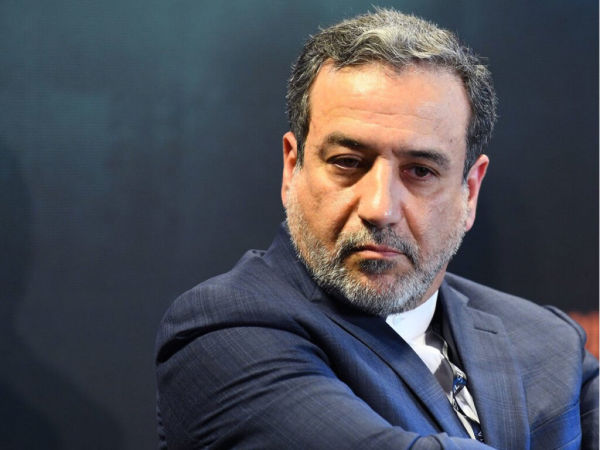
“As far as we are concerned, the Strait of Hormuz remains open, particularly for friendly nations,” he said, adding that any restrictions would apply only to “hostile actors”.
The Iranian foreign minister said vessels from friendly and other nations were required to coordinate their passage with Iranian military forces to avoid incidents and ensure safe transit through the strategic waterway.
Araghchi added that the only viable solution was a “complete end to this act of aggression”, saying Iran would guarantee safe passage for all shipping once hostilities ended.
Xi hosts Trump at historic Zhongnanhai garden
Chinese President Xi Jinping escorted US President Donald Trump through the gardens of Zhongnanhai ahead of a private lunch in Beijing, according to the Associated Press.
Xi highlighted centuries-old trees inside the historic compound and noted that former Chinese leaders Mao Zedong and Zhou Enlai had lived there. He described the visit as a return of the hospitality Trump showed during Xi’s 2017 visit to Mar-a-Lago.
-
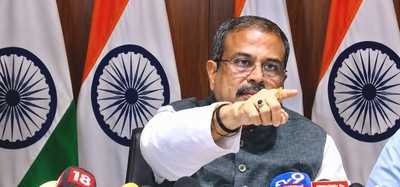
NEET UG To Be Held In Computer-Based Test Mode From 2027: Dharmendra Pradhan
-
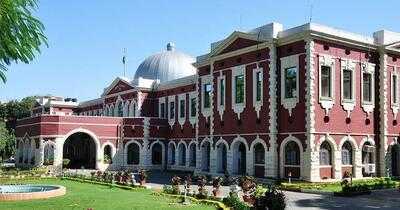
Custodial deaths represent 'profound failure of constitutional machinery', says Jharkhand HC
-
Custodial deaths represent 'profound failure of constitutional machinery', says Jharkhand HC
-
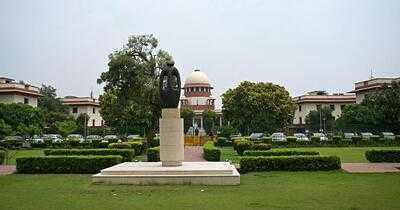
SC questions why panel for appointing Election Commissioners should include Cabinet minister
-
This book argues that leaders weaponise world trade to wage wars and win votes