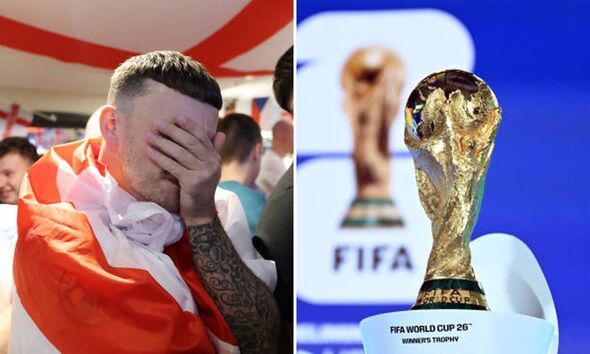
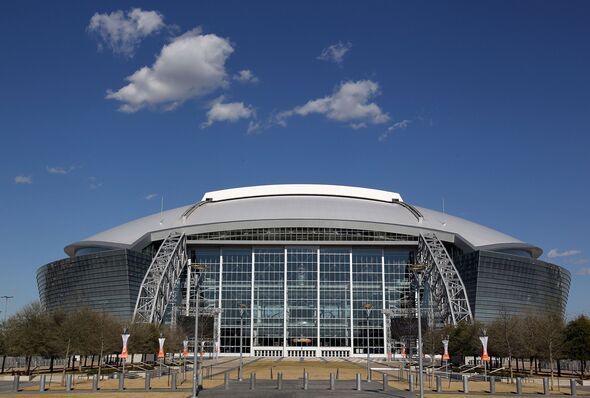
England supporters travelling to Texas for next month's World Cup opener against Croatia are amongst those most vulnerable to heat-related health complications, academics have cautioned. The AT&T Stadium in Arlington is fully air-conditioned, meaning both players and spectators inside the ground will be shielded from the sweltering temperatures.
However, the World Weather Attribution (WWA) group of academics are particularly concerned about the impact of the heat on fans making their way to matches, queuing outside venues and attending outdoor fan festivals. The WWA has established that there is a one in three chance of the Wet Bulb Globe Temperature (WBGT) surpassing 28 degrees Celsius in Dallas during the England match on June 17, amongst other fixtures.
The WBGT is an index that measures how effectively the human body can cool itself, with world players' union FIFPRO stating that matches ought to be postponed where the WBGT exceeds 28 degrees.
In total, the WWA anticipates that nine of the 104 matches will be played in conditions above 26 degrees, where FIFPRO advises that safety measures be put in place, with approximately five expected to take place where the WBGT surpasses 28 degrees. While players are elite athletes capable of adapting their physical output, Dr Chris Millington from Imperial College London believes spectators face the greatest risk.
He said: "They're more medically diverse, maybe older or very young. They may have cardiovascular disease, kidney or metabolic disease. They may be taking medications that affect heat tolerance and they may be unacclimatised visitors. They may also be exposed for much longer than the match itself, walking to the stadium, queuing in direct sun, attending fan zones, sitting in exposed seats and travelling home on crowded transport.
"People who have got medical comorbidities, such as heart disease, will go into that situation. They'll probably not hydrate very well the night before. They might not sleep very well the night before, and then they might have some beer during the day. And gradually they'll get hotter and hotter and hotter. They probably won't put wear a hat.
"They may wear their sports shirt, or, as they sometimes do, they might be not wearing a top, and exposing themselves to those risks as well, and then what happens is, someone who has got that blocked coronary suddenly finds they're dehydrated and they're pushing all their blood flow to their skin, and suddenly not enough blood flow is going to their heart, and they suffer a heart attack that they wouldn't have suffered were they not in that situation."
FIFA has yet to publicly disclose the WBGT threshold that would trigger a postponement. However, it has introduced three-minute hydration breaks midway through each half at every match during this summer's finals as a measure to protect player welfare. Dr Millington argued that such measures fall short of adequately addressing the heat impact on players, calling for a lengthier half-time interval to be introduced. He cautioned, however, that steps taken to reduce risks for players could inadvertently heighten the risk to spectators by prolonging the overall match-day experience.
Dr Friederike Otto, Professor of Climate Science at Imperial College London, urged FIFA to reconsider the timing of future World Cup tournaments. "It would definitely be advisable to have these either earlier in the year or later in the year to have the ability to have a football party and not something that is a massive health risk," Dr Otto said.
A FIFA spokesperson confirmed that a tiered heat mitigation model would be operational at this summer's finals whenever temperatures surpass defined thresholds. Under such conditions, "spectators will be permitted to bring one factory-sealed water bottle, and venues will activate additional cooling capacity, including shaded areas, misting systems, cooling buses and expanded water distribution," the spokesperson said.
FIFA has additionally devised a medical set piece protocol for exertional heat illness affecting players, which incorporates the use of specially designed cooling bags by trained match doctors, enabling immediate treatment to be administered at any location.
Get the latest World Cup news straight to your inbox by signing up to our Make Football Great Again newsletter now!
-
Heavy rain cools Yadgir district after three months of intense heat
-
The Yorkshire Vet's Julian Norton's life from cycling accident to Channel 5 wife

-
DWP Universal Credit May 12 update as 46 per cent of claimants affected

-
Concerns Raised Over Passenger Facilities at Pari Chowk in Greater Noida

-
'We are not against Hindus, but against Hindutva': TN minister Aadhav Arjuna