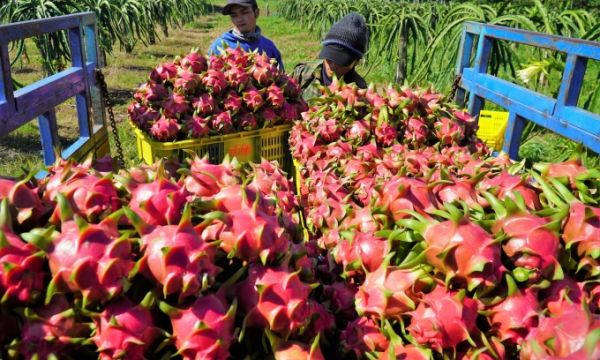
The Vietnamese fruit remains subject to enhanced control under Annex II of Regulation (EU) 2019/1793, with an inspection frequency of 30%, according to the Ministry of Agriculture and Environment.
The pressure on exporters is expected to increase further after the EU in late January announced a shift from a “risk-based” to a “hazard-based” approach in setting maximum residue limits. Under the new method, high-risk substances potentially linked to cancer or endocrine disruption will be subject to a default limit of just 0.01mg per kilogram. The change could directly affect agricultural production processes in exporting countries, including Vietnam.
|
Dragon fruits harvested in the former Binh Thuan Province. Photo by Read/Viet Quoc |
Dang Ngoc Diep, deputy minister of Agriculture and Environment, said the ministry has directed localities and specialized agencies to assess the impact of the new regulations and review issues for discussions with EU authorities. It has also organized technical training programs to keep businesses and producers updated on the new requirements to ensure compliance throughout the production and export chain.
Vietnamese authorities said food safety warnings from the EU declined sharply from 64 cases in 2024 to 17 last year thanks to strengthened inspections, traceability measures and corrective actions.
Notably, an inspection by the EU Directorate-General for Health and Food Safety last June resulted in positive assessments of Vietnamese chilli, dragon fruit and durian exports, creating a basis for future negotiations to reduce inspection frequency.
Huynh Tan Dat, director of the Department of Plant Production and Protection, said Vietnam is promoting sustainable farming models, reducing dependence on chemicals and increasing the use of biological plant protection measures to improve compliance with EU standards. Inspections and stringent settlement of violations will also be intensified to boost production transparency and meet international requirements.
Diep said stricter EU requirements present both a challenge and an opportunity for Vietnam’s agricultural sector to improve product quality, transparency and sustainability, thereby strengthening the position of Vietnamese farm produce in international markets.
-
Teen boy drowns while swimming in canal near Kembhavi in Yadgir district

-
Waterstones has 'free drink offer' fans are only just realising exists

-
Sharon Stone announces devastating death news in latest family tragedy

-
From Dubai to IPL: Macneil in CSK after mother quit job, father spotted talent

-
Starmer, Streeting, Burnham and the bacon eater - the runners and riders to be our next PM