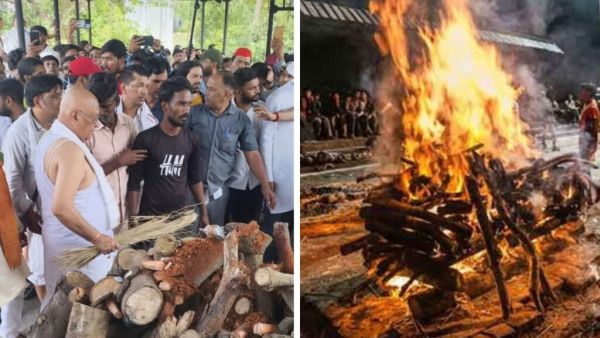
On May 13, the news of the demise of Prateek Yadav, step brother of Samajwadi Party chief Akhilesh Yadav, came to light. The next day, on May 14 (Thursday), his last rites were performed in Lucknow. But in this entire incident, one thing especially caught people’s attention. His funeral pyre was not given by any son or brother of the family, but by his father-in-law Arvind Singh Bisht, who is the father of Aparna Yadav. Let us tell you that Prateek Yadav was married in 2011, after which he has two daughters.
Regarding this, many questions started being raised on social media and in general discussions that how correct is the role of father-in-law in the tradition of lighting the funeral pyre? According to the scriptures, only the son has this right, or can other family members also fulfill this responsibility under the circumstances? Let us know…
Acharya Shri Satyavrat Mishra of Shri Sacha Prem Baba Ashram Arail Prayagraj told that ‘According to the rules of Gotra and Sapindta (Manu Smriti) and Hindu scriptures, the first right of Mukhagni and Pind Daan is given only to the person who is a part of the clan, gotra or ‘Sapinda’ (blood ) family of the deceased. After marriage, the Gotra of the girl changes, due to which the hereditary Gotra of the son-in-law and father-in-law becomes completely different.
Meaning- At the time of marriage, after the seventh round (Saptapadi), the woman separates from her father’s Gotra and merges with her husband’s Gotra. Therefore, the son-in-law is not a sapinda (blood relative) of the father-in-law’s clan or gotra. Due to different Gotra, the father-in-law does not have any hereditary right over his son-in-law.
Who can offer funeral pyre to the deceased?
According to Acharya Shri Satyavrat Mishra, Mahant of Shri Sacha Prem Baba Ashram, Arail, Prayagraj, there is a rule in the scriptures that only the son can offer Mukhagni and Pind Daan because only he has the authority to liberate the soul from hell. Punnamno Narakadyasmattrayate Pitram Sutah.Tasmatputra Iti Proktah Swayamev Swayambhuva॥ (Manusmriti, Chapter 9, Verse 138) Meaning: Since the son saves his parents from the hell called ‘Put’ (Pum), Lord Brahma himself has called him ‘Putra’. The son-in-law is only a marital relative, he cannot be the classical heir to carry forward the father-in-law’s lineage or discharge his ancestral debt, and the same rule applies to the father-in-law.
Order of officials for funeral pyre and cremation (Garuda Purana)Garuda Purana (Pratakalpa, Chapter 10) clearly states who can perform funeral pyre and cremation. According to the scriptures, it has a strict hierarchy, in which there is no mention of father-in-law or son-in-law: Putrabhave ca pautrastu tatputro va sahodarah. Sahodrabhave shishyao va brahminashcha samacharet (Garuda Purana, Pretakalp) Meaning – In the absence of a son, the grandson (grandson), in his absence the great-grandson (great-grandson), brother, or brother’s son (nephew) should perform the last rites. If there is no male in the Sapinda clan, then the disciple or any other qualified Brahmin of the clan can perform the last rites. In this entire rights list, the eligibility of father-in-law or son-in-law to perform the last rites has been barred because they are not to each other.
-
Health Tips: How safe is dough kept in the fridge? How does it affect health?

-
Summer Cooling Tips: If you want to avoid the scorching heat, not AC-cooler, then follow the indigenous tips given by Sadhguru.
-
Anthropic Rolls Out New Legal AI Tools: Legal Research, Document Management, And Specialised Legal Support For Law Firms

-
Discover proven methods to recover iPhone data without backup. Learn how to restore lost photos, mes

-
Arsenal in ‘perfect state of mind’ ahead of season’s final games, says Arteta