
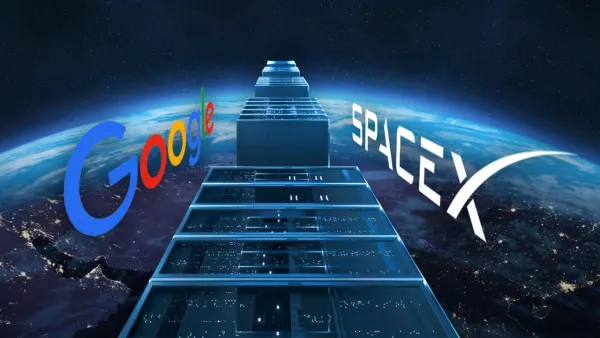
The global AI race may soon move far beyond Earth. In a development that sounds straight out of a sci-fi movie, Google is reportedly discussing future rocket launches with SpaceX for a bold new project aimed at building AI data centers in orbit.
The initiative, internally known as Project Suncatchercould redefine how artificial intelligence infrastructure is built and powered in the future. Instead of massive Earth-based facilities consuming enormous amounts of electricity and water, Google is exploring the possibility of running AI computing systems directly in space using solar-powered satellites.
And if the project moves ahead, Elon Musk’s SpaceX may become one of its biggest partners.
Credits: Reuters
What Exactly Is Project Suncatcher?
Project Suncatcher is reportedly a research effort by Google to create an orbital AI cloud. The idea involves launching a network of satellites equipped with Google’s powerful Tensor Processing Units (TPUs), which are custom chips optimized for AI workloads.
These satellites would operate in space using uninterrupted solar energy, potentially solving one of the biggest problems facing the AI industry today: the massive energy demands of AI data centers.
AI models are becoming increasingly power-hungry. Training advanced AI systems requires enormous computing infrastructure, which in turn demands huge quantities of electricity, cooling systems, and physical land. As companies race to build larger AI models, traditional data centers are becoming more expensive and environmentally controversial.
Google appears to believe the next frontier may not be on Earth at all.
The company is reportedly planning an initial prototype launch around 2027 with satellite imaging company Planet Labs.
A Surprising Google–Musk Alliance
Perhaps the most fascinating part of the story is the involvement of Elon Musk’s SpaceX.
Musk has historically positioned himself as a rival to Google in the AI world. In fact, he co-founded OpenAI in 2015 partly out of concern over Google’s growing dominance in artificial intelligence.
Musk also famously clashed with Google co-founder Larry Page over AI safety concerns. Over the years, Musk has repeatedly warned about the dangers of unchecked artificial intelligence while criticizing major tech firms for moving too aggressively.
But the economics of the new AI era appear to be changing old rivalries.
If SpaceX works with Google on Project Suncatcher, it would mark yet another example of Musk aligning with former AI competitors when strategic opportunities emerge. The partnership would also highlight how critical SpaceX has become to the future of global technology infrastructure.
Why Space-Based Data Centers Are Becoming Attractive
Orbital computing may sound futuristic, but several factors are making the idea increasingly realistic.
First, solar power in space is far more efficient because satellites can receive near-constant sunlight without atmospheric interference or nighttime interruptions. That means orbital servers could potentially operate with cleaner and more reliable energy than many Earth-based facilities.
Second, AI companies are struggling with rising infrastructure costs. Building giant data centers on Earth requires massive investments in land, electricity grids, cooling systems, and water resources. Space-based systems could eventually reduce some of those limitations.
There is also a strategic advantage. Future AI systems may require distributed computing networks capable of operating independently of terrestrial infrastructure. Space-based AI clouds could support communications, defense systems, autonomous vehicles, and global internet networks.
SpaceX’s IPO Ambitions Add Another Layer
The report also suggests that orbital data centers are becoming a major reason behind SpaceX’s long-anticipated IPO plans.
Developing AI infrastructure in space is expected to be extremely expensive and technologically complex. Raising public market capital could help SpaceX fund the next phase of its ambitions beyond rockets and satellite internet.
Interestingly, the momentum behind orbital AI infrastructure is already building. Last week, Anthropic reportedly agreed to use the full computing capacity of SpaceX’s Colossus 1 facility in Memphis. The company also expressed interest in collaborating on future gigawatt-scale orbital AI data centers.
That means Google may not be alone in pursuing this futuristic vision.
Credits: WAYA Media
The AI Race Is No Longer Limited To Earth
The AI industry has already transformed smartphones, workplaces, finance, healthcare, and entertainment. But the next phase of competition may revolve around who controls the infrastructure powering advanced AI systems.
And increasingly, that battle appears headed toward space.
If Project Suncatcher succeeds, Google and SpaceX could help create the world’s first large-scale orbital AI cloud — a move that may fundamentally change how computing infrastructure is designed for decades to come.
-
Petrol, diesel price hike 'Modi's gift', country has come to 'tragic situation': Shivakumar

-
NEET-UG Re-Exam on June 21 After Cancellation Over Paper Leak

-
'People being plundered': Vijayan attacks Centre over fuel price hike

-
Actor Darshan denied bail, Supreme Court orders completion of trial within one year

-
Assam Chief Minister Reviews Industrial Growth and Power Infrastructure