The barn owl species has gained widespread attention in natural pest management discussions within the United States due to its predatory nature against rodents, nocturnal lifestyle, and ability to flourish around agricultural land and open areas. However, wildlife scientists warn that there is often a lack of understanding among householders regarding the factors needed for the successful attraction of barn owls to residential locations.
As explained by the Owl Research Institute, barn owls react to environmental quality, food availability, nest site requirements, and protection from disturbances, instead of merely the installation of a wooden box within the premises. Scientists and wildlife agencies suggest that the priority of homeowners should be to focus on the surroundings rather than pest control benefits.
The researchers conducting the study highlighted that nest boxes are most effective when the environment around them provides owls with favorable hunting grounds and sufficient rodents to breed. Put simply, the owl responds to its surroundings first and only then to the box itself.
Another paper available via the National Center for Biotechnology Information highlights that nest boxes can be subject to degradation due to weathering, deterioration, and wear-and-tear effects. The researchers note that deteriorated nest boxes can become dangerous or unsuitable for breeding purposes. In turn, homeowners installing nest boxes must regard them as an ongoing obligation rather than a one-off backyard endeavor.
Experts believe that owls need wide areas for hunting instead of closed suburban areas where they cannot fly freely because of continuous interference by people around them. This means that, despite setting a barn in the garden, an owl may never show up simply because of a lack of suitable conditions.
Studies conducted in Cyprus proved that hunting behavior among barn owls is seasonal and dependent on the type of habitats, prey animals, and environmental conditions. Scientists stated in the Journal of Arid Environments that owls are responsive to local ecological circumstances and do not have equal feeding preferences across all types of territories.
Even when a good nesting box is present, the time taken by barn owls to locate the box, establish territories, find mates, breed, hatch, and raise their young may take months. Barn owls are known to revisit their preferred nesting sites in accordance with their lengthy reproductive cycles and not the immediate environment. As such, scientists state that homeowners should not expect an immediate decline in rodent numbers once a box is installed.
According to the authors of the research, the consumption of poisoned rodents will lead to the accumulation of poisonous substances in the predator's body, causing internal hemorrhaging and damage to the organs. Additionally, a study documented in Science of the Total Environment has identified rodenticide poisoning among barn owls.
It has been noted that there is an inherent contradiction in the efforts to conserve barn owls since they are the natural predators of rats and mice while being exposed to rodenticides.
Scientists state that the only way to create a backyard system is straightforward. It consists of providing a safe habitat, avoiding toxic substances, maintaining the nest box, and giving nature some time to react to the changes.
As explained by the Owl Research Institute, barn owls react to environmental quality, food availability, nest site requirements, and protection from disturbances, instead of merely the installation of a wooden box within the premises. Scientists and wildlife agencies suggest that the priority of homeowners should be to focus on the surroundings rather than pest control benefits.
A nest box alone is usually not enough
While homeowners often look forward to the quick arrival of the owls when they install owl boxes, scientific literature available in the journal Animals shows that the presence of owls depends much more on the surrounding environment than on the nest itself. According to the findings, barn owls are drawn to certain locations due to the presence of potential prey, opportunities for hunting, and low disturbance. This means that some nest boxes can lie unused for years before finally being occupied because of inadequate habitat conditions for the species.The researchers conducting the study highlighted that nest boxes are most effective when the environment around them provides owls with favorable hunting grounds and sufficient rodents to breed. Put simply, the owl responds to its surroundings first and only then to the box itself.
Another paper available via the National Center for Biotechnology Information highlights that nest boxes can be subject to degradation due to weathering, deterioration, and wear-and-tear effects. The researchers note that deteriorated nest boxes can become dangerous or unsuitable for breeding purposes. In turn, homeowners installing nest boxes must regard them as an ongoing obligation rather than a one-off backyard endeavor.
Food and open hunting space matter more
According to wildlife experts, one of the key reasons that dictates the presence of barn owls is the abundance of prey in the environment. As revealed by a Swiss research on farmland published in Frontiers in Ecology and Evolution, barn owls hunt in areas with more prey animals available, as well as open spaces which facilitate their movement.Experts believe that owls need wide areas for hunting instead of closed suburban areas where they cannot fly freely because of continuous interference by people around them. This means that, despite setting a barn in the garden, an owl may never show up simply because of a lack of suitable conditions.
Studies conducted in Cyprus proved that hunting behavior among barn owls is seasonal and dependent on the type of habitats, prey animals, and environmental conditions. Scientists stated in the Journal of Arid Environments that owls are responsive to local ecological circumstances and do not have equal feeding preferences across all types of territories.
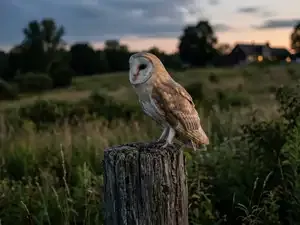
Image Credit: Gemini| A barn owl perched on a weathered wooden post
Barn owls do not respond overnight
Scientists have further stated that barn owl-based rodent control is a gradual process since barn owl populations tend to fluctuate based on prey populations. According to a study published in Ecography, barn owl population levels and reproduction rates change in accordance with fluctuations in vole and rodent populations. This implies that they will react gradually and seasonally to pest infestations.Even when a good nesting box is present, the time taken by barn owls to locate the box, establish territories, find mates, breed, hatch, and raise their young may take months. Barn owls are known to revisit their preferred nesting sites in accordance with their lengthy reproductive cycles and not the immediate environment. As such, scientists state that homeowners should not expect an immediate decline in rodent numbers once a box is installed.
Rodent poison can seriously harm owls
The wildlife experts have noted that one of the major threats to barn owls is rodenticides. Research conducted in Texas and documented by the National Center for Biotechnology Information has revealed that barn owls are usually exposed to anticoagulant rodenticides after consuming their prey.According to the authors of the research, the consumption of poisoned rodents will lead to the accumulation of poisonous substances in the predator's body, causing internal hemorrhaging and damage to the organs. Additionally, a study documented in Science of the Total Environment has identified rodenticide poisoning among barn owls.
It has been noted that there is an inherent contradiction in the efforts to conserve barn owls since they are the natural predators of rats and mice while being exposed to rodenticides.
Natural pest control still has limits
While barn owls can contribute to reducing rodents in certain environments, scientists do not advise considering them an absolute substitute for other pest control techniques. According to research conducted in various regions, there were cases where rodent activity grew. The results showed that the use of barn owls was effective only within a larger ecological approach. This includes managing habitats, implementing safe pest control measures, and being patient.Scientists state that the only way to create a backyard system is straightforward. It consists of providing a safe habitat, avoiding toxic substances, maintaining the nest box, and giving nature some time to react to the changes.