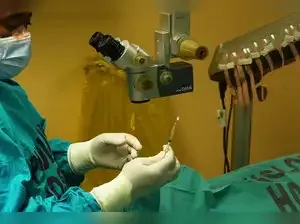
Doctors at a Delhi hospital have successfully restored hand function in an 18-year-old college student through a rare toe-to-finger transplant procedure, showcasing an advanced feat in reconstructive surgery.
The patient, a tourism student, suffered from a severe deformity in her left middle finger that progressively worsened over time. The condition led to soft tissue contraction, restricted movement and difficulty carrying out routine activities. The deformity also deeply affected her confidence and social comfort.
“Not having a finger affected my confidence for many years, and I often felt awkward in front of others. After this reconstruction surgery, I feel much more confident and positive. It has really helped me to carry out daily activities more comfortably,” the patient said.
The complex surgery was performed by a multidisciplinary team led by Dr Rahul Kapoor, head of department and consultant for onco-reconstructive and plastic surgery at Manipal Hospital. During the eight-hour procedure, surgeons harvested the patient’s second toe and transplanted it to her hand to reconstruct the missing finger.
“Routine microsurgery uses vessels over 1-1.5 mm, but here we worked with 0.5-1 mm ones, raising the complexity,” Dr Kapoor explained.
As part of the surgery, the damaged metacarpal bone in the hand was removed and replaced with a matching metatarsal segment taken from the toe. Surgeons then performed microvascular anastomosis, a delicate process involving the connection of tiny blood vessels to maintain circulation and ensure survival of the transplanted tissue.
Doctors said one of the most innovative aspects of the procedure was the use of the patient’s existing finger skin, which had become redundant because of the deformity. Instead of removing it, the team repurposed the skin to cover the transplanted toe.
“This gave us an advantage. We achieved both adequate bulk and preserved sensation, which typically takes six to eight months to develop after nerve repair,” Kapoor said.
The surgery also involved major anatomical challenges, as the functional differences between toes and fingers required careful adaptation. Surgeons additionally had to account for prior tissue changes in the hand before carrying out the reconstruction.
“Understanding both donor and recipient anatomy at this level is crucial. Fingers have more strength than toes,” Dr Kapoor said, adding that such reconstructive procedures continue to evolve with experience and innovation.
Following the surgery, the patient has regained nearly 80% to 95% of hand function, with doctors noting considerable improvement in grip strength and mobility. Although some stiffness remains, continued physiotherapy is expected to further improve movement and recovery. Doctors estimate the transplanted toe could eventually achieve 60% to 80% of the strength of a natural finger as it adapts over time.
“Such surgeries can be life-changing, but they are often underused because of limited awareness and misconceptions. In this case, the impact was not only physical — the psychological recovery has been equally important,” said Dr Kapoor while stressing the importance of expanding access to reconstructive options that can dramatically improve quality of life.
The patient, a tourism student, suffered from a severe deformity in her left middle finger that progressively worsened over time. The condition led to soft tissue contraction, restricted movement and difficulty carrying out routine activities. The deformity also deeply affected her confidence and social comfort.
“Not having a finger affected my confidence for many years, and I often felt awkward in front of others. After this reconstruction surgery, I feel much more confident and positive. It has really helped me to carry out daily activities more comfortably,” the patient said.
The complex surgery was performed by a multidisciplinary team led by Dr Rahul Kapoor, head of department and consultant for onco-reconstructive and plastic surgery at Manipal Hospital. During the eight-hour procedure, surgeons harvested the patient’s second toe and transplanted it to her hand to reconstruct the missing finger.
“Routine microsurgery uses vessels over 1-1.5 mm, but here we worked with 0.5-1 mm ones, raising the complexity,” Dr Kapoor explained.
As part of the surgery, the damaged metacarpal bone in the hand was removed and replaced with a matching metatarsal segment taken from the toe. Surgeons then performed microvascular anastomosis, a delicate process involving the connection of tiny blood vessels to maintain circulation and ensure survival of the transplanted tissue.
Doctors said one of the most innovative aspects of the procedure was the use of the patient’s existing finger skin, which had become redundant because of the deformity. Instead of removing it, the team repurposed the skin to cover the transplanted toe.
“This gave us an advantage. We achieved both adequate bulk and preserved sensation, which typically takes six to eight months to develop after nerve repair,” Kapoor said.
The surgery also involved major anatomical challenges, as the functional differences between toes and fingers required careful adaptation. Surgeons additionally had to account for prior tissue changes in the hand before carrying out the reconstruction.
“Understanding both donor and recipient anatomy at this level is crucial. Fingers have more strength than toes,” Dr Kapoor said, adding that such reconstructive procedures continue to evolve with experience and innovation.
Following the surgery, the patient has regained nearly 80% to 95% of hand function, with doctors noting considerable improvement in grip strength and mobility. Although some stiffness remains, continued physiotherapy is expected to further improve movement and recovery. Doctors estimate the transplanted toe could eventually achieve 60% to 80% of the strength of a natural finger as it adapts over time.
“Such surgeries can be life-changing, but they are often underused because of limited awareness and misconceptions. In this case, the impact was not only physical — the psychological recovery has been equally important,” said Dr Kapoor while stressing the importance of expanding access to reconstructive options that can dramatically improve quality of life.