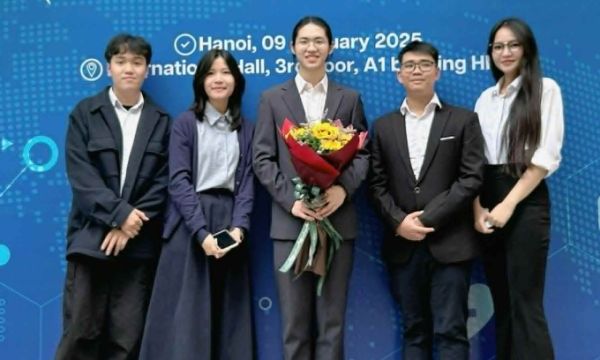
This Q1-ranked journal recently featured their work, which identifies a “U-shaped” relationship between dietary iron intake and gastric cancer risk. The study, “Dietary iron intake and risk of gastric cancer,” lists 13 authors, and five of them, Pham Hoang Thanh, Nguyen Trong Tan, Nguyen Minh Phuong, Nguyen Nhi Bac, Hoang Huy Anh, are currently at the university.
Published in early February, the journal holds an impact factor of 3.4 and is considered one of the world’s most prestigious academic publications.
The core of the research involved a survey conducted by the students and their supervisor, involving nearly 1,200 patients and 3,000 control cases in Vietnam. Their findings indicate that the risk of developing stomach cancer increases in cases of both iron deficiency and iron excess.
|
(From L) Pham Hoang Thanh, Nguyen Trong Tan, Nguyen Minh Phuong, Nguyen Nhi Bac, Hoang Huy Anh, a group of students from Hanoi Medical University behind a recent cancer study publication. Photo provided by the group |
The team noted that previous international studies on this topic had produced inconsistent results. By providing clearer data, this new study offers essential evidence for designing nutritional intervention programs tailored to different population groups.
The Vietnamese students took the lead on every stage of the project, including the literature review, hypothesis development, data analysis, and manuscript writing.
The project also benefited from a global support network. Vietnamese doctors in the U.S. assisted with complex statistical algorithms, while collaborators in Japan helped with proofreading the final manuscript.
For Bac, a sixth-year preventive medicine student and the group’s eldest member, the primary challenge was coordination. Since the team included students from the second to sixth years, they had to dedicate extra time to self-studying research methods to ensure everyone reached the same level of understanding.
|
The research group at a science conference held at the Hanoi Medical University in 2025. Photo provided by the group |
The team also had to balance the project with demanding class schedules and intensive hospital practice. Tan, the youngest member and a third-year student, joined the project a year ago. Despite his primary interest being clinical medicine, he was responsible for data analysis and the discussion section. He admitted that the hardest part was meeting the supervisor’s strict standards, though he credits the guidance of lecturers and seniors for his growth.
According to Bac, Tan was instrumental in processing data and quickly navigating English-language medical literature. She emphasized that it is rare for a student as early as their second year to participate in such high-level scientific research.
Beyond the technical work, the group also navigated a rigorous international peer-review process, addressing expert comments before the paper was accepted for publication.
Reflecting on their journey, the group suggests that students should begin research in their first or second year when academic workloads are more manageable. They noted that by the fourth year, the combination of coursework and hospital training often makes consistent research difficult. Ultimately, they believe research provides a vital bridge for students to connect with lecturers and engage in real-world medical projects.
-
Major change to Rachel Reeves' tax policy proposed

-
Governor interrupts Vijay after TVK chief goes off-script during oath-taking ceremony
-
Controversial Wedding Incident in Ghazipur: Groom's Outburst During Ritual

-
Astrological Insights: Sun's Transit into Taurus on May 15, 2026, Brings Golden Opportunities for Leo

-
Urvil Patel Sets IPL Record with Fastest Half-Century