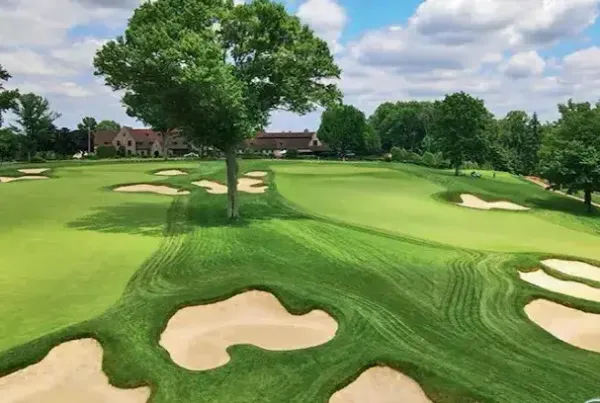
On Sunday evening, if the light cooperates, Aronimink’s bunkers glow. From the clubhouse veranda, they look almost theatrical. White sand lies in long, ragged clusters, scooped into the slopes as if someone tried to erase parts of the fairway and then thought better of it. On television, they are scenic. For the 156 players arriving for the PGA Championship, they are something else entirely: a reminder that the season’s second major has come to a course that remembers who solves it and who flinches.
Aronimink, outside Philadelphia, is a Donald Ross design that architecture obsessives have rhapsodized over for years, but men’s golf has rarely trusted it for the majors. This week it will play as a par 70, 7,394 yards, with a routing heavy on exacting par-4s, three par-3s over 200 yards, and two par-5s that reward only very high, controlled second shots.
It hosted the PGA Championship once, in 1962, then went quiet as a major venue until the AT&T National visited in 2010 and 2011 and the BMW Championship in 2018. A meticulous restoration has since widened fairways back to Ross’s original corridors, restored green shapes, and re-established his clustered bunkering, more than 170 of them now, often in those signature “rows of three” that force decisions rather than offering escape.
CONTENDERS
Into that puzzle walks a field with a clear gravitational centre. Scottie Scheffler remains the alpha male, the defending PGA champion, and the player whose strokes-gained numbers still sit at or near the top in overall performance and tee-to-green. In most markets, he is a sub-5-1 favourite, with modelled win probabilities around 18 percent, which is outrageous for a 156-man field. Next is Rory McIlroy, reframed by back-to-back Masters as a mid-thirties force who has finally learned to close at Augusta and is now chasing the same calm at the PGA. His length and high-flying irons are an obvious asset on par-4s that routinely stretch past 450 yards.
 Around them, the contenders form familiar clusters. Xander Schauffele arrives as a recent PGA champion with one of the most balanced statistical profiles on tour.
Jon Rahm and Bryson DeChambeau carry their usual volatility: seasons marked by brilliance, strokesgained off the tee that can overwhelm any layout, yet less week-to-week consistency than Scheffler or Schauffele.
Collin Morikawa remains the benchmark for iron play; his approach numbers are still elite enough that a neutral putting week puts him on any major leaderboard.
And then there is Cameron Young, whose 2026 has shifted from promise to proof. He opened the year by winn i n g t h e C a d i l l a c Championship, then went to TPC Sawgrass and took The Players.
Also read | History-chasing Barca eye title party in Liga Clasico
At Sawgrass, he closed with a four-under 68, played the back nine bogey-free while others leaked shots into the water, and hit the wedge that will follow him to Aronimink: a flighted shot into the wind at the island 17th, earning him a birdie claw even w i t h M a t t Fitzpatrick. After T3 at the Masters, multiple top-five finishes, and strokesgained numbers that place him among the tour’s better drivers and iron players this season, Young looks like a major-ready golfer.
Aronimink, however, has a longer memory than a single hot season, and one of the names it remembers best is Justin Rose. He won the 2010 AT&T National here at 10-under, closing with seven straight pars for a one-shot victory, and returned eight years later to lose the BMW Championship in a playoff to Keegan Bradley after both finished at 20-under in a rain-delayed Monday finish. Two visits, two Sundays in contention — enough to make him, at 45, the most experienced Aronimink hand in the field, if not quite the ‘course horse’ that three strong weeks would suggest.
DIFFICULT COURSE
The course rewards precision and calculated risk. The front nine includes a 242-yard downhill par-3 at the 8th, where the green almost touches the 10th and club selection is non-negotiable, and a 605-yard uphill par-5 at the 9th that climbs steadily back toward the clubhouse. Fairways are wide, but safe lines often lead to awkward approaches; aggressive lines flirt with the sand. The short par-4 11th, 425 yards with more than 20 bunkers, ends on an uphill green so sensitive that too much spin can drag a shot back dozens of yards down the slope. The 229-yard 17th over water tests nerve as much as swing. The 490-yard 18th, lined by trees and guarded by three right-side fairway bunkers, finishes with an uphill shot into a terraced green, where corner flags can turn pars into small victories.
The last decade of PGA champions — Walker, Thomas, Koepka, Morikawa, Mickelson, Schauffele, Scheffler — shows a repeating pattern: elite tee-to-green profiles with either significant power or precision iron control.
On that evidence, the shortest list for 2026 probably starts with Scheffler and Schauffele and now includes Young. Scheffler because he is the statistical outlier; Schauffele because his all-around game translates seamlessly to major setups; Young because his combination of power, bigevent wins, and a rising strokes-gained profile looks exactly like what the modern PGA tends to reward.
Aronimink, outside Philadelphia, is a Donald Ross design that architecture obsessives have rhapsodized over for years, but men’s golf has rarely trusted it for the majors. This week it will play as a par 70, 7,394 yards, with a routing heavy on exacting par-4s, three par-3s over 200 yards, and two par-5s that reward only very high, controlled second shots.
It hosted the PGA Championship once, in 1962, then went quiet as a major venue until the AT&T National visited in 2010 and 2011 and the BMW Championship in 2018. A meticulous restoration has since widened fairways back to Ross’s original corridors, restored green shapes, and re-established his clustered bunkering, more than 170 of them now, often in those signature “rows of three” that force decisions rather than offering escape.
CONTENDERS
Into that puzzle walks a field with a clear gravitational centre. Scottie Scheffler remains the alpha male, the defending PGA champion, and the player whose strokes-gained numbers still sit at or near the top in overall performance and tee-to-green. In most markets, he is a sub-5-1 favourite, with modelled win probabilities around 18 percent, which is outrageous for a 156-man field. Next is Rory McIlroy, reframed by back-to-back Masters as a mid-thirties force who has finally learned to close at Augusta and is now chasing the same calm at the PGA. His length and high-flying irons are an obvious asset on par-4s that routinely stretch past 450 yards.
A view of the course where The PGA Championship will be played this week.
Jon Rahm and Bryson DeChambeau carry their usual volatility: seasons marked by brilliance, strokesgained off the tee that can overwhelm any layout, yet less week-to-week consistency than Scheffler or Schauffele.
Collin Morikawa remains the benchmark for iron play; his approach numbers are still elite enough that a neutral putting week puts him on any major leaderboard.
And then there is Cameron Young, whose 2026 has shifted from promise to proof. He opened the year by winn i n g t h e C a d i l l a c Championship, then went to TPC Sawgrass and took The Players.
Also read | History-chasing Barca eye title party in Liga Clasico
At Sawgrass, he closed with a four-under 68, played the back nine bogey-free while others leaked shots into the water, and hit the wedge that will follow him to Aronimink: a flighted shot into the wind at the island 17th, earning him a birdie claw even w i t h M a t t Fitzpatrick. After T3 at the Masters, multiple top-five finishes, and strokesgained numbers that place him among the tour’s better drivers and iron players this season, Young looks like a major-ready golfer.
Aronimink, however, has a longer memory than a single hot season, and one of the names it remembers best is Justin Rose. He won the 2010 AT&T National here at 10-under, closing with seven straight pars for a one-shot victory, and returned eight years later to lose the BMW Championship in a playoff to Keegan Bradley after both finished at 20-under in a rain-delayed Monday finish. Two visits, two Sundays in contention — enough to make him, at 45, the most experienced Aronimink hand in the field, if not quite the ‘course horse’ that three strong weeks would suggest.
DIFFICULT COURSE
The course rewards precision and calculated risk. The front nine includes a 242-yard downhill par-3 at the 8th, where the green almost touches the 10th and club selection is non-negotiable, and a 605-yard uphill par-5 at the 9th that climbs steadily back toward the clubhouse. Fairways are wide, but safe lines often lead to awkward approaches; aggressive lines flirt with the sand. The short par-4 11th, 425 yards with more than 20 bunkers, ends on an uphill green so sensitive that too much spin can drag a shot back dozens of yards down the slope. The 229-yard 17th over water tests nerve as much as swing. The 490-yard 18th, lined by trees and guarded by three right-side fairway bunkers, finishes with an uphill shot into a terraced green, where corner flags can turn pars into small victories.
The last decade of PGA champions — Walker, Thomas, Koepka, Morikawa, Mickelson, Schauffele, Scheffler — shows a repeating pattern: elite tee-to-green profiles with either significant power or precision iron control.
On that evidence, the shortest list for 2026 probably starts with Scheffler and Schauffele and now includes Young. Scheffler because he is the statistical outlier; Schauffele because his all-around game translates seamlessly to major setups; Young because his combination of power, bigevent wins, and a rising strokes-gained profile looks exactly like what the modern PGA tends to reward.
(Disclaimer: The opinions expressed in this column are that of the writer. The facts and opinions expressed here do not reflect the views of www.economictimes.com.)