After the final Audi R8 rolled off the line in late 2024, Audi’s performance line-up suddenly felt incomplete. The brand that once gave the world screaming naturally aspirated supercars seemed to have left behind its wild side. But now, Audi has answered that silence with something completely unexpected, and gloriously unhinged.
Meet the Lucca.
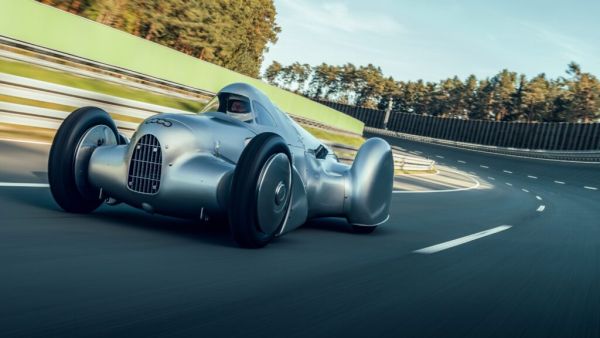
This isn’t an electric concept trying to imitate emotion through speakers and software. It’s a hand-built, fire-breathing machine powered by a supercharged 6.0-litre V16 engine running on methanol. It looks like a 1930s science-fiction fantasy and sounds like thunder trapped inside metal.
And somehow, it’s real.
A Lost Legend Reborn
The Lucca is not an entirely new creation. Instead, it’s a painstaking recreation of a long-lost Auto Union speed record car from 1935. Back then, Auto Union — one of the companies that would eventually become Audi was battling Mercedes-Benz in an all-out race for speed supremacy.
The original car was based on the terrifying Auto Union Type A Grand Prix racer. Wrapped in streamlined bodywork and weighing just over 1,000kg, it packed a 5.0-litre V16 producing around 343bhp. In February 1935, legendary racing driver Hans Stuck pushed the machine to 326.9kph (203mph) on a closed public road near the Italian city of Lucca.
At the time, it became the fastest anyone had ever travelled on a public road.
The original car disappeared sometime after World War II. Some believed it was dismantled, while others claimed it was taken away as war loot. Either way, the machine was lost to history.
Until now.
Built by Craftsmen, Not Computers
Audi’s heritage division, Audi Tradition, partnered once again with British motorsport specialists Crosthwaite & Gardiner to bring the Lucca back to life. The same team previously recreated the stunning Auto Union Type 52, another forgotten V16 icon.
The project reportedly took three years and cost well into seven figures.
Unlike the original, however, this version benefits from nearly a century of engineering hindsight. Instead of the period-correct 5.0-litre engine, Audi fitted a later-spec 6.0-litre V16 producing a claimed 520 horsepower.
Every inch of Lucca feels obsessively handcrafted. The aluminium body panels were hand-beaten into shape, while the polished open-gate manual linkage looks like a mechanical art piece. Even the paint pays tribute to the past, finished in a delicate “Cellulose Silver” inspired by the original car’s historic shade.
Fast Enough to Terrify
Audi says the Lucca will only appear at select demonstration events, and for good reason.
There are no seatbelts. No crash protection. No modern safety systems whatsoever. Even the speedometer only stretches to 300kph, which is technically lower than the car’s historic top speed.
There’s also one unsolved mystery still haunting the project. Audi engineers have been unable to fully determine how the original canopy remained secured at extreme speeds. The historic blueprints simply no longer exist.
That means if the Lucca attempted another top-speed run today, there’s a genuine risk the fighter jet-style canopy could rip clean off.
Which somehow makes this machine even cooler.
In an era where performance cars are becoming quieter, heavier, and increasingly digital, the Lucca feels wonderfully rebellious. It’s loud, dangerous, mechanical, and deeply emotional a reminder of a time when speed records were chased with courage rather than algorithms.
And honestly, the automotive world needed something this mad.
-
Women’s T20 World Cup 2026: Pakistan team announced for T20 World Cup 2026, captain making fifty on 15 balls

-
Feeling of electric current after touching metallic things in office, number of patients increased, understand in the video, doctors told these reasons.

-
IRCTC’s explosive Kashmir tour package, travel from Srinagar to Pahalgam in just Rs 30 thousand, know how to book?

-
How did puja happen in ‘Bhojshala’ after the court’s decision, what did people say?

-
BMW’s craziest SUV yet? XM soundmachine comes with rooftop DJ stage and massive speakers