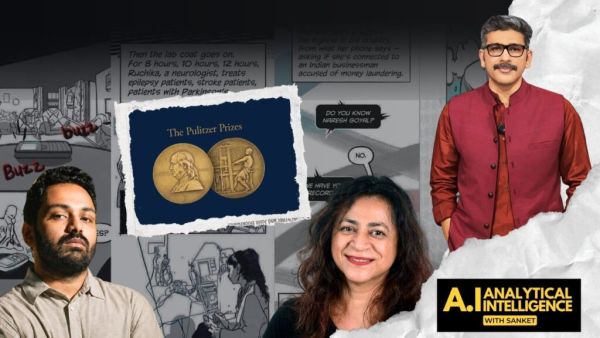
Digital arrest scams are thriving on fear, trust, and desperation, and according to Pulitzer-winning journalists Suparna Sharma and Anand RK, the people behind these operations are often products of the same economic anxieties affecting millions of young Indians.
Their Bloomberg illustrated investigation titled Trapped explored the emotional devastation caused by cyber fraud, while also exposing the organised network powering these scams.
The Federal spoke to Suparna Sharma and Anand RK about the growing role of illustrations in journalism, the psychology behind digital arrest scams, and the disturbing ecosystem of educated young Indians entering cybercrime networks due to unemployment and rising aspirations.
Visual storytelling
The discussion began with the format of Trapped, an illustrated story that has received global recognition for its innovative storytelling. Sharma said journalism has reached a moment where presentation is as important as reporting, especially for younger audiences with shrinking attention spans.
She said visual storytelling creates easier access for readers because complex issues become more engaging when presented graphically. According to her, while documentaries and films are common tools for visual storytelling, illustrated journalism offers a different immersive experience.
Sharma joked that the making of the story drove the team “a little kuku”, highlighting how labour-intensive the process was. But she argued that this format is particularly effective for younger readers who consume information rapidly through scrolling and swiping.
Also read: ‘Digital arrests’ will end only when people stop fearing police
She added that journalists must innovate if they want to capture the attention of a generation that decides everything “in one second”. According to her, such experimentation becomes necessary because the younger generation will eventually shape the country’s future.
Ground reporting
Anand RK explained that the illustration process was deeply rooted in field reporting rather than imagination alone. Even before the first draft of the script was completed, the team travelled to Lucknow to understand the environment surrounding the victim’s story.
He said the visits helped him gather visual references of the locality and the victim’s surroundings, which became crucial for the illustrations. The team also had access to photographs from inside the victim’s home, allowing the visual narrative to remain grounded in reality.
At the same time, Anand RK pointed out that the comic format allowed for creative flexibility that traditional documentaries cannot always achieve. He explained that illustrations could combine symbolic backgrounds and emotional imagery without disconnecting readers from reality.
For example, when the victim received overwhelming numbers of fake legal documents on her phone, the team visually represented her standing in front of a flood of documents. Anand RK said such visual metaphors become more impactful in illustrated journalism than in conventional documentary filmmaking.
Victim psychology
The discussion then shifted to Dr Ruchika Tandon, the neurologist whose experience formed the centre of the story.
Sharma described Tandon as an exceptionally accomplished and intelligent doctor who was surprisingly not digitally savvy. She revealed that Tandon was still using an old Nokia keypad phone when the scammers first contacted her.
According to Sharma, the scammers even forced Tandon to purchase a smartphone to continue the fraud operation. The journalist said the reason Tandon fell for the scam was rooted not in ignorance but in trust.
Sharma explained that Tandon represented a generation of Indians who took pride in never having dealt with the police or violated rules. She described her as someone who genuinely believed people would not lie to her because she herself had never lied.
The scammers instructed Tandon to isolate herself at home during the so-called “digital arrest”. When they asked her to tell her workplace she was unwell, she reportedly refused because she did not want to lie.
Sharma recounted how Tandon argued with the scammers, insisting that she had “never lied” in her life. The journalist described her as “a beautiful, simple, brilliant woman who just trusts people”.
Scam ecosystem
The conversation later explored the people operating these cyber fraud networks. Anand RK said the reporting team had initially considered telling the story partly from the perspective of scammers or police officers because ending the narrative solely with the victim’s financial loss felt incomplete.
Sharma then revealed the extent of their investigation into scam operations. The team travelled to states including Odisha and Bihar in search of the individuals involved in digital arrest scams.
Also read: Supreme Court orders pan-India CBI probe into ‘digital arrest’ scam
According to Sharma, the reporters met people connected to different “departments” within the scam network. She compared the scam operation to a corporate office with multiple divisions handling different functions.
One of the people they encountered was a former employee of HSBC, another had worked at Axis Bank, while another had previously worked at Bank. Sharma also described meeting a highly educated woman involved in converting scam money into cryptocurrency transactions.
The woman, whom scammers reportedly called the “P2P aunty”, specialised in moving money through peer-to-peer crypto systems. Sharma explained that digital arrest scams usually end with stolen money being converted into cryptocurrency and disappearing from traceable systems.
The journalists also encountered a former Aadhaar centre operator and an ex-Indian Navy employee linked to the scam ecosystem.
Joblessness factor
Sharma argued that many scammers are themselves products of India’s worsening unemployment crisis and rising aspirations among youth.
She said many young Indians were promised a “New India” filled with opportunity and prosperity, but the economic reality has failed to meet those expectations. According to her, scam networks have flourished by exploiting this frustration.
She linked the phenomenon to the aspirational culture that accelerated after economic liberalisation and intensified after 2013-14, when political promises about rapid transformation became more ambitious.
The journalist narrated the story of one scammer living in a Mumbai slum who had previously worked for Reliance Jio for a salary of Rs 13,000 despite holding an MCom degree and multiple diplomas. She said the man later moved to Cambodia, where he earned between Rs 60,000 and Rs 80,000 per month at a scam centre.
Sharma remarked that India was effectively “exporting scammers”.
The discussion ended with both journalists expressing hope that the award recognition would help the illustrated story reach wider audiences and create greater awareness about cyber fraud and digital arrest scams across India.
The content above has been transcribed from video using a fine-tuned AI model. To ensure accuracy, quality, and editorial integrity, we employ a Human-In-The-Loop (HITL) process. While AI assists in creating the initial draft, our experienced editorial team carefully reviews, edits, and refines the content before publication. At The Federal, we combine the efficiency of AI with the expertise of human editors to deliver reliable and insightful journalism.
-
Why Carrying a Power Bank on a Flight Is Dangerous: Learn Essential Safety Measures Before You Travel..

-
What are the benefits of the new Aadhaar App? Over 20 million people have downloaded it in just three months..

-
WhatsApp Update! 'Liquid Glass' Look Coming to iPhone; Chats to Become Fully Transparent

-
Chrome Is Secretly Doing This—Downloading This 4GB File Without Permission..

-
Teachers to educate students across the country with the help of AI; preparations underway to train 1 million teachers by 2027..