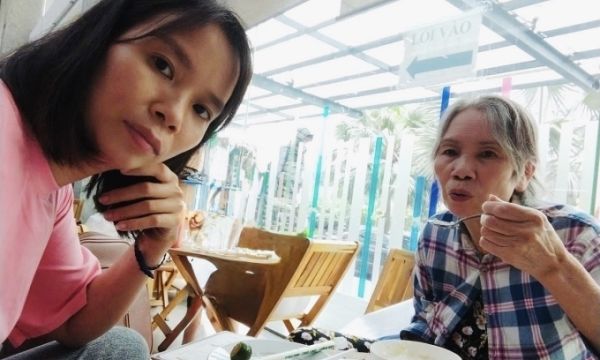
“My mother was finally freed from her pain, but when she passed away, I felt truly alone,” My, 37, from northern Bac Ninh province says.
Her mother was diagnosed with stage-three cancer along with Parkinson’s disease, in 2023. She quit her job in Hanoi and switched to freelance work so that she could care for both her three-month-old child and ailing mother.
She handled her mother’s five daily doses of medication, fed her through a tube, changed dressings, and cleaned tumor discharges each day, all by herself. Her husband often worked until late at night, and relatives could only help in emergencies. Unable to speak, her mother would clap her hands if she needed some assistance.
“Some nights, I would barely fall asleep when I would be jolted awake by the sound of clapping,” My says. “This went on over and over again until I was completely exhausted.”
|
My and her mother during a medical visit at the National Geriatric Hospital in 2022. Photo courtesy of the family |
Tran Quoc Trung, 26, of northern Ninh Binh province, faces a similar plight. Two years ago, he quit his overseas job to return home and care for his mother, who was left bedridden following a stroke.
Without siblings to pitch in, he now juggles freelance work while helping his father look after her. To cover her medical expenses, he works two or three jobs at a time and only sleeps about four hours a day.
He laments: “On one side is my sick mother, on the other my aging father. Sometimes I just want to run away, but I can’t because I’m their only support.”
According to psychologist Nguyen Thi Minh of the Academy of Politics Region II, single children facing pressures like My and Trung are not uncommon and the number is likely to rise, as Vietnamese families shrink in size.
Data from the Ministry of Health shows the national fertility rate fell from 2.11 children per woman in 2021 to 1.91 in 2024 and continues to decline.
The 2019 Population and Housing Census found that households with one to three members account for 50 percent of the country’s total while the traditional family model of four to five or more members is no longer dominant.
This shift reflects a major change in social structure leading to a growing number of one child families in which the only child must take on full responsibility for caring for aging parents. Thus, more only children are forced to take complete responsibility for aging parents.
Professor Giang Thanh Long, a population expert, says Vietnam’s elderly care system still relies heavily on families.
As households shrink into a “1-2-4” structure, meaning one child supports two parents and four grandparents, the entire burden falls on a single individual. “The gap between care needs and community support systems is widening.”
A study by the University of Missouri in the U.S. of 1,800 people found that only children report higher stress levels when caring for family members.
They are also more likely to experience caregiver burnout because they do not have siblings to share family memories or help make critical, often life-and-death, decisions about their parents.
However, Long cautions against viewing the issue from a single perspective, saying having more children does not necessarily mean parents will receive better care.
In financially strained families, hardship can persist down generations while an only child with good education, health and finances might be able to care for their parents better.
Psychologist Minh says single children carry not just financial and physical responsibilities, but also emotional expectations.
While in larger families duties can be shared, with some contributing money and others providing care, only children lack that support system, she adds.
Single children also tend to have especially close emotional ties with their parents. As their parents grow frail, they face not only the loss of loved ones but also the loss of their main source of emotional support. Without siblings to share memories or responsibilities, feelings of isolation during caregiving can become more intense.
 |
|
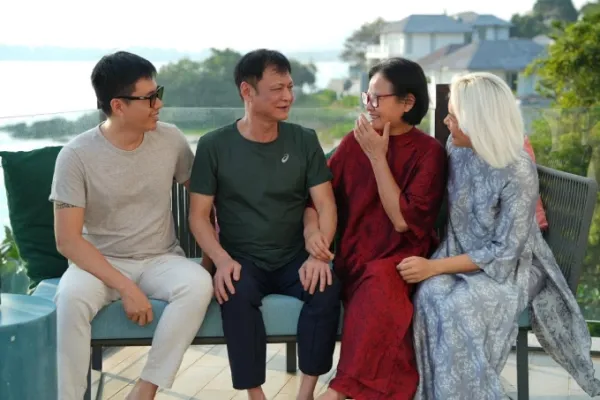
Linh and her husband (left and right) with her parents during Tet 2024. Photo courtesy of Linh |
Dieu Linh, 40, of Hung Yen suffered from just that kind of emotional toll: Her mother was diagnosed with Alzheimer’s at 54, and did not recognize family members any more.
Although Linh was financially capable, she found herself confronting a deeper loss as her once most important source of emotional support was no longer accessible. “It took me two years to come to terms with the shock,” she says.
She eventually brought her mother to live with her to provide care.
As her mother’s condition worsened, Linh’s father, who lived alone in northern Thai Nguyen provine, began to grow frail. He once underwent a surgery by himself to avoid burdening his daughter. “During moments like that, I felt helpless because I couldn’t be in two places at once,” Linh says.

Linh shares her experience as an only child caring for her ailing parents. Video courtesy of Linh
To ease this pressure, experts say both parents and children need to prepare early. Parents should build financial independence and maintain their health. Only children, instead of trying to handle everything alone, should seek support from professional care services or extended family while their parents are still lucid.
At a broader level, Long says, Vietnam needs to strengthen its social welfare system, including community-based elder care and in-home care services, to reduce the burden on the so-called “sandwich generation”, referring to people who have to care for two aging parents and also their own spouse and children.
-
Viral: Food Brands Hop On Gen Z vs Millennial Marketing Trend
-
Shreyas Iyer once used to hit this player like a novice bowler, now he became the victim of the same.

-
IPL 2026: Punjab Kings won the toss against Sunrisers Hyderabad, decided to bowl first

-
Why was the hosting of IPL 2026 final snatched from Bengaluru? BCCI issued a statement and explained the reason

-
SIR didn’t cost Mamata Bengal, women’s anger did, says Yashwant Deshmukh