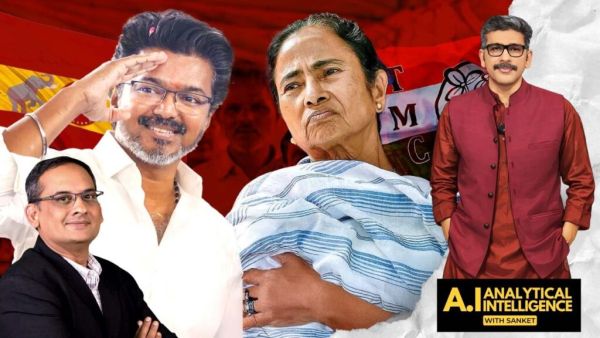
“Mamata Banerjee lost largely because a significant chunk of female voters decided they were going to vote against her.”
This blunt assessment from veteran psephologist Yashwant Deshmukh cuts through the noise around Special Intensive Revision (SIR) and voter deletions that have dominated the post-result discourse in West Bengal.
Also read: What happens if Mamata does not resign? West Bengal drama hots up
With the Bharatiya Janata Party (BJP) delivering a sweeping mandate and Tamil Nadu throwing up a historic third-force verdict, India’s assembly election results have upended conventional political wisdom. The Federal spoke with Yashwant Deshmukh, senior journalist and founder of CVoter in this episode of AI With Sanket, to decode what the numbers really say.
Here are excerpts from the interview:
What is your assessment of the West Bengal result?
My assessment is that if this had been a close contest and the BJP had won by a narrow margin, I would have paid close attention to the SIR- concerns.
But the scale of the BJP’s victory is so large that even if I remove all the doubtful seats — roughly 140 seats where the margin of victory is less than the total number of deleted votes — even then the BJP would be winning around 158 seats and winning the state.
While SIR and voter deletion will remain a legitimate concern — special tribunals must act, no genuine voter should be denied their right — I genuinely do not believe SIR was the reason Mamata Banerjee lost. She lost largely because a significant chunk of female voters decided they were going to vote against her.
This is very significant. Over the last two-and-a-half years, after Shivraj Singh Chouhan’s victory in Madhya Pradesh, we have seen every government doling out cash schemes to win over women voters — and it has worked brilliantly in pro-incumbent settings. Women who received the cash dues voted to keep the government. But in West Bengal, this is a very strong anti-incumbent verdict from women, even after they were receiving those cash benefits. That is what one should be asking: why were cash doles not enough for female voters in West Bengal?
Also read: ‘Trump in sari’: Bengal BJP leader Dilip Ghosh mocks Mamata for refusing to quit
The answer is a bit uncomfortable. Mamata’s own slogan is “Ma, Mati, Manush”. If “Mati and Manush” (ground, people) remain with you but “Ma” (mother) goes away, you have serious thinking to do.
That is what happened — because of the law-and-order situation, because of crimes against females, because of the complete lack of sensitivity towards rape victims, not just from the government side but personally from Mamata herself. And when those law-and-order issues began getting fused with communal lines — the perception that she was turning a blind eye to Muslim criminals because of vote-bank politics — it induced a very different level of polarisation.
We have seen that female voters in recent years have broken caste and religious lines to vote on issues. They voted pro-incumbent when they were getting welfare benefits. But when a strong woman chief minister who has carried the women’s vote bank for 15 long years loses female voters on law and order, it tells us something fundamental: no welfare scheme is useful for women if their basic safety, security, and dignity are not addressed.
Can you back this up with data points on SIR’s actual impact?
There are two data points. First: wherever maximum deletions happened, who won those seats? In Bihar, when SIR was made a huge issue, the top 10 seats with the maximum deletions were all lost by the BJP and Janata Dal (United) — even though they swept the rest of Bihar. The same pattern holds in Bengal. The overwhelming majority of seats the TMC won are coming from areas where maximum deletions happened. If the voter deletions were rigged against the TMC, the BJP should be winning those seats. They are not.
Second: look at seats where almost negligible deletions occurred — seats where Mamata should have been winning comfortably. The BJP’s performance has actually been maximised in those very seats, where minimum deletions happened. That means the natural anti-incumbency built up, and she lost those seats fair and square.
There is also a very good report in the Hindustan Times that does a direct seat-by-seat correlation between deletions and margin of victory. The correlation coefficient does not cross one — in fact, it is negative. Deletions and BJP wins are negatively cor.
Also read: What happens if Mamata does not resign? West Bengal drama hots up
There is also a piece, I believe in the Indian Express, which analysed the Muslim population as a variable. When you rank Bengal constituencies from low to high Muslim population, the TMC’s performance tracks that same low-to-high curve in all previous elections.
This time, in the high-Muslim-population seats, the TMC’s numbers have fallen — not because the BJP picked them up. The BJP remains negligible in those seats but because the Congress, Left Front, Humayun Kabir’s party (AJUP), ISF, MIM and other Muslim candidates have eaten into the TMC’s Muslim votes.
So, the dent to TMC in high-Muslim seats came from non-BJP, non-TMC parties — parties and candidates that were seen as more authentically representing Muslim interests. This same pattern is visible in Maharashtra’s Malegaon, where Muslim voters moved from the Congress to the NCP, then to the MIM, then to a more explicitly Islamic local party.
In Bengal’s Malda-Murshidabad belt, you see the same regression — from the Congress to ISF to Humayun Kabir to independent candidates. That fragmentation has happened.
Mamata could have crossed 100 seats if she had held all those Muslim seats. She could not. That is also a fact.
You also mentioned the Bangladesh factor. Can you explain that?
One more factor that has not been fully analysed with empirical data is the impact of what happened under Muhammad Yunus in Bangladesh — the months of instability, the violence against Hindus, the rise of Jamaat-e-Islami. That had a very unique way of entering Bengal politics that neither Muhammad Yunus nor Mamata Banerjee would have anticipated.
The seats in Bangladesh’s national elections where Jamaat-e-Islami won are all scattered along the Indian border. If you look at those seats and then look at their mirror image on this side of the border, you will see extreme negative polarisation — a counter-reaction — that directly benefited the BJP.
Also read: 3-ticket gamble: Lottery King family wins seats across TN, Puducherry
The Pakistan factor has always had an all-India impact — it was never localised to border states such as Rajasthan or Punjab. But the Bangladesh situation has had a very specific localised impact on Bengal, tied directly to the geography of the border.
This takes us into deeper historical territory. Whenever we discuss Partition in India, we almost exclusively discuss Punjab — in films, literature, public memory, 99 per cent of Partition narratives are about Punjab. Bengal’s Partition story has been largely subsumed.
The 1971 formation of Bangladesh seemed to close that chapter for the rest of India — as if cultural identity had triumphed over religious identity. But that chapter never fully closed for Bengali society. The fault lines were always there, even during Left Front rule, but they were plastered over by economic reforms, Operation Barga, and Left Front politics. The moment the BJP entered the picture, those fault lines opened wide.
Here is one remarkable historical fact: in the very first election of independent India, three Bharatiya Jana Sangh MPs won seats. Two of them came from West Bengal — Shyama Prasad Mukherjee from Kolkata South, and Durga Prasad Chatterjee from what is now Jharkhand. That tells you the depth of historical roots. In between, 75 years passed — 60 of which we spent believing those wounds had healed. But it was only a matter of time. The Bengali “bhadralok” world of art, culture, literature, cinema, and music had completely blanked out those fault lines. And then it just happened.
We should not be looking at West Bengal only through the binary of SIR versus non-SIR. The historical and communal undercurrents are real, and they matter.
What is Mamata Banerjee’s path forward?
The Catch-22 for her is this: does she want to become what the Congress became in Assam — a party so identified with minority appeasement that it became impossible for them to win — or does she want to return to the middle-ground Bengali identity politics that powered her Parivartan victory in 2011?
Remember, Mamata was an NDA ally for a long time. She was a minister in Atal Bihari Vajpayee’s government. She was a partner of the BJP. Against the Left Front, the overwhelming majority of Hindus voted for her. But over the last 15 years, she seems to have taken that Hindu vote for granted.
Here is the practical politics of it: if she had taken a really tough stand on Sandeshkhali — if she had made it a point to visibly punish criminals regardless of their religious background — would Muslims have deserted her? No. Because she is the prime anti-BJP force in the state. Muslims had nowhere else to go. And Hindus would have stayed with her because justice would have been seen to be done.
The problem now is that if she does not return to that middle ground, further polarisation and further disintegration of her Hindu vote will lead her down the path that the Congress has walked in Assam. That is a clear and present danger for her.
So far, the BJP has tried very hard to brand her as anti-Hindu and failed. But Sandeshkhali is something Mamata did to herself — the BJP did not do it to her. These narratives travel far and wide, and unfortunately for her, the Bangladesh crisis added fuel to a fire she had already helped start.
Your assessment of Tamil Nadu — was this result surprising?
This is neither extraordinary nor out of the blue for Tamil Nadu. The state is known for welcoming a matinee idol into politics — be it MGR, Jayalalithaa, or Karunanidhi. Many people are asking me why only Vijay succeeded where Rajinikanth, Captain Vijay Kant, and Kamal Haasan could not. The answer is simple: when you already have two star performers dominating the political space, there is no room for a third actor. Vijay had perfect timing. When he entered, all those stalwarts were gone. There was a vacuum.
Also read: Tamil Nadu verdict 2026: Will TVK chief Vijay form government with Congress?
He got the benefit of anti-incumbency, but more importantly, he benefited from the fact that the two biggest names who dominated Tamil Nadu politics for four decades were no longer there. They had died. Into that vacuum came youth appeal, female voter magnetism, and urban energy — an amalgamation of all three.
But this should not be compared to the sweeps we saw from MGR, Jayalalithaa, NTR, or even Arvind Kejriwal. All of them came in and swept from near-zero to a pinnacle. Vijay has fallen short of the magic number. The DMK is at 31 per cent, the AIADMK at nearly 30 per cent — they are breathing down his neck. This is an important moment in Tamil Nadu politics, but it is not an extraordinary sweep.
What made Vijay succeed where others like Rajinikanth failed?
Vijay entered at the right time. He also made one very clear political decision: he said he is neither here nor there; he is on his own. That independent positioning probably propelled him forward.
He also did something similar to what the Aam Aadmi Party (AAP) did — he fielded fresh, non-political faces. The overwhelming majority of his MLAs come from non-political backgrounds, just as Kejriwal did in his early phase.
But here is the critical difference. Kejriwal had a very clear alternative governance agenda — specific policies, specific promises. With Vijay, nobody knows what his policies are or what his government will look like. He has simply ridden his popularity into office on the back of the government’s unpopularity. Imagine if Jayalalithaa had been alive — do you think Vijay would have won these many seats? The anti-incumbency pendulum would have swung to the AIADMK instead.
So full credit to him for entering at the right time, exploiting his popularity, and running a spirited campaign. But it is a great challenge as well. He will have to prove himself. And that has been quite challenging for many such leaders who come into power without much experience.
Tamil Nadu’s welfare expectations have also grown enormously. During MGR’s time, welfare policy meant a pair of plastic slippers and a plastic pot for women to carry water. Today, it includes colour TVs, juicers, mixers, cash doles, and gold ornaments. The sky is the limit for Tamil Nadu politicians. Fulfilling all those promises and managing all those expectations is going to be very, very challenging for him.
What constituency did Vijay actually appeal to?
Urban youth and urban women — primarily. That’s it.
As the age bracket goes up, Vijay’s vote share comes down. As the age bracket goes up, DMK and ADMK numbers go up. As you move from urban to rural, his votes come down, and the AIADMK’s go up. There is very clear demographic profiling here.
He has polled the majority of Christian voters and a significant share of Muslim voters. Minorities have largely gone for him. He himself comes from a minority background, which has obviously helped. But among the non-minority religious backgrounds, it is the 18-to-30 age group and female voters where he gets his strength.
One more very interesting finding my team shared this morning: Tamil Nadu is probably the only state this time where upper-caste Hindus, Muslims, and Christians have all voted in the same pattern. In every other state, we see a clear contrast — minorities voting one way, upper-caste Hindus the other.
Also read: Vijay doesn’t have to ‘prove’ his majority since Constitution never asked him to
In Kerala, for example, upper-caste Hindus voted for the Left or BJP, while Muslims and Christians went with the Congress-led UDF. That religious polarisation contrast is very visible across India — except in Tamil Nadu this time.
In the 2024 general elections, upper-caste Hindus in Tamil Nadu voted for the BJP-NDA-AIADMK, while Muslims and Christians voted for the DMK alliance. This time, minorities voting for Vijay has not pushed upper-caste Hindus in the opposite direction. They have voted for Vijay in almost the same proportion. It is a genuinely unique phenomenon.
Among OBCs, it is the AIADMK that has held the ground. Among Scheduled Caste and Scheduled Tribe voters, the DMK has held the ground. But among upper castes and minorities, it is Vijay.
Does this pattern remind you of any earlier political moment?
Yes — Delhi 2013 and 2015, when something very similar happened for Kejriwal. People voted for him lock, stock, and barrel. Upper-caste Hindus and Muslims voted with similar enthusiasm for Kejriwal in that nascent phase. His inexperience and the absence of any prior track record actually worked as an asset, not a liability — just as it has for Vijay now.
However, the moment Lok Sabha elections came in Delhi, it went 7-0 to the BJP. The entire Hindu block moved to the BJP and the AAP went to third place in all Delhi constituencies in both 2014 and 2019.
Also read: Understanding the Vijay phenomenon in Tamil Nadu politics
So, Tamil Nadu will be very interesting to observe at the national level. Will it become bipolar — like Andhra Pradesh between the TDP and Jagan Mohan Reddy — or will there be space for a different alignment?
Suppose the Congress leaves the DMK alliance, which is very much in the news right now, and joins the TVK. Then you could have a bipolar contest between an NDA-AIADMK bloc and a TVK-led alliance, with the DMK going some other way. That is a very interesting possibility. Tamil Nadu politics has suddenly become far more complex than the clean ADMK-to-DMK swings we have seen for decades.
The content above has been transcribed from video using a fine-tuned AI model. To ensure accuracy, quality, and editorial integrity, we employ a Human-In-The-Loop (HITL) process. While AI assists in creating the initial draft, our experienced editorial team carefully reviews, edits, and refines the content before publication. At The Federal, we combine the efficiency of AI with the expertise of human editors to deliver reliable and insightful journalism.
-
UK travel company plunges into liquidation - all bookings suddenly cancelled

-
Massive Blaze Engulfs Structure in DeLand, Florida, Prompting Emergency Response

-
New Hantavirus Case Linked to Cruise Ship Outbreak in Switzerland

-
BBC Breakfast's Naga Munchetty left 'battered and bruised' after 'bloody' accident
-
Man Utd summer target 'at the heart of fight in training' as transfer opportunity grows