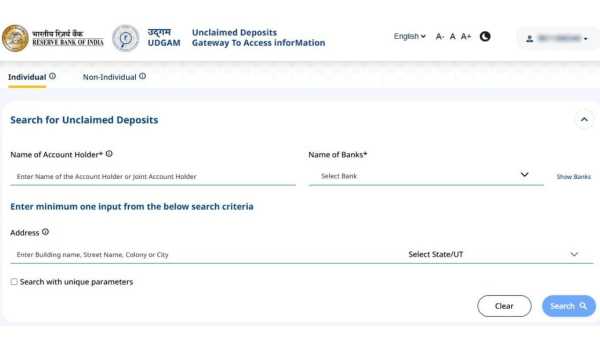
The Reserve Bank of India told the Supreme Court on Tuesday that the 'Unclaimed Deposits – Gateway to Access Information' (UDGAM) portal helps registered users to find unclaimed deposits lying in many banks. These things were placed before the bench of Justices Vikram Nath, Sandeep Mehta and Vijay Bishnoi. This bench was hearing a petition, which sought a direction that a system should be made to provide information about the dormant unclaimed deposits lying in the bank accounts to the legal heirs of the deceased depositors. The lawyer appearing for RBI told the bench that so far about 44 lakh searches have been done on UDGAM. This is an interactive portal.
Petitioner's lawyer's argument
Advocate Prashant Bhushan, appearing for the petitioner, said that the real issue is how the legal heirs of the deceased depositors will know about the unclaimed deposits lying in the bank accounts. He argued that although RBI has said that it has asked all banks to enter information on the UDGAM portal, deposits are also made in post offices and insurance policies.
Bhushan said that nothing has been done to connect all these together. He further said that the system should be such that the legal heirs can get all this information in a single search.
The lawyer appearing for the Central Government told the bench that he has prepared an updated affidavit, which will be filed in the court. The bench directed the central government to file an updated affidavit with necessary information within a week and fixed May 19 for the next hearing of the case.
What happened in the hearing of March 17?
While hearing the petition on March 17, the Supreme Court had asked the Central Government and the RBI as to why information about the bank accounts of deceased persons cannot be given to their heirs, and said that the government should formulate a policy on this issue. Bhushan had argued that the RBI had also stressed the need to create a “centralized and searchable database” so that people could trace the accounts of their deceased parents. Additional Solicitor General N. appearing for the Central Government. Venkatraman had said that if a real heir comes forward, the money will be returned to him from the 'Depositor Education and Awareness Fund'.
Answer was sought from the ministry
Unclaimed deposits of commercial and co-operative banks are deposited in the 'Depositor Education and Awareness Fund' established by RBI in 2014. The Supreme Court had earlier asked the Finance Ministry to file its reply on the PIL, in which directions were sought to create a centralized database. This database will give information about bank accounts, insurance, deposits and post office funds of people who are no longer alive. In this petition, direction has also been sought to establish a process by which unnecessary litigation can be eliminated while settling the claims of legal heirs related to bank deposits, insurance, post office funds etc.
How much is the deposit in DEAF?
The petition states that at the end of March 2021, there were Rs 39,264.25 crore in the 'Depositor Education and Awareness Fund'. This amount was more than Rs 33,114 crore at the end of March 31, 2020, and was a significant increase compared to Rs 18,381 crore at the end of March 2019. The petition states that there is an urgent need to create a centralized online database under the control of RBI. This database will provide information about the deceased account holder, which will include information like his name, address and date of last transaction made by the account holder.


-
Summer Vacation Announcements for Schools in Delhi and Other States
-
Coal India CIL Management Trainee Recruitment 2026: Apply for 276 Positions

-
Understanding Endometrial Cancer: Risks and Prevention

-
Lucknow's Safety Project Targeted by Thieves During IPL
-
Impact of Middle East Conflict on India's Economy: Challenges and Resilience