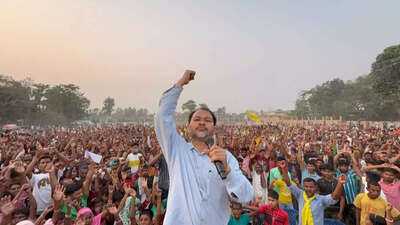
A file image of Raijor Dal chief Akhil Gogoi at a public rally in Assam (Photo: @AkhilGogoiAG/ X)
Guwahati, May 5: In the recent Assembly elections in Assam for 2026, regional parties exhibited a varied performance. The Asom Gana Parishad (AGP) and Bodoland People’s Front (BPF) maintained their positions within the BJP-led coalition, while Raijor Dal saw a slight increase in its influence. Conversely, the Assam Jatiya Parishad (AJP) struggled to gain traction once again.
The AGP, contesting 26 seats as part of the NDA, managed to secure 10 seats, marking an increase of one seat compared to previous elections.
During the campaign, the party's strategy attracted attention, particularly its choice to nominate 13 candidates from religious minority groups, which constituted nearly half of its total candidates.
Despite Atul Bora's defense of this strategy, none of the minority candidates succeeded in winning a seat.
Successful AGP candidates included Jibesh Roy from Bilasipara, Dipak Kumar Das from Barpeta, Dharmeshwar Roy from Bajali, Dr. Tapan Das from Dimoria, Keshab Mahanta from Kaliabor, Prithiraj Rava from Tezpur, Bikash Saikia from Teok, Atul Bora from Bokakhat, Diptimoyee Choudhury from Bongaigaon, and Prakash Chandra Das from Hajo-Sualkuchi.
Atul Bora expressed, “This victory is not just a political achievement; it reflects the people's trust in the NDA and their commitment to advancing Assam's development.”
He further stated, “We are thankful to the people of Assam and every AGP, BJP, and BPF worker who contributed tirelessly. We will honor this mandate and continue our efforts for the State's development, peace, and prosperity.”
The BPF, which rejoined the NDA prior to the elections, performed well in its strongholds within the Bodoland Territorial Region (BTR), securing 10 seats, including Dotma, Sidli Chirang, Manas, Baksa, Bhergaon, Udalguri, Mazbat, Gossaigaon, Kokrajhar, and Baokhungri, thus reaffirming its dominance in the Bodo region.
In contrast, its rival UPPL did not win any seats. Among the opposition regional parties, Raijor Dal made modest gains, winning two seats in Sivasagar and Dhing, indicating a gradual strengthening of its base in Upper Assam and areas with significant minority populations.
Akhil Gogoi won from Sivasagar, while Mehboob Muktar secured victory in Dhing. The party had fielded 13 candidates in total.
On the other hand, the Assam Jatiya Parishad (AJP), which aimed to present itself as a regional alternative focused on Assamese nationalism, failed to establish a significant presence in the Assembly, falling behind larger alliance partners.
Party president Lurinjyoti Gogoi lost to BJP’s Chakradhar Gogoi by a margin of 9,984 votes, while general secretary Jagadish Bhuyan lost to BJP’s Bolin Chetia by 41,749 votes. The AJP had nominated 10 candidates.
The election results highlight a continuing evolution in Assam's political dynamics. While regional parties remain significant, their influence is largely confined to alliance frameworks or specific geographic areas.
Both AGP and BPF have managed to sustain their relevance through their alignment with the ruling coalition, while Raijor Dal's modest gains suggest limited opportunities for independent regional assertion.
-
Bihar NDA Government Prepares for Major Cabinet Expansion on May 7
-
Final Marks Released for BPSSC Range Officer of Forest Recruitment 2025
-
Indian illustrator Anand RK, journalist Suparna Sharma win Pulitzer Prize for illustrated reporting

-
BJP Appoints J.P. Nadda as Central Observer for Assam Legislative Party Leadership
-
Rare Oriental Pied Hornbill Spotted in Arunachal Pradesh, Signaling Ecological Health