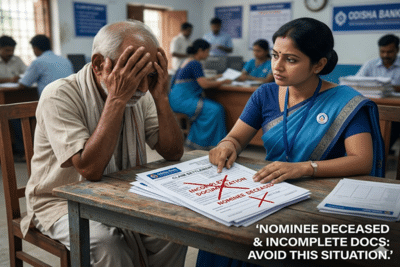
Odisha Case: A shocking case recently emerged from Odisha, where a brother had to dig up his sister's grave and bring the skeleton to the bank just to withdraw money. Everyone should learn from this case.

Learn from the Odisha bank case how to protect your deposits.
Odisha Bank Case: A shocking incident recently emerged from Odisha. An elderly man was seen carrying a skeleton on his shoulder to a bank. This video quickly went viral on social media. After the video went viral, the truth was revealed: it was a brother who had brought his sister's skeleton to the bank to withdraw some money. By showing it to bank employees, he could confirm his sister's death. This incident is not a trivial one, but rather a lesson for everyone.
This case raises many questions. In this case, both the account holder and the nominee have passed away. When a brother went to withdraw a mere 20,000 rupees from his sister's account, he had to bring her dead body to the bank as proof due to incomplete documents.
This case holds
a significant lesson for those who take banking matters lightly. Account holders should properly submit all documents to the bank. Because, upon the death of the account holder and the nominee, withdrawing funds from the account becomes extremely difficult, especially if the bank fails to receive the documents after the death.
The process becomes easier if there is a nominee.
If the account holder dies while the nominee is still alive, the process becomes easier. In such a case, the nominee becomes the heir of the funds and can easily withdraw the money. However, when the nominee also dies, withdrawing money from the account becomes more difficult. In such a case, the legal heir faces similar difficulties when withdrawing the money.
What if both the account holder and the nominee die?
If the account holder dies without a nominee, this situation can be a bit complicated. To address this, the bank requires certain documents from the legal heirs, such as:
- Legal Heir Certificate
- Family register or affidavit
- Consent of all heirs
- death certificate
What if your documents are incomplete?
Even if you have incomplete documents, there's no need to worry; you have a few options, such as:
- A claim can be taken from the bank by giving an Indemnity Bond.
- The process can be made easier by obtaining a No Objection Certificate (NOC) from other heirs.
- In cases of small amounts (like up to Rs 5-10 lakh), many banks follow a simpler process.
What if the account is disputed?
If the account is disputed, meaning there are multiple claimants who are fighting among themselves, a succession certificate is also submitted.
- This is issued by the district court.
- This makes it clear to the bank who the real owner is.
It's worth noting that each bank has its own procedures. Hastily submitting incorrect or incomplete documents can result in a claim being rejected. In the event of a dispute, it's best to seek legal advice. In such cases, it's easier and better to proceed with consultation.
-
Heat triggers massive fire at Bahadurpura scrap yard near Hyderabad zoo
-
Shaun Murphy has never forgiven Ronnie O'Sullivan over 'verbal abuse' three decades ago

-
Bhuvneshwar Kumar Makes History as First Indian Fast Bowler to Claim 350 T20 Wickets

-
Wisdom of Chanakya: Avoiding Toxic Individuals

-
'Dubai will not be forgotten': Sheikh Mohammed honours winners of Erth Dubai awards