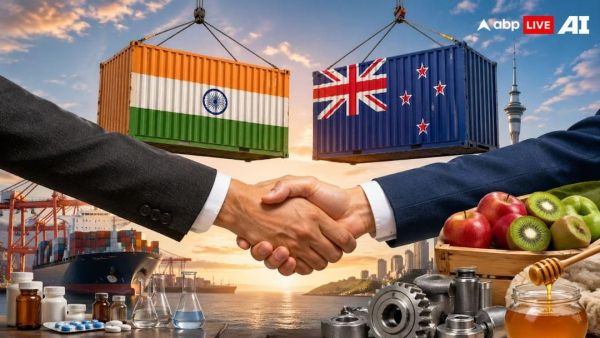
Even as India awaits ratification of a slew of recently concluded free trade agreements, the India–New Zealand FTA signed by Commerce Minister Piyush Goyal and New Zealand's trade minister Todd McClay amidst geopolitical turbulence, international tariff wars and back home, high pitch state electoral fervour in key states, arrives opportunely for India’s push for new market access and new vote banks.
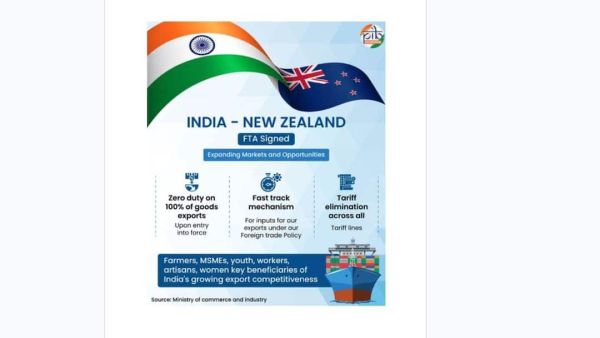
In its seventh FTA signed in five years, after Mauritius, UAE, Australia, EFTA, UK and Oman and In a major show of diplomatic heft, India has got New Zealand to eliminate tariffs on 100 per cent of tariff lines from the beginning of implementation of the FTA.
This includes removal of earlier tariffs (around 10 per cent on 450 key products and the average applied tariff of 2.2 per cent, giving Indian exporters complete market access and improved competitiveness, according to figures from Rubix Data Sciences. (See Fig 1) 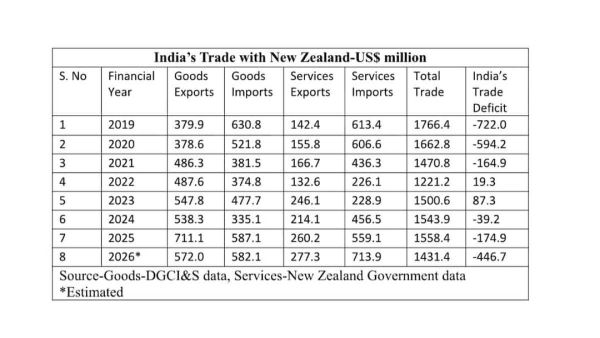
Focus on Market Access and Export Boost
Focus on market access: Director General CII Chandrajit Banerjee is optimistic about the FTA provision of 100 per cent duty-free access for Indian exports unlocking significant opportunities for trade expansion in the coming years.
“Key sectors such as transport and automotive, pharmaceuticals, plastics and rubber, electrical and electronic equipment, and mechanical machinery are poised to scale up exports, enhance competitiveness and strengthen their presence in global markets.
Notably, the pact is aimed at doubling bilateral trade to $5 billion over the next five years, signalling strong growth potential and renewed momentum in economic ties,” observes Banerjee.
Trade Reality Check and Scope for Expansion
The FTA no doubt is strategically placed to give India better access to a small but wealthy Pacific market, agrees Ajay Srivastava, founder Global Trade Research Institute.
The agreement significantly improves market access and tariff preferences for Indian exports to New Zealand, while also positioning New Zealand as a gateway to the broader Oceania and Pacific Island markets.
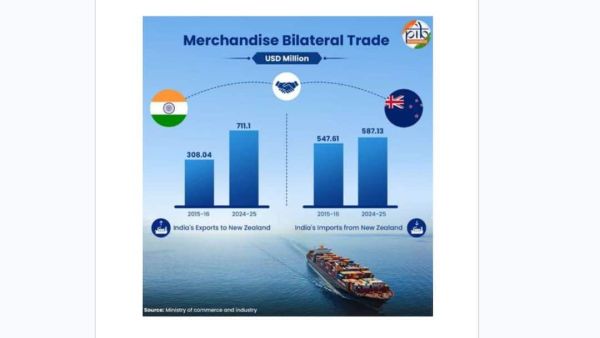
Rubix Data Sciences shows bilateral trade between India and New Zealand moved up from $ 855 million in 2015-2016 to $ 1298 million in 2024-2025 propelled by a 130 per cent increase in exports and a modest increase in imports of 7.21 per cent in 10 years.
Merchandise trade between India and New Zealand crossed the $1 billion mark in FY2025 and 11 months of FY2026 (April–February 2026).
However, New Zealand remains a relatively minor trading partner for India, ranking 80th in exports and 73rd in imports, highlighting substantial scope for diversification and expansion of bilateral trade flows. (See Fig 2)
Growth Momentum vs Emerging Slowdown
“Given the modest scale of bilateral trade which was about $2.1 billion in calender year (CY) 2025, the India-New Zealand FTA is less a major trade breakthrough and more a framework for deeper cooperation,” notes Srivastava.
This would be needed at a time when recent data points to some moderation in the momentum of bilateral merchandise trade growth.
Rubix Data Sciences show bilateral goods trade peaked at $1.3 billion in FY2025 before easing to $1.06 billion in FY2026 (April-February), indicating a recent slowdown after strong growth.
While both exports and imports have recorded strong double-digit compounded annual growth rates (CAGR)s between FY2022 and FY2025, the presence of cyclical fluctuations and moderation observed in FY2026 makes the FTA an important mechanism to enhance trade stability, predictability, and long-term growth momentum.
Export Diversification and Sectoral Gains
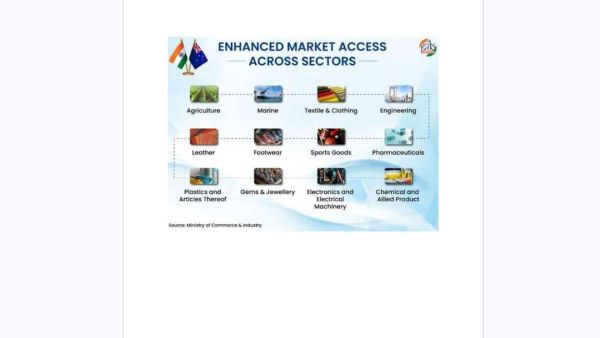
President of Federation of Indian Export Organisations (FIEO) SC Ralhan views the India-New Zealand FTA as a strategic step towards diversifying India’s export destinations across key sectors such as agriculture, textiles, pharmaceuticals, engineering goods and services such as IT & ITES, engineering, construction.
“With reduced tariff barriers and streamlined trade procedures, Indian businesses will gain with improved competitiveness in the New Zealand market,” points out Ralhan.
Ratification Delays and Uncertainty
On the flip side, similar to the India-UK and India-EU deals, the India-New Zealand pact too comes after a protracted process of revival of talks in 2010 only to be stalled in 2015 after nine rounds.
Though sealed in one of India’s fastest concluded negotiation rounds launched in March 2025 and concluded by December 2025, the India-New Zealand pact quite like the wait for ratification of the India-UK and India-EU agreements may take about six months to enter into force, after approval by India’s Cabinet and New Zealand’s Parliament, a matter of uncertainty for Indian exporters.
Services Sector: The Real Winner?
Winning edge for services sector: Importantly, services and mobility dividends from the deal may outweigh gains in goods, according to Srivastava.
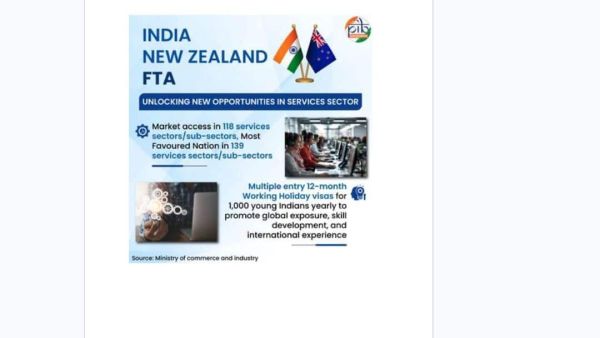
“The India-New Zealand FTA gives India better access to a small but wealthy Pacific market, but goods export gains may be limited and services may deliver bigger gains than goods, with New Zealand offering commitments in 118 sectors and most favoured nation (MFN) treatment in 139 sectors,” says Srivastava.
New Zealand has created new visa pathways for Indian students, STEM graduates, young workers and up to 5,000 skilled professionals.
This could help India in IT, healthcare, education support, financial services and telecom-linked services. (See Fig 3)
Services Trade Imbalance and Deficit Concerns
New Zealand data also show that it has a large services surplus with India, mainly because Indian students and tourists spend heavily there.
In FY2025, India’s services imports from New Zealand were $550 million, against services exports of $255.8 million.
India’s total trade deficit with New Zealand is projected to rise from $170.2 million in 2025 to $ 353.6 million in 2026.
Tariff Asymmetry and Market Realities
Apple growers may take hit: Tariff Hit On the face of it, the agreement focuses on reducing tariffs on goods, improving market access in services and easing trade procedures, while protecting India’s policy space in sensitive areas, especially basic dairy products.
However, tariff asymmetry is central to the India-New Zealand FTA.
New Zealand’s average import tariff is only 2.3 per cent, compared with India’s 16.2 per cent, and 58.3 per cent of New Zealand’s tariff lines are already duty-free.
This means Indian exporters already had fairly wide access to the New Zealand market even before the FTA.
Impact on Domestic Agriculture
Reciprocally, India will open about 70 per cent of tariff lines, covering nearly 95 per cent of New Zealand’s exports, while protecting sensitive dairy, sugar and edible oils.
Apples, kiwifruit, Mānuka honey and albumins will enter only under quota limits, minimum prices and safeguard conditions.
New Zealand apples get concessional duty only from April to August, with duty cut from 50 per cent to 25 per cent within quota and only above $1.25/kg.
These safeguards though may not be enough to shield Indian farmers.
Srivastava argues that apple imports already account for nearly one-fifth of India’s domestic production and warns that new FTA concessions to New Zealand, along with pressure from the US, EU and other partners, could further increase the share of imported apples in India.
Moreover, cheap apples from Iran and Turkey are already affecting lower-grade Indian apples.
“Lower-duty apples from New Zealand, the US and the EU could soon compete in mid-premium and premium markets, especially in cities and during the off-season. This could hurt apple growers in Kashmir and Himachal Pradesh, who already face high transport costs, poor cold-chain facilities, weak marketing systems and unstable prices,” says Srivastava.
Investment Promises Under Scrutiny
The GTRI founder goes on to suggest that without urgent reforms in storage, grading, transport, branding and market access, FTA concessions may steadily reduce the market share and earnings of Himalayan apple growers.
At the same time, Indian consumers may continue to pay high prices for imported fruit.
Srivastava is also wary of New Zealand’s proposed $20 billion FDI commitment over 15 years which is one of the headline features of the India-New Zealand FTA.
However, as New Zealand’s existing investment in India is less than $1 billion over the past 25 years, reaching $20 billion will require a major increase in investment.
“The EFTA experience shows that headline investment promises do not always turn into real inflows.
The FTA will bring more predictability in goods, services, mobility and investment, but its real impact will depend on follow-up action.
Both countries must move beyond tariff cuts and build stronger links in supply chains, education, tourism, aviation training, fintech, forestry and agriculture,” suggests the GTRI founder. (See Fig 4)
Industry Optimism on Investment Linkages
Looking ahead, Banerjee finds the FTA’s innovative linkage between trade and investment as particularly noteworthy.
He expects New Zealand’s commitment to facilitate $20 billion in investment over 15 years to catalyse the development of industrial infrastructure, manufacturing ecosystems, and innovation clusters across India.
“This model signals a shift towards deeper economic integration, where trade, investment, and job creation reinforce each other, paving the way for sustained and inclusive growth,” says the CII DG.
Sectoral Winners: Food, MSMEs and Engineering
Big wins for food, engineering: Sectorally, there are big takeaways from the FTA which includes a boost to labour-intensive sectors like textiles, apparel, leather and footwear.
They gain a significant competitive advantage through duty-free access.
Ralhan agrees that the FTA presents immense opportunities for MSME exporters to tap into a high-value market with growing demand for quality goods and services.
One of the big winners, according to Mohit Singla, Chairman, Trade Promotion Council of India (TPCI), is Indian agri-food products.
This includes processed foods, beverages, spices, and marine products.
The FTA provisions are likely to significantly enhance market access for this basket of goods in a less penetrated, high-income market by reducing tariffs and easing non-tariff barriers.
“Equally important is the opportunity for deeper collaboration in areas such as agri productivity, food processing, cold chain infrastructure and quality standards.
New Zealand’s expertise in food safety, traceability and sustainable practices can complement India’s growing capabilities, enabling exporters to integrate effectively into global value chains,” says Singla. (See Fig 5)
Also set to benefit is India’s engineering sector, which gets zero-duty market access under the FTA.
This is expected to help MSMEs explore new opportunities and strengthen India’s position in global value chains.
“For the engineering sector, there is a clear opportunity to double exports to around $280-300 million to New Zealand over the next five years,” says Pankaj Chadha, Chairman, Engineering Export Promotion Council.
According to Chadha, India’s engineering exports to New Zealand grew from $129.8 million in 2024-25 to $140.5 million in 2025-26, registering an overall growth of about 8 per cent.
“While automobiles, industrial machinery for dairy sector and medical & scientific instruments and office equipment have recorded impressive growth, metal-based exports such as products of iron and steel, aluminium and zinc products have also contributed significantly,” he adds.
Trade, Innovation and Growth
Expectations are running high in Indian industry over the India-New Zealand FTA enhancing bilateral economic engagement.
The focus remains on shared priorities of trade diversification, innovation and sustainability, with the aim of taking India-New Zealand trade to new heights.
-
Why Vijay, Rashmika are suddenly making separate appearances?

-
Aamir Khan opens up on not having a 'happy ending' for QSQT, Mansoor Khan reveals actors were laughing, didn't take it seriously

-
'Raaka': Allu Arjun and Atlee's upcoming sci-fi to 'do wonders'; says SFX supervisor Vishal Tyagi

-
Palash Muchhal takes a spiritual break amid a busy schedule, visits Saptashrungi Temple and seeks divine blessings

-
Shekhar Suman on the decline of the Hindi language in the entertainment industry