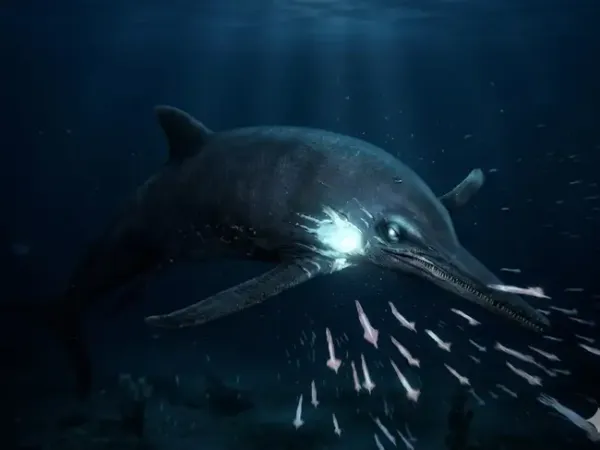
A well-preserved ichthyosaur fossil discovered in the Mistelgau clay pit near Bayreuth, Germany, is offering new insights into the survival and anatomy of large marine reptiles from the Early Jurassic period, according to a study published by EurekAlert.
The fossil belongs to the genus Temnodontosaurus, a group of large marine reptiles that resembled modern dolphins and lived around 180 million years ago. Several parts of the skeleton have been preserved, including fragments of the skull and lower jaw, the shoulder girdle, forefins, spine and more than 100 teeth. Researchers noted that the exceptional three-dimensional preservation allows for detailed examination of anatomical structures that have rarely been documented, particularly in the palate, orbital region and fins.
The fossil belongs to the genus Temnodontosaurus, a group of large marine reptiles that resembled modern dolphins and lived around 180 million years ago. Several parts of the skeleton have been preserved, including fragments of the skull and lower jaw, the shoulder girdle, forefins, spine and more than 100 teeth. Researchers noted that the exceptional three-dimensional preservation allows for detailed examination of anatomical structures that have rarely been documented, particularly in the palate, orbital region and fins.